
Your industry tells you a lot about how to market your business, but it is only half the answer. The other half is how your customers buy: how they find you, how large your market is and how often they come back. Two businesses in the same industry can need quite different plans if those things differ.
This guide sets out the marketing strategies by industry that we use at The Digital Marketing Consultants (TDMC), and explains the economics that sit underneath them. From here, you can move to the detailed guide for your own industry, where you will find one recommended strategy each for a small, a growing and a large business.
At a glance
- Every business needs a steady flow of new leads. That is the hard, expensive part, and nothing replaces it.
- Fast replies, rebooking and reminders multiply the value of every lead you pay for.
- Reviews matter, and they come from a habit rather than a campaign.
- The size of your market shapes which ads are likely to work.
- SEO is ongoing, like going to the gym.
- Some industries lean more on relationships and personal brand, and most need some of both.
In this guide:
Leads come first. Conversion, rebooking and retention then multiply every lead you earn.
Find your industry marketing strategy
Each industry guide goes deeper into one kind of business. Before you choose yours, it helps to see how differently customers behave from one industry to the next. The table shows how customers usually find you, how often they naturally come back and the retention tool that does the most work.
| Industry | How customers usually find you | Natural return cycle | Best retention tool |
|---|---|---|---|
| Dental marketing | Google search and reviews | 6 or 12 months | Recall and rebooking at checkout |
| Law firm marketing | Search for urgent matters, referrals for estate and commercial | Life events | Past client check ins and newsletter |
| Allied health marketing | Referrers plus direct search | Care plan, then recall | Booking the full plan |
| Physio marketing | Referrers plus direct search | Care plan, then 30 days to 12 months | Plan completion and discharge recall |
| Medical practice marketing | Search, reviews and access | Chronic care and preventive checks | Recall |
| Real estate marketing | People you know and personal brand | Years | Database and regular contact |
| Hospitality marketing | Discovery, social, guides and search | Weeks | Guest list and birthday offers |
| Childcare marketing | Search, listings and parent word of mouth | Years, plus siblings | The family relationship |
| Tourism marketing | Distribution partners, reviews and search | Repeat trips and referrals | Guest follow up |
| Aged care marketing | Referrers, reputation and family research | Single decision | Trust and fast follow up |
| Franchise marketing | Brand fund plus local area marketing | Varies by system | Local retention and community |
Reading down the columns, a pattern appears. Where customers return often, retention does much of the work. Where they buy once or rarely, trust and referrals carry more weight. The six principles below explain why.
Six principles that apply to every industry
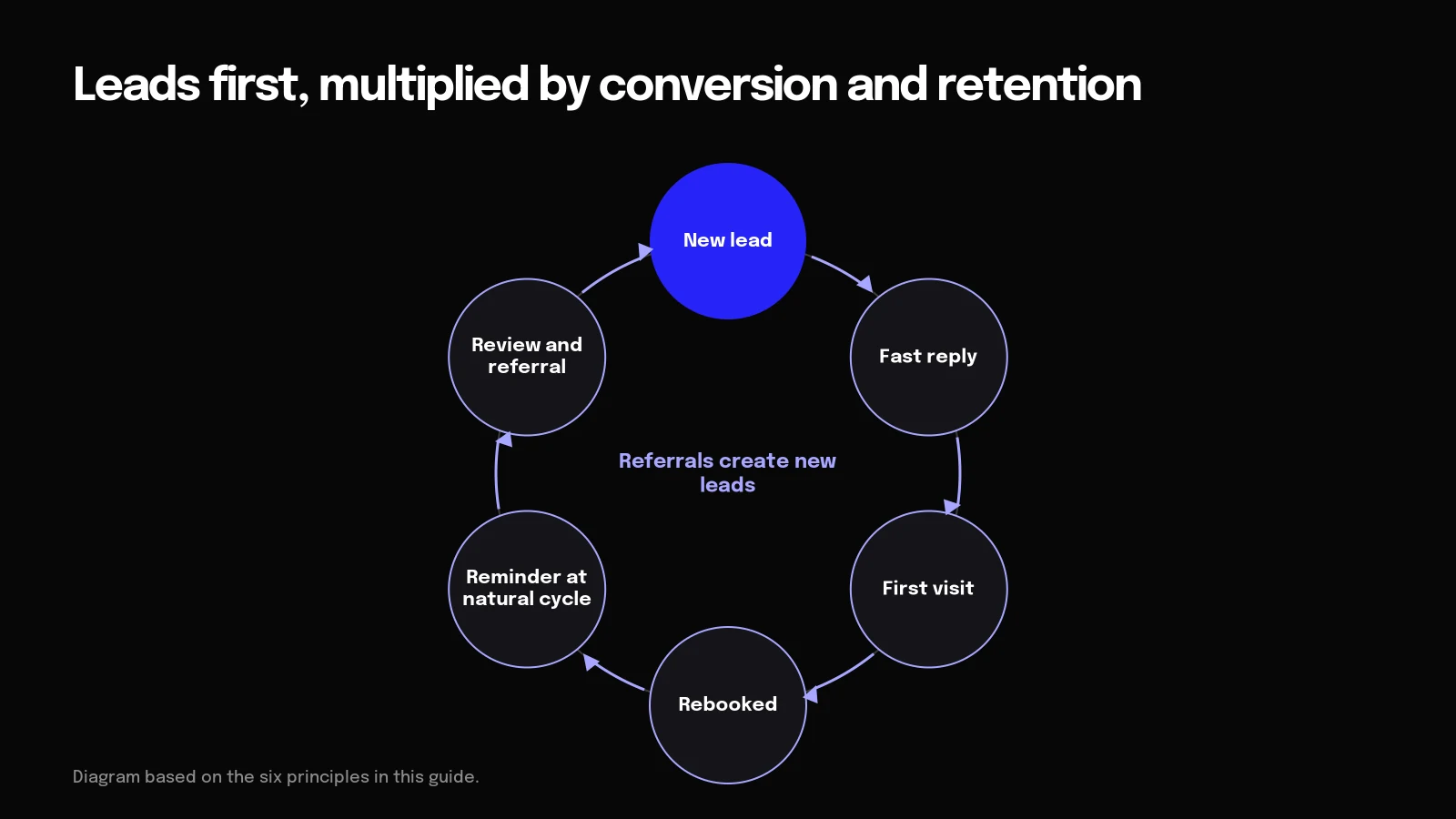
1. Leads first, multiplied by conversion and retention
Without new enquiries, there is nothing to retain, so lead generation always comes first. It is also the hardest and most expensive part of marketing. That is exactly why the habits that follow a lead matter so much: each one increases what that lead is worth.
The cheapest booking you will ever get is the one you make before the customer leaves. Rather than asking “would you like to book again?”, offer two specific times at checkout. Email and SMS reminders, timed to the natural cycle of your service, then bring people back without paying to win them a second time.
The same idea applies to customers who have drifted away. On quiet days, working through a list of people who have not returned recovers revenue that is already in your system. Where it suits your business, an annual plan, membership or guest list goes a step further, encouraging repeat visits while collecting the contact details you need for everything else.
2. Reviews: a habit, not a campaign
Once customers are coming back, reviews are the next multiplier. The best time to ask is in person, at the high point of the experience, followed by a direct link on the same day or within a few days. Replying to every review in a warm, natural way shows future customers how you treat people.
Over time, reviews lift the conversion rate of every other channel you run. On their own, however, they rarely drive growth, so we treat them as a multiplier rather than a lead source.
3. Your population decides the channel
If leads come first, the next question is where they will come from, and the size of your market has a big influence on the answer. Two terms help explain why. Demand capture means appearing when someone is already searching for what you offer. Demand creation means putting your offer in front of people who were not searching yet, so they decide they want it.
In a small town or a single suburb, there may not be many people searching each month, and costs rise quickly when several competitors bid on the same few searches. There, demand capture alone is rarely enough. We usually recommend a mix: Meta ads with a strong offer to create demand, Google search on the terms people genuinely use, and steady community and referral work.
With a large population or a wide service area, there is enough search demand for Google Ads to work well alongside Meta. Urgent and high intent needs, such as an emergency repair or a legal problem, are the exception to the population rule. Google search tends to work for these even in smaller areas, because people search the moment they need help.
TDMC experience: In our experience, Google Ads alone seldom books out a small local business, and owners sometimes credit ads for results that also came from a better website or a seasonal swing. Ads clearly work in the right contexts too, particularly for urgent and high value services. For a small market, we recommend treating the first few months as a test, splitting budget between Meta and Google, tracking cost per customer and keeping what works.
4. SEO is ongoing, and competition comes in three types
Paid ads stop when the budget stops, which is why most businesses also invest in SEO. A local business with a modern, fast website often starts to see SEO results within about six months, depending on competition. SEO never really finishes, though. Like going to the gym, it works best as a steady weekly habit. Our guide to what SEO is and how it works covers the basics.
How quickly you rank depends on the kind of competition you face, and it usually takes one of three forms. Intensity is when established competitors have years of content and links, as is common among long established professional firms. You win that contest with patience, depth and specific pages they have not written.
Volume is simply a large number of competitors, such as cafes or dentists across a metro area. Here, suburb and service pages, steady reviews and a better than average website make the difference. Dominance is when a few large sites own page one, as realestate.com.au and Domain do for property searches. Rather than competing for the broadest terms, target the specific searches those sites answer poorly.
5. Offers and pricing structure
When you create demand rather than capture it, the offer does much of the work. Someone scrolling Facebook was not looking for you, so a clear, low risk first step gives them a reason to act. In our experience, value offers usually work better than deep discounts, because customers who arrive for a discount tend to leave for the next one.
Offers also need to fit the rules of your industry. Health providers, for example, must state the terms of any offer, and childcare services cannot offer inducements to enrol. Each industry guide covers the rules that apply.
6. Where marketing makes the biggest difference
The five principles above apply everywhere, but the balance between marketing and relationships varies by industry. In hospitality, childcare, tourism, dental and GP clinics, marketing does most of the work. Physio, allied health, franchise, aged care and consumer law sit in the middle, with a mix of marketing and relationships. Real estate agents, commercial and estate lawyers and medical specialists rely mostly on relationships and personal brand.
Even in that last group, marketing is what makes relationships visible. A personal brand simply means being known for one thing by one group of people, such as the agent who knows the local market best. The way to build one is to choose that one thing, show up consistently where your people are and share useful content about it every week.
Strategy by business size
These principles stay the same as a business grows, but the way you apply them changes. Every industry guide follows the same three stages, summarised in the table below. The 7Ps of marketing make a useful checklist alongside them.
| Stage | Lead generation | Multipliers | Measure |
|---|---|---|---|
| Small (early stage) | One reliable lead source matched to your population | Booking, rebooking, reminders and reviews | Leads and customers by source |
| Medium (growth) | Add SEO and an offer led Meta engine | Recall flows, reactivation, memberships | Cost per customer, return rate |
| Large | Paid search and social per site where tracking supports it, plus PR | Central intake, dashboards, memberships | Cost and lifetime value by source and site |
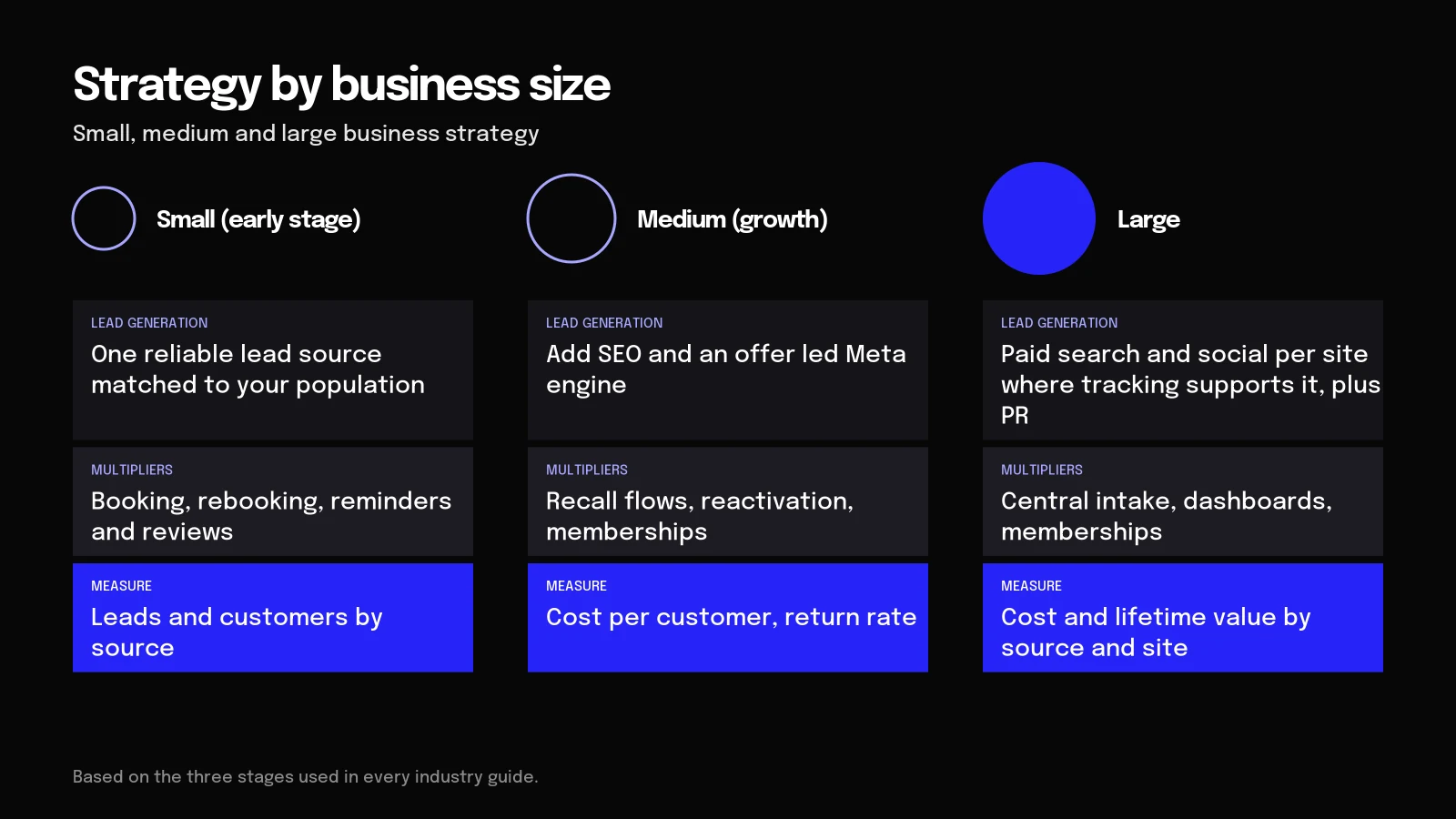
A small business needs one reliable lead source and the habits that multiply it. A growing business adds a second engine, usually SEO or offer led Meta ads, along with recall and reactivation. A large business then runs each site or service by its own numbers. In every case, the stages build on each other rather than replace each other. Each stage works best with a clear strategy behind it, and our marketing consulting team can help you shape one for your business.
Google Ads vs Meta economics
Whatever your stage, paid advertising eventually raises the same question: will it pay for itself? Before you spend, it helps to know whether paid search can cover its costs and when Meta or other channels are likely to be cheaper. Our advertising services are built around answering exactly that question. For the details of each platform, see our complete guide to Google Ads and our complete guide to Facebook and Meta ads.
The six numbers, explained plainly
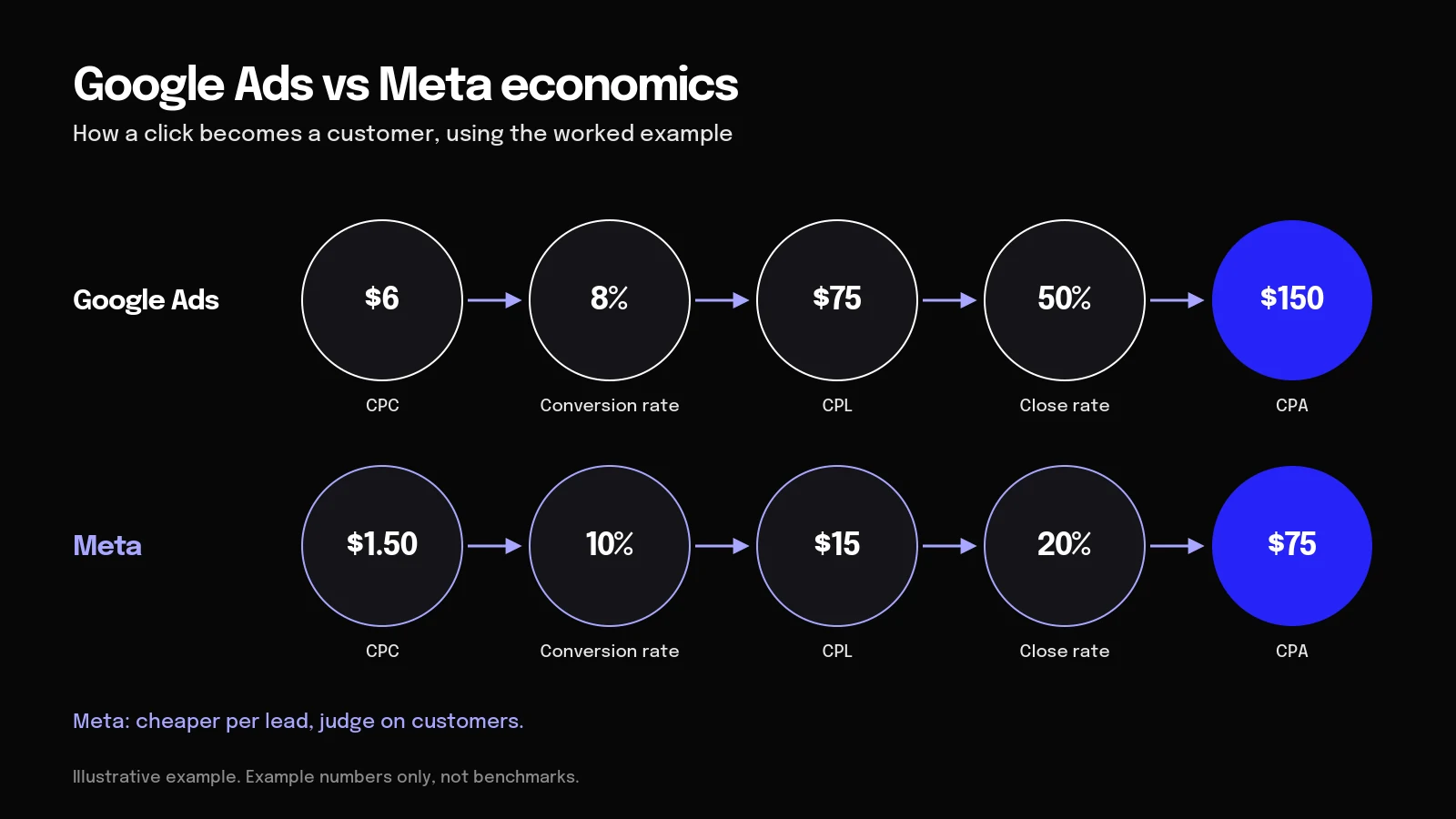
Six numbers tell you whether advertising is working, and each one builds on the last. CPC (cost per click) is your total spend divided by clicks. Your conversion rate is the share of clicks that become leads, such as calls, forms or bookings. Divide CPC by the conversion rate and you get your CPL (cost per lead). Divide CPL by the share of leads who become paying customers, and you have your CPA (cost per acquisition).
The last two numbers tell you what you can afford. Break-even CPA is the most you can pay for a customer without losing money, based on gross profit (revenue minus the direct cost of delivering the service). Lifetime value (LTV) is the gross profit a typical customer brings while they stay with you. Use your own records for this rather than an estimate.
Putting these together explains the first principle in numbers. If your CPA is above break-even on the first sale, the campaign only pays when customers come back or buy more. That is why retention makes paid lead generation affordable.
Worked example (EXAMPLE NUMBERS ONLY, not benchmarks)
The table applies the six numbers to four simple scenarios.
| Scenario | CPC | Conversion rate | CPL | Close rate | CPA | First sale gross profit | Verdict |
|---|---|---|---|---|---|---|---|
| Lower value service, one visit | $6 | 8% | $75 | 50% | $150 | $80 | Loses $70 per customer |
| Same service, 5 visits on average | $6 | 8% | $75 | 50% | $150 | $400 lifetime | Earns $250 per customer |
| Higher value service ($4,000 treatment) | $25 | 5% | $500 | 30% | About $1,667 | $2,000 | Pays on the first sale |
| Meta comparison | $1.50 | 10% | $15 | 20% | $75 | Depends on service | Cheaper per lead, judge on customers |
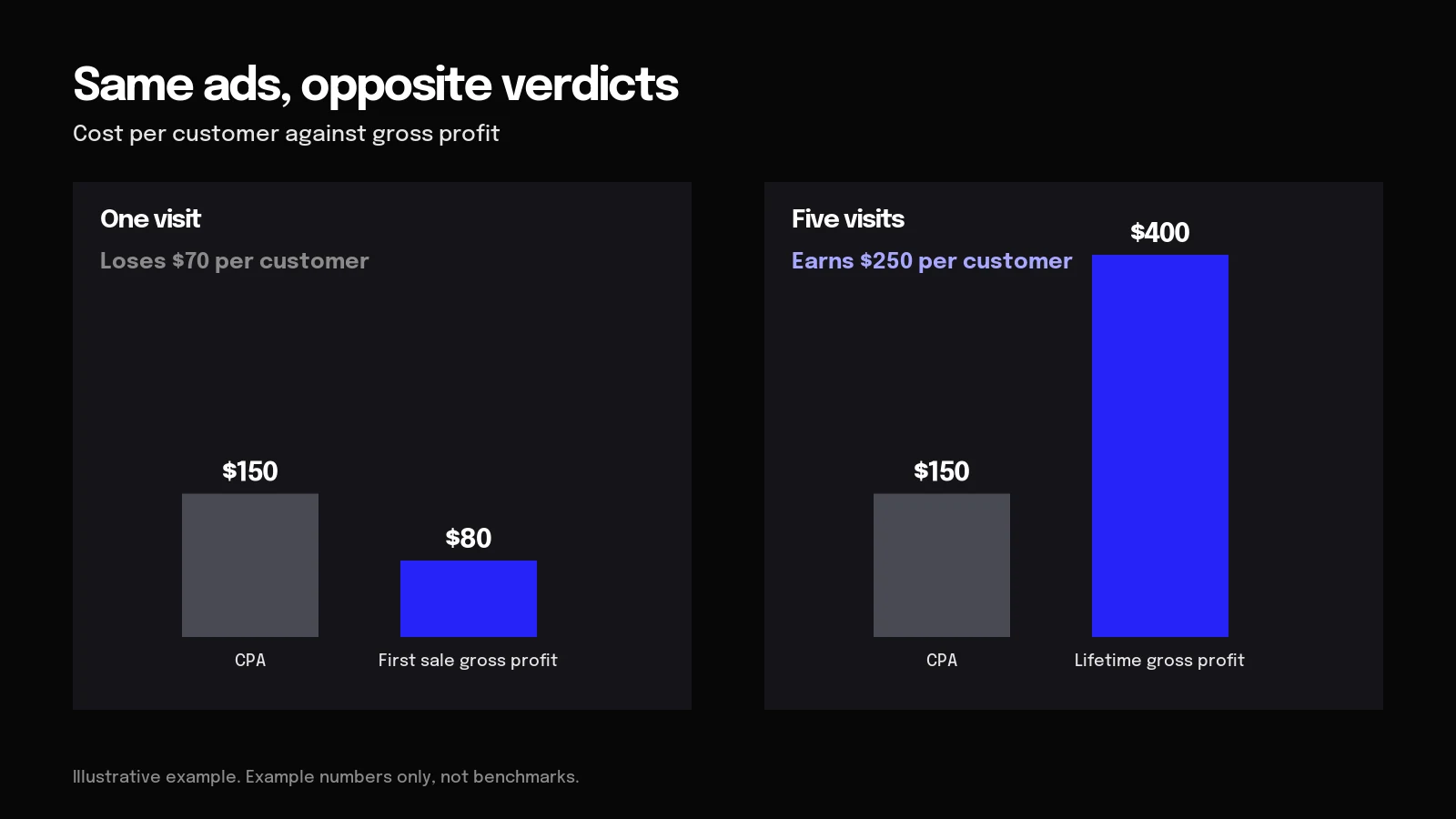
The same ads give opposite verdicts. What decides the outcome is rebooking and the value of the service.
What the benchmarks say
Your own numbers matter most, but published benchmarks are a useful sense check. The US figures below, from WordStream and LocaliQ, are in US dollars, and your market will differ.
| Industry (US, 2025) | Google CPC | Google CPL | Meta lead ads CPL |
|---|---|---|---|
| All industries | $5.26 | $70.11 | $27.66 |
| Dentists | $7.85 | $83.93 | $76.71 |
| Attorneys and legal | $8.58 | $131.63 | $18.17 |
| Real estate | $2.53 | $100.48 | $16.61 |
| Restaurants and food | $2.05 | $30.27 | $3.16 |
Sources: WordStream Google Ads benchmarks 2025 and WordStream Facebook ads benchmarks 2025. For healthcare, LocaliQ’s healthcare benchmarks report a median CPL of $32.79 for physical therapy and $141.17 for mental health.
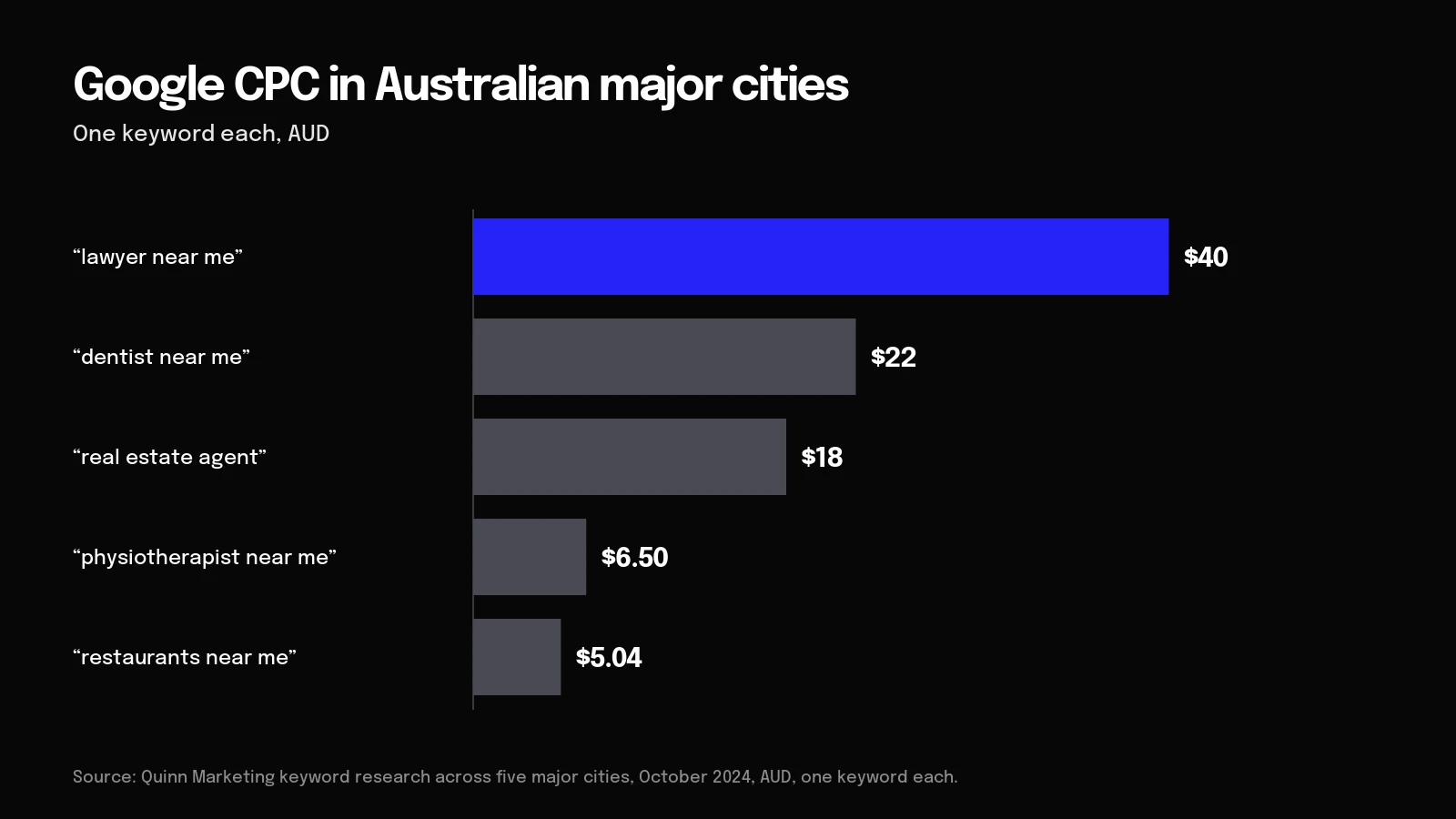
We found no independent Australian CPC benchmark by industry. The best available is Quinn Marketing’s keyword research across five major cities (October 2024, AUD, one keyword each): “dentist near me” $22, “lawyer near me” $40, “physiotherapist near me” $6.50, “real estate agent” $18 and “restaurants near me” $5.04. To see current prices in your own area, use Google Keyword Planner.
What we check before scaling ads
Benchmarks and examples are a starting point, so before we increase any budget, we check four things for the business itself. First, we work out the break-even cost per customer, because it is the number that decides everything else and many businesses have not yet calculated it. Second, we look at repeat value, since a first sale that only breaks even becomes profitable once even a share of customers come back.
Third, we make sure only real outcomes, such as booked jobs, are passed back to the ad platform, so automated bidding learns from genuine customers rather than low quality enquiries. Finally, we verify tracking and tighten search terms, so no budget is spent before we can see what it returns.
Why the basics are hard, and how to make them easy
Most of what makes ads pay comes down to everyday habits: answering quickly, asking for reviews and rebooking. You probably already know these matter. What helps is understanding why each one is worth the effort, and having an easy way to do it.
Speed matters more than many owners expect. Harvard Business Review research, as summarised by Rework, found that firms that tried to contact a web lead within an hour were nearly seven times as likely to qualify it as those that waited longer. Reviews carry similar weight. In BrightLocal’s 2025 survey, only 4% of consumers said they never read online reviews, and 96% were open to writing one.
Even so, these habits are hard to keep up, and the reasons are understandable. Front desks juggle phones, payments and complaints, and a British Dental Journal survey found that 41% of UK dental practice managers and receptionists scored high on emotional exhaustion. Asking for reviews can also feel awkward, and nearly a quarter of people in BrightLocal’s survey said their experience was not noteworthy enough to review.
The good news is that the fixes are small. Automate review requests and reminders from your booking software, and write a one line script so anyone on the team can make the ask. Give each task one named owner, with 30 minutes a week set aside for it, and use online booking or call overflow at peak times. Tracking one number per task then makes the effort visible and gives the team credit for it.
Compliance basics (dates rechecked October 2026)
Every strategy in this guide sits within Australian consumer and advertising rules, and several of them changed recently. On payments, eftpos, Mastercard and Visa no longer allow card surcharges from 1 October 2026, through card network rules enabled by the RBA. Weekend and public holiday surcharges are not affected, and the RBA’s surcharging FAQs explain the detail.
Pricing rules are also tightening. From 1 July 2027, per transaction charges such as booking fees must be shown clearly next to the advertised price, under the Competition and Consumer Amendment (Unfair Trading Practices) Act 2026. Compulsory fees already belong in the total price under the ACCC price display rules.
Two further areas apply to particular businesses. In aged care, the new Aged Care Act started on 1 November 2025. For reviews and customer messages, follow the ACCC’s online reviews guidance and the ACMA’s spam rules for SMS and email.
Glossary
- SEO: earning free listings in Google.
- Keyword: the phrase people type into Google.
- Retargeting: showing ads to people who already visited your site or watched your videos.
- Demand creation: getting your offer in front of people who were not yet searching.
- Personal brand: being known for one thing by one group of people.
- CPL: cost per lead.
- Lifetime value: the gross profit a customer brings over the time they stay with you.
This guide is general information, not legal or financial advice. Check the rules for your profession and state before you advertise.
If you’d like a plan built for your industry and your stage of growth, contact us or email hello@thedigitalmarketingconsultants.com.au. We’ll tell you straight where we see the biggest opportunity.