
Physio marketing brings a clinic new patients in two ways: through referrers, such as GPs, specialists, gyms and clubs, and through people who find you directly on Google or social media. Finding them is only half the picture, though. The value of every new patient depends on whether they complete their care plan and come back when they need you again.
That idea, that a completed plan is what makes a patient worth winning, runs through this guide. Once it is clear, decisions about referrers, recalls and ad spend become much simpler. We set out one recommended plan for a new or small clinic, a growing clinic and a multi-site group, covering lead generation, conversion, retention and recall, reviews and what to measure at each stage.
At a glance
Build a steady flow of new patients from referrers and direct search. Book the full care plan at the first visit as a clinical recommendation. Then use simple, automated recalls after discharge. Completion and recall multiply each new patient, so paid ads become far easier to justify.
In this guide:
A completed care plan, not a single consult, is what makes each new patient worth winning.
How physio marketing works
For many clinics, referrers are the largest source of new patients. GPs, specialists and other practitioners send a steady flow when they know and trust you, and that trust is built in person over time. Community connections work in a similar way. Spending time at a local gym or club, getting to know the coach or owner and offering to look after their members builds relationships that printed material alone rarely achieves.
Paid ads sit alongside these channels rather than replacing them. They work well for some clinics and less well for others, and Meta suits some clinics better than Google while the reverse is true elsewhere. That is why we recommend working through your personal and referral network first, then testing ads with careful tracking.
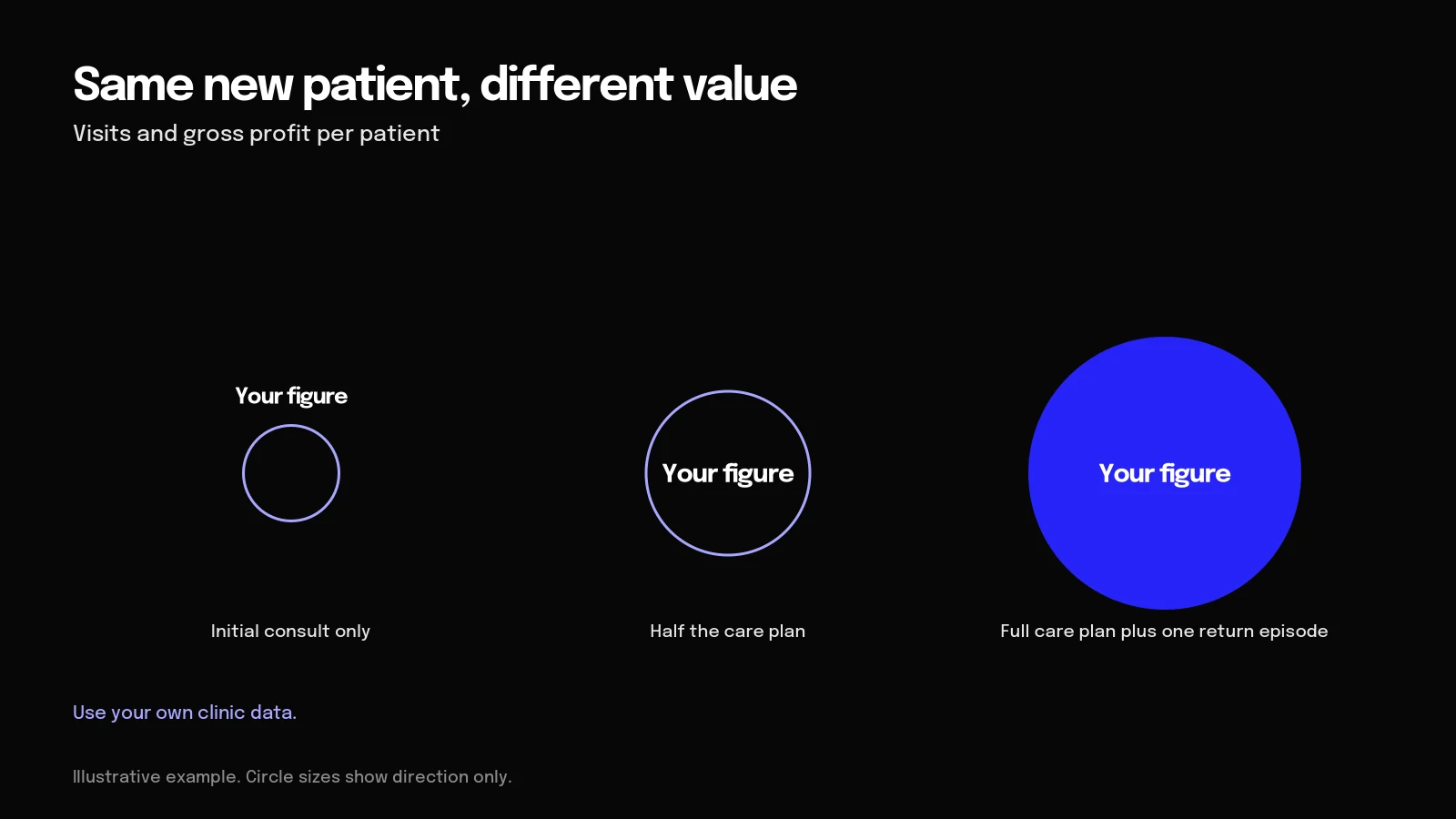
Whichever channel brings a patient in, plan completion decides whether that patient is profitable. An initial consult alone often does not cover the cost of winning the patient, while a completed plan usually does. The chart below shows the idea using your own clinic’s numbers.
Why the basics matter, and why they are hard
If completion decides profitability, then the habits that support completion are worth getting right. Follow-up matters to patients as well as to the clinic. A patient who stops attending and hears nothing back can easily assume the clinic was not concerned, and that impression shapes whether they return or recommend you to others.
Physios, however, are usually fully booked, and phone calls take time that is better spent with patients. Admin adds to the load too, as unpaid invoices, rescheduling when a clinician is unwell and re-entering data between systems can fill a small team’s day.
The fixes are mostly about freeing time and choosing the right channel. Start by freeing admin time: add a payment link to the SMS confirmation, turn on your accounting software’s automatic overdue reminders and keep a short checklist for rescheduling when a clinician is unwell. With that time recovered, book the full plan at the first visit as a clinical recommendation rather than a sales conversation. For patients who are not rebooked, a text usually gets a better response than a call, so have reception work from a weekly list of patients not booked for the following week. Finally, put one gym or club visit a month in the calendar, so community relationships grow steadily without competing for clinical time.
Stage 1: New or small clinic
Recommended strategy: book the plan, and build a local referral network.
A new clinic grows fastest through the people who already know you, so start with your personal network and local community. Running workouts and injury screening sessions with local gyms and clubs each quarter puts you in front of active people who are likely to need a physio at some point. Joining club sessions and offering screenings does the same in a relaxed, natural way.
Referrer visits build on the same principle and work best when you bring something useful. Lead with what is distinctive about your clinic, such as a niche or a short wait time, and leave an introduction letter. Since doctors’ appointment time is precious, a brief visit to the practice with a simple brochure and cards for the staff room is usually more welcome than booking a consult slot or a lunch session. The relationship itself is the value here, so keep the focus on useful information and never offer gifts or inducements for referrals.
Direct patients need an easy path to you as well. Complete your Google Business Profile and set up online booking, the first steps in local SEO and longer term SEO, then run a small, tracked Google or Meta test with a clearly priced initial assessment and the terms stated.
Once enquiries arrive, offer online booking and reply quickly to every one. After the first session, send the GP a one page report letter, which keeps the referrer informed and makes the next referral more likely.
Retention starts at that first visit, when you book the full care plan. Send a text check-in to post-operative patients and to patients who were progressing well and then stopped, because these are the patients for whom a follow-up matters most. When a patient is discharged, ask for a review in person and then send the direct link by SMS, testing whether asking on the day or a few days later works better for your clinic. To see what is working, track plan completion rate and referrals by partner.
Stage 2: Growing clinic
Recommended strategy: return patient flows and local demand creation.
With referrers in place and plans being completed, a growing clinic can start creating demand of its own. Meta ads in your local area for a clearly priced assessment work well here, and our Facebook and Meta ads guide shows how. SEO (search engine optimisation) builds alongside them through condition pages, such as running injuries or knee rehabilitation after surgery. Physio search is competitive, so suburb and condition pages backed by reviews help you stand out, and our guide to what SEO is explains the approach. Developing a niche that GPs can remember, supported by a short talk or a one page sheet for nearby practices, strengthens your referrals at the same time.
As patient numbers grow, rebooking needs a clear owner. Give reception responsibility for the weekly “not rebooked” list and the text messages that go with it.
Recall then brings past patients back. Send post-discharge emails at about 30 days, then at 3, 6 and 12 months. Where it suits your model, offer an exercise class or membership for patients who want ongoing support. Automating review requests from your practice software after discharge keeps reviews steady without extra effort. At this stage, watch returning patients and cost per attended new patient.
Stage 3: Multi-site group
Recommended strategy: managed referrers and paid search by site.
At several sites, the relationships that one founder once managed need named owners. Give each site a referrer relationship owner who sends a quarterly update on wait times. Run Google or Meta ads for each site, and keep them where tracked attended patients justify the spend. Because results differ from site to site, each site’s own data should decide its budget, and our Google Ads complete guide covers the tracking that makes this possible. Club sponsorships that offer real community value complete the mix.
Central booking that answers within business hours keeps conversion consistent across sites. Reporting recall completion by site and clinician shows where retention is strong, and a Google Business Profile for each site, with replies from the local team, keeps reviews personal. The measures that matter most now are new patients and cost per patient by referrer, channel and site.
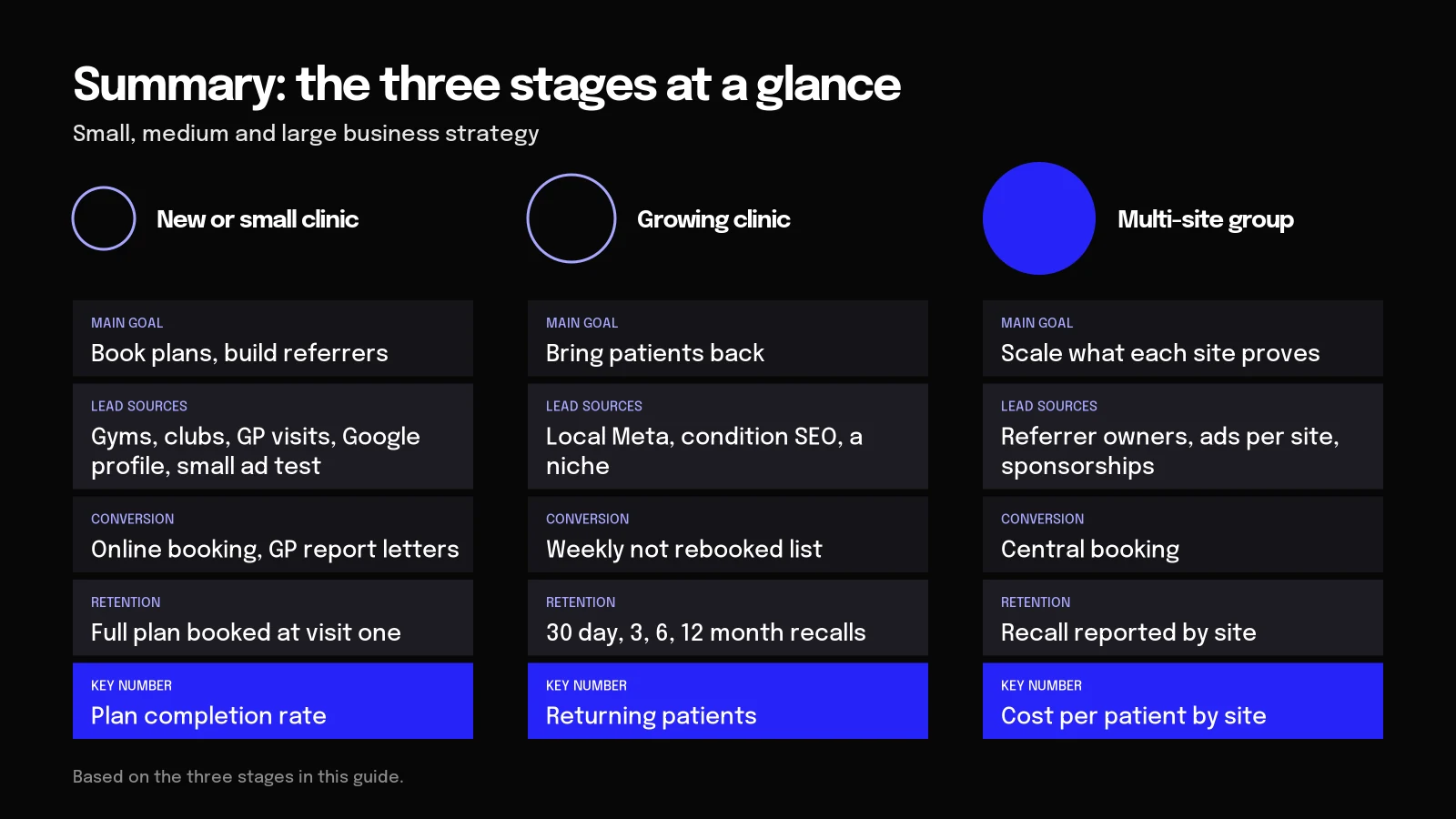
Summary: the three stages at a glance
| New or small clinic | Growing clinic | Multi-site group | |
|---|---|---|---|
| Main goal | Book plans, build referrers | Bring patients back | Scale what each site proves |
| Lead sources | Gyms, clubs, GP visits, Google profile, small ad test | Local Meta, condition SEO, a niche | Referrer owners, ads per site, sponsorships |
| Conversion | Online booking, GP report letters | Weekly not rebooked list | Central booking |
| Retention | Full plan booked at visit one | 30 day, 3, 6, 12 month recalls | Recall reported by site |
| Key number | Plan completion rate | Returning patients | Cost per patient by site |
Do ads pay for physio?
Often they do, provided patients complete their plans. Quinn Marketing’s Australian keyword research (October 2024) puts “physiotherapist near me” at about $6.50 a click (AUD), with about 49,500 monthly searches (Quinn Marketing). In the US, LocaliQ puts the average cost per lead for physical therapy at US$32.79, one of the lowest in healthcare (LocaliQ).
In our experience, Google Ads alone seldom fills a small suburban clinic, but with careful Google Ads management it can work well alongside referrers, especially for new injuries, when people search the moment they need help. For the maths on CPC, cost per lead, break-even and lifetime value, see the Google Ads vs Meta economics section of our industry marketing guide.
Compliance checklist
Physio advertising is regulated, so every channel above should be checked against these points.
- Physiotherapy Board advertising guidelines, including stating the terms of any offer (Physiotherapy Board of Australia).
- No testimonials about clinical aspects, including reviews reposted on your website or social media (AHPRA testimonial tool).
- Penalties for advertising offences are up to $60,000 for individuals and $120,000 for bodies corporate per offence (AHPRA).
- No gifts or inducements tied to referrals.
- Card surcharges: eftpos, Mastercard and Visa ban card payment surcharges from 1 October 2026 (Reserve Bank of Australia). Update your fee schedule and booking pages.
- Spam Act and Privacy Act for recall messages (ACMA).
For how people, process and price fit together in a clinic, see our guide to the 7Ps of marketing.
Ready to grow your caseload with confidence? Reach out to our team or email hello@thedigitalmarketingconsultants.com.au, and we’ll help you build a plan that fits your clinic’s stage.