
Tour and experience operators have something most local businesses do not: a whole distribution system that can sell for them. Online travel agents (OTAs), hotels, visitor centres and inbound tour operators can bring guests you could never reach alone. The trade-off is commission, so pricing, reviews and repeat guests decide how profitable that flow of bookings is.
That balance, between the reach partners give you and the margin you keep, runs through this guide to tourism marketing. We set out one recommended plan for each of three stages: a new operator, a growing operator and a large operator. Each plan covers lead generation, conversion, retention, reviews and what to measure.
At a glance
Build reviews fast, list on the platforms your guests use, price so commission is affordable at the same retail price everywhere, and build local partners. Then turn past guests into repeat bookers and referrers.
In this guide:
Reviews, the right platforms and one consistent retail price everywhere turn first time guests into repeat bookers.
Key terms, in plain English
Tourism distribution has its own vocabulary, so it helps to start with four terms we use throughout.
- OTA (online travel agent): a booking platform such as Viator or GetYourGuide.
- ITO (inbound tour operator): an Australian business that packages tours for overseas travel agents.
- Nett rate: what you receive. Gross or retail rate: what the guest pays.
- Rate parity: the same retail price direct and through every partner.
How tourism distribution works
With those terms in place, the system itself is easy to follow. Tourism Australia explains that the gross rate “should be consistent across all distribution channels”, because agents will not promote a product they know guests can buy cheaper direct (Tourism Australia: the travel distribution system). It publishes guide commission levels, which it describes as a guide only:
| Channel | Guide commission (Tourism Australia) |
|---|---|
| Inbound tour operator | 30% |
| Wholesaler | 20% |
| Online travel agent | 10 to 15% |
| Retail travel agent | 10% |
| Direct to guest | Nil (same retail price) |
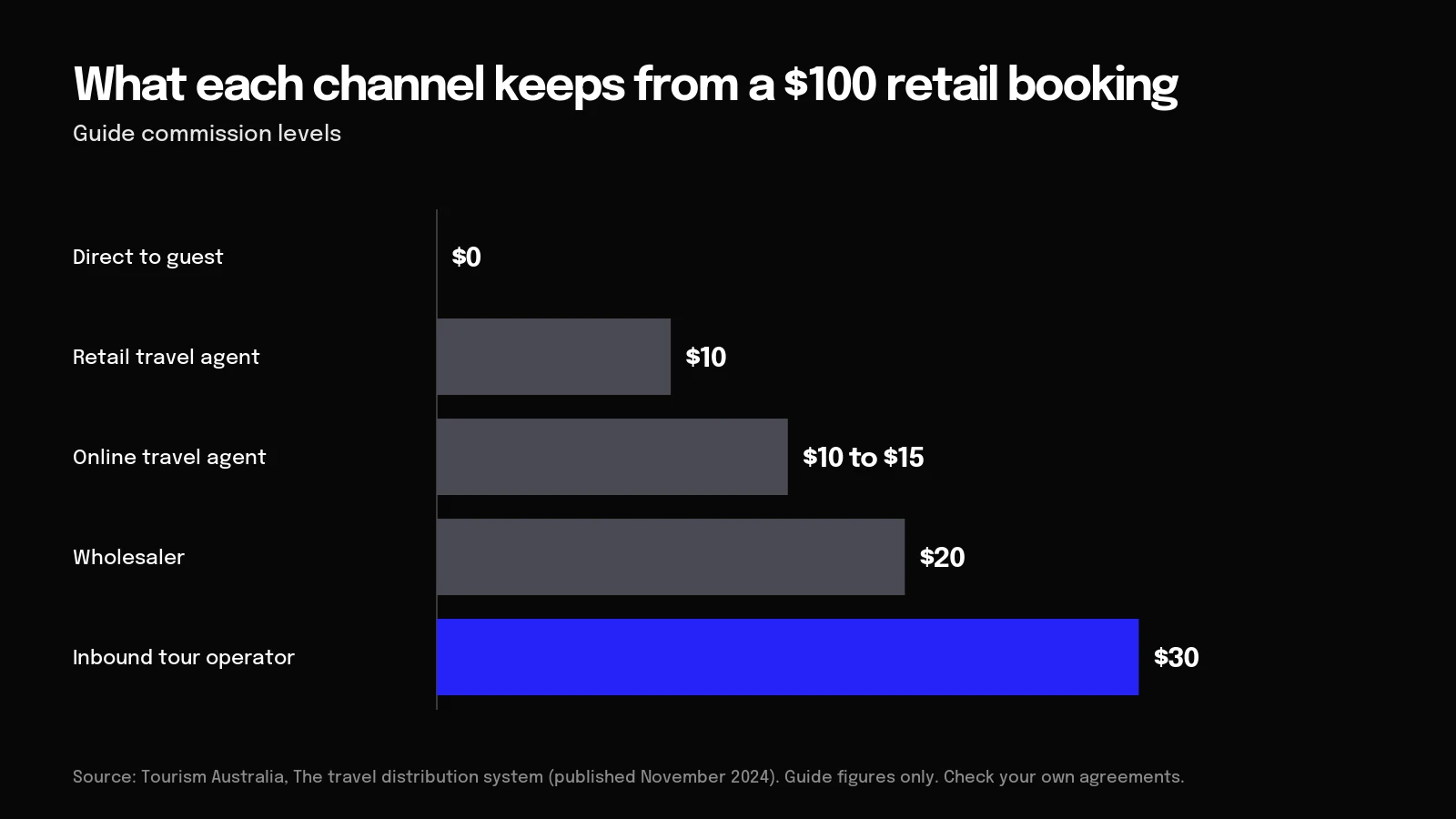
In practice, the commission you pay an OTA can sit well above this guide, especially if you want strong placement in its search results. Platforms and agreements vary, so we recommend modelling your real average commission before you set prices. The reasoning is simple. If your price is too low, every OTA booking eats into your margin, but if commission is built into the price, every channel becomes worth having.
Why the basics matter, and why they are hard
Commission explains how bookings are paid for, while reviews decide whether many of those bookings arrive at all. They lift your ranking on OTAs, and they give guests the confidence to book with you directly. Tours are very much a referral business, so the aim is a review from every guest. The wider evidence points the same way: in the US, BrightLocal’s 2025 survey found 71% of adults always or regularly read reviews for local businesses (BrightLocal).
The difficulty is that operators guide all day and do the admin at night. Asking strangers for reviews can feel awkward, and steady online bookings take time to build. That is completely normal, and it is why simple systems matter more than extra effort.
A few low-effort habits make those systems work. Hand out a QR card at the end of every tour, and send an automatic thank you email the same evening with photos and the review link. Track partner reference codes in your booking system so you can see which partners send guests, and block one evening a month for partner visits.
Stage 1: New operator
Recommended strategy: reviews, listings and local partners.
A new operator’s first task is to become visible and trusted, so we recommend starting with your Google Business Profile and Tripadvisor, where reviews drive local SEO. You do not need a polished website on day one; a complete Google profile, an OTA booking link and flyers in hotels, B&Bs and cafes can carry your first bookings. Next, list on Viator and GetYourGuide, with pricing built to cover commission at rate parity. Each platform suits different visitors, so test both and keep the one that books. We also recommend familiarisation tours for concierges, visitor centre staff and accommodation hosts, so they can recommend you first hand.
Launch tours need a little care, because the obvious shortcut breaks the rules. Running free tours in exchange for reviews is tempting, but Google’s review policy bans offering free goods or services in exchange for reviews, and it also bans asking only happy customers. A better approach is to keep free places for familiarisation guests such as concierges, offer a launch price to the public if you like, and ask every paying guest for an honest review.
When guests do find you, the listing has to persuade them. Clear photos, a polished description and recent reviews all lift a listing, so answer enquiries the same day and make your booking link easy to find on Google. After the tour, collect emails (the QR link can do both jobs) and follow up with a “bring a friend” or returning guest perk.
Reviews deserve the most attention in these early months. We recommend concentrating them on one platform first, so they build up quickly where guests see them, and making the ask easy. A QR code on a card or a final slide, followed by an email a few hours later, works well. So does showing the QR sign a minute or two before the end, or sending guest photos later along with the review link. A simple script helps: “If you enjoyed today, a Google review is the biggest help to a small operator like us. The QR code is on the card.” To see how it is going, track reviews per tour and bookings by source.
Stage 2: Growing operator
Recommended strategy: balance the distribution mix and grow direct value.
Once bookings flow from several channels, the question becomes which mix is most profitable. That is why we recommend modelling your average commission across all channels each quarter. Partner reference codes for hotels and concierges, paid monthly, keep those relationships active. A concierge script might be: “Here are QR cards with your hotel’s own booking link; you’ll get [x]% on every booking, paid monthly.”
Locals are a market too, so local media and event listings are worth the effort. Local online magazines, your tourism board’s event page and your business district’s listings can all bring guests alongside Tripadvisor. Join your regional tourism organisation, and use the ATEC Tourism Export Toolkit if you target international visitors. Meta ads in source markets can then create demand, for example in Perth metro for a South West experience. Our Facebook and Meta ads guide explains how.
Growing direct bookings is the other half of a profitable mix, and rate parity shapes how you do it. Rather than offering a lower price, add value to direct bookings with a perk such as a photo pack or local guide, so parity holds. Past guests become more valuable at this stage too, so email them about new seasonal tours, since locals and visiting friends and relatives are your repeat market. Keep the end of tour review ask going, reply to every review personally, and watch average commission, share of direct bookings and partner bookings.
Stage 3: Large operator
Recommended strategy: a season-based channel mix, plus trade.
A large operator can use each channel for what it does best, and the season is the main guide. Use OTAs and ITOs for international guests and off-peak capacity, and lean on direct bookings and locals in peak season. Google Ads on high volume destination searches in season can pay well when tracked to bookings; our Google Ads complete guide covers tracking. SEO for destination and experience pages adds steady traffic over time. Travel search is dominated by giants such as Tripadvisor and Booking.com, so the opportunity lies in specific searches they do not answer well, and our guide to what SEO is explains the approach. Travel media and creators then add reach for seasonal launches.
With so many partners, consistency protects your margin. Keep rates and inventory consistent across every channel, with clear terms for each partner. Repeat business grows from the same care. Treat gift vouchers as a retail line and push them before Christmas and Mother’s and Father’s Day, and email past guests each season. Name one person to own review responses across all platforms, and focus on margin by channel, repeat and referral bookings, and voucher sales.
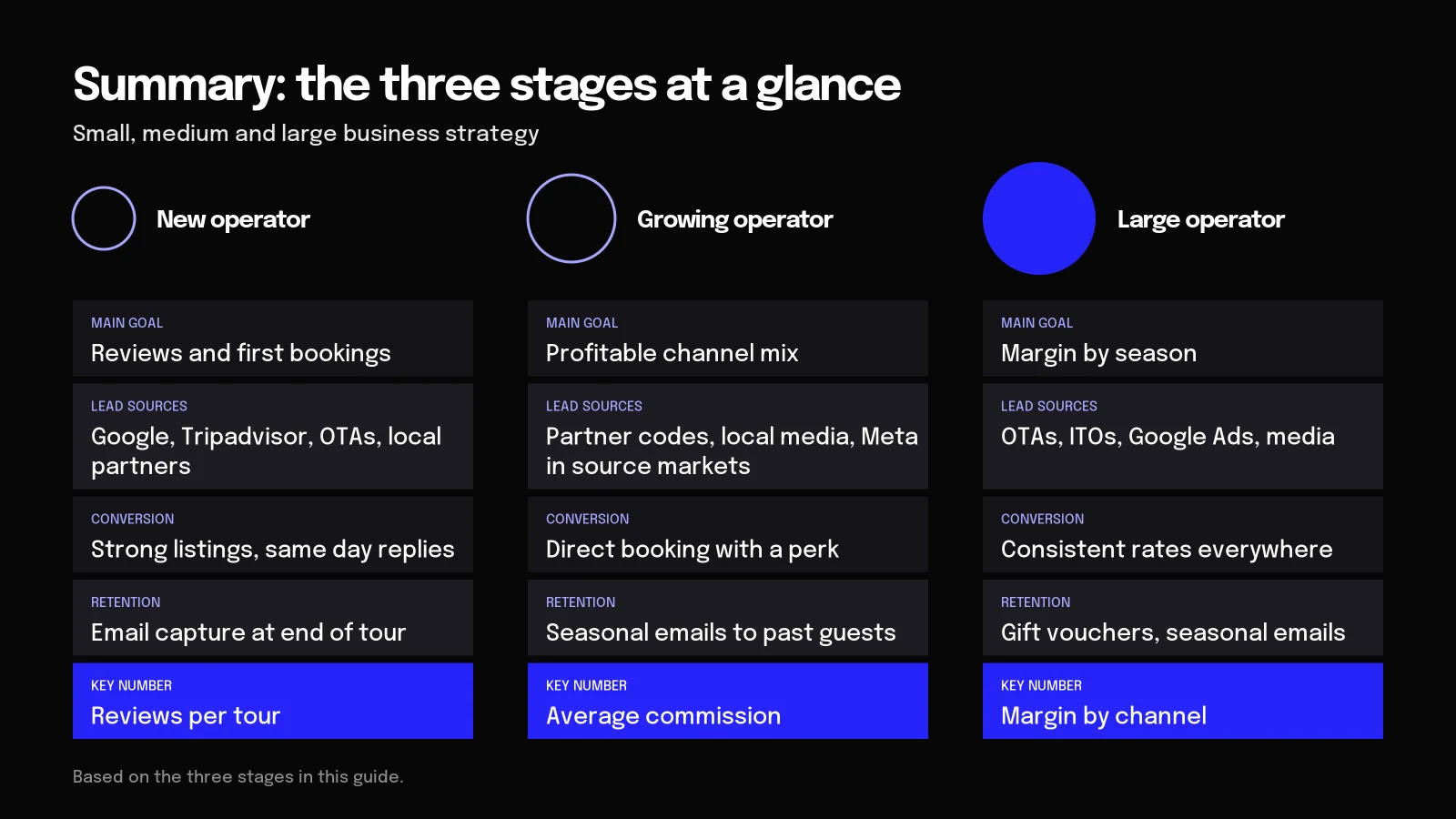
Summary: the three stages at a glance
Side by side, the three plans show the focus moving from reviews to margin as an operator grows.
| New operator | Growing operator | Large operator | |
|---|---|---|---|
| Main goal | Reviews and first bookings | Profitable channel mix | Margin by season |
| Lead sources | Google, Tripadvisor, OTAs, local partners | Partner codes, local media, Meta in source markets | OTAs, ITOs, Google Ads, media |
| Conversion | Strong listings, same day replies | Direct booking with a perk | Consistent rates everywhere |
| Retention | Email capture at end of tour | Seasonal emails to past guests | Gift vouchers, seasonal emails |
| Key number | Reviews per tour | Average commission | Margin by channel |
Do ads pay for tourism?
Sometimes, and the answer depends on the season and the search. Quinn Marketing’s Australian keyword research (October 2024) has no tour-specific keyword, but puts “travel agent” at about $4.11 a click and “hotel booking” at about $6 (Quinn Marketing). In the US, WordStream’s 2025 benchmarks put travel at $2.12 a click and $73.70 per lead (WordStream).
Those costs are worth comparing with OTA commission, which you only pay when a booking is made. In our experience, search tends to pay for tours on high volume destination terms in season, and focused Google Ads management within a wider advertising plan helps you catch that demand. For the full maths on CPC, cost per lead, break-even and lifetime value, see the Google Ads vs Meta economics section of our industry marketing guide.
Compliance checklist
Pricing sits at the centre of tourism marketing, and so do the rules around it. These are the main points to check.
- Show the total price, including compulsory fees (ACCC price displays).
- Drip pricing: from 1 July 2027, the Competition and Consumer Amendment (Unfair Trading Practices) Act 2026 requires per transaction charges such as booking fees to be shown clearly next to the base price (Federal Register of Legislation).
- Card surcharges: eftpos, Mastercard and Visa ban card payment surcharges from 1 October 2026. The change does not cover weekend or public holiday surcharges (Reserve Bank of Australia).
- Reviews: do not offer incentives only for positive reviews (ACCC online reviews).
- Spam Act for guest emails (ACMA).
Each of these points comes back to the balance we started with: partners bring reach, and clear, consistent pricing protects the margin you keep. For how price, place and partners fit together, see our guide to the 7Ps of marketing.
If you’d like more direct bookings and more repeat guests, reach out to us or email hello@thedigitalmarketingconsultants.com.au. We’ll help you get the most from every channel.