
A GP clinic grows when patients know a doctor is available, find it easy to book, and come back for the care they need. Specialists grow in a different way, mainly through GPs who trust them with their patients. In both cases, marketing’s role is to make that availability and that trust visible.
Visibility is the organising idea of this guide to medical practice marketing. Patients can only book a doctor they know about, and GPs can only refer to a specialist they remember. We set out one recommended plan for a new clinic (or a new doctor joining), a growing clinic and a multi-site group, covering lead generation, conversion, recall, reviews and what to measure at each stage.
At a glance
Make availability visible: online booking, an accurate Google profile, clear billing information and each doctor’s special interests. Book follow-ups at checkout and run recalls for care plan reviews and preventive checks. Ask for reviews consistently. Put any ad spend behind doctors who have capacity.
In this guide:
Make availability visible, book follow ups at checkout and put any ad spend behind doctors with capacity.
How medical practice marketing works
Visibility starts with what patients see before they book. Your clinic’s Google rating and each doctor’s website profile shape where patients choose to go. Profiles work best when they name specific special interests, such as women’s health or skin checks, because broad phrases like “chronic care, preventative care” give patients little to choose between.
The same principle explains how quickly a new doctor’s book fills. Billing model, local demand and how busy the rest of the clinic is all play a part, so timelines vary widely. When the other doctors are not yet full, a new doctor will usually take longer, and it helps to plan with that in mind. Actively announcing a new doctor, and making their availability easy to see and book, speeds things up noticeably.
Once patients arrive, recall becomes the engine of retention. Chronic care reviews and preventive checks give patients natural, clinically appropriate reasons to return. Specialists rely on a different engine, which is GP referrals. Most GPs already have someone in mind for each type of referral, so a specialist needs something genuinely distinctive, such as a niche, faster access or a specific service, to earn a place on that list.
Why the basics matter, and why they are hard
Two habits support everything above: asking for reviews and running recalls. Reviews shape first impressions. In the US, BrightLocal’s 2025 survey found 71% of adults always or regularly read reviews for local businesses (BrightLocal). Recall matters just as much, because it supports continuity of care, which patients and doctors both value.
Both habits are hard to keep up consistently. GPs are short on time, and asking patients for reviews can feel awkward. Reception teams handle high call volumes, payments and anxious patients all day. A 2024 British Dental Journal survey of UK dental practice managers and receptionists found 41% scored high on emotional exhaustion (British Dental Journal). It is a UK dental study, but front desks in general practice face similar pressures.
The answer is to let systems carry most of the load. Your clinical software can generate recalls automatically, and online booking for overflow means the phone is not the only way in. A printed review request handout at reception makes asking easier, especially when each doctor has claimed their own Google profile as well as the clinic’s. Template SMS messages for new doctor announcements and recalls then save the team from writing each one from scratch.
Stage 1: New clinic or new doctor
Recommended strategy: make access visible and introduce every doctor properly.
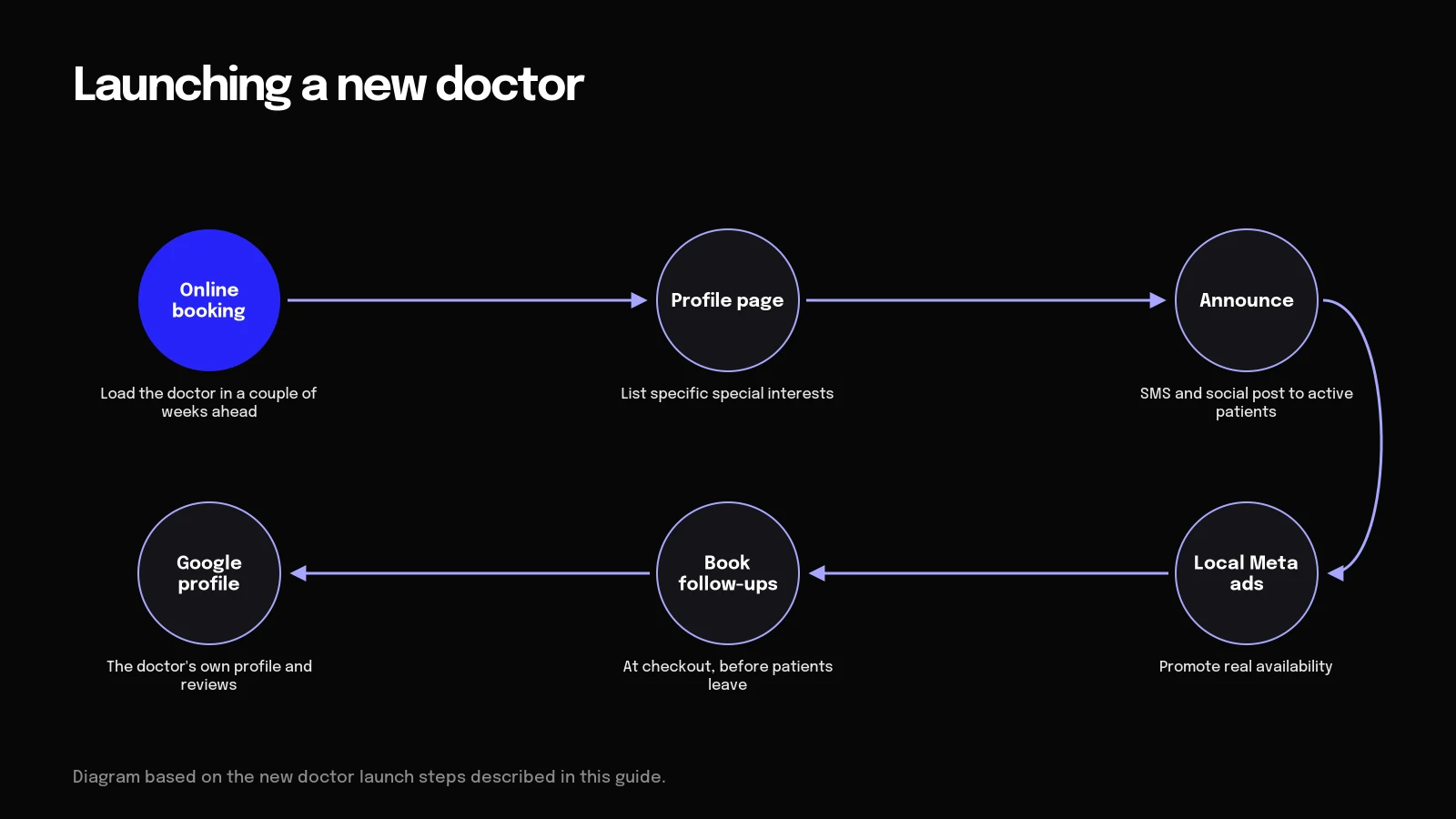
A new clinic or new doctor needs, above all, to be found and booked. Start with online booking, an accurate Google Business Profile (the base of local SEO and good SEO) and clear billing information (who is bulk billed and when) on the website and booking page. Then announce each new doctor on the website, on social media and by SMS to active patients: “Welcome Dr [Name] to [clinic]. Dr [Name] has a special interest in [women’s health, skin checks, sports injuries] and has appointments available this week. Book: [link].”
Paid and word of mouth channels can then extend that announcement. Local Meta ads can promote availability and special interest clinics, framed as services rather than discounts, and our Facebook and Meta ads guide explains the setup. Letting current patients know the clinic has new availability, and inviting them to tell friends, adds word of mouth. Local referral points help too. Contact specialists who need GPs for their patients, and leave cards with nearby urgent care services.
For specialists, the best approach is a visit to the practice manager with a one page referral sheet. A GP’s appointment time is best kept for patients, so this route is usually more welcome than booking a consult to introduce yourself. Focus on GPs who do not yet have a referral partner for your area.
Conversion at this stage is mostly about timing. Load a new doctor into the booking system a couple of weeks ahead, so patients can book from the day they start. Retention then begins at checkout, by booking the follow-up with two specific times: “Dr [Name] wants to see you again in [x weeks] for your review. I have [time] or [time].”
Reviews start with each doctor claiming their own Google profile alongside the clinic’s. To see how the launch is going, track new patients per doctor per week and the number of days it takes to fill a new doctor’s book.
Stage 2: Growing clinic
Recommended strategy: recall, reviews and continuity.
Once each doctor is visible and booking, a growing clinic can build depth. Doctor profile pages with specific special interests, plus special interest service pages, form the core of SEO (search engine optimisation) for a clinic. Large sites such as Healthdirect dominate general health information searches, so local and service specific searches are where a clinic can stand out. Our guide to what SEO is explains how. Recruitment marketing matters at this stage as well, because the supply of doctors often sets the limit on growth.
Clear billing information at every step of the booking journey keeps conversion smooth as more patients arrive.
Recall now becomes the main source of growth. Send SMS recalls for care plan reviews, health checks and screening: “Hi [Name], Dr [Name] would like to see you for your [care plan review, skin check or health check]. Book here: [link] or call [number].” Quieter appointment times are a good opportunity for clinically appropriate preventive care, such as cancer screening, mental health checks and medication reviews, with a follow-up booked when the next step is uncertain. In this way, good care and good recall support each other.
Reviews benefit from the same consistency. Set up a regular review request flow, by handout or automated SMS, and test the timing. BrightLocal’s 2025 survey suggests people expect healthcare review requests a few days to a week after the visit. At this stage, measure recall completion, appointment utilisation, review rating and continuity with the same doctor.
Stage 3: Multi-site group
Recommended strategy: capacity-based marketing.
A multi-site group has a different question to answer: where to send demand. The answer is to put spend behind doctors and clinics with capacity, and pause it where books are full. Run Google and Meta ads for each clinic, keep them where tracked new patients justify the spend, and check them against Google’s healthcare and medicines policy. Our Google Ads complete guide covers tracking. Local PR about community health programs adds reach.
The same focus on capacity shapes the patient experience. Online booking across all sites, with live availability by doctor, lets patients find the next open appointment easily. A central recall team working from the clinical software keeps recall consistent, and tracking ratings by clinic and doctor shows where reviews need attention. The numbers that matter most now are utilisation by doctor and clinic, and cost per new patient.
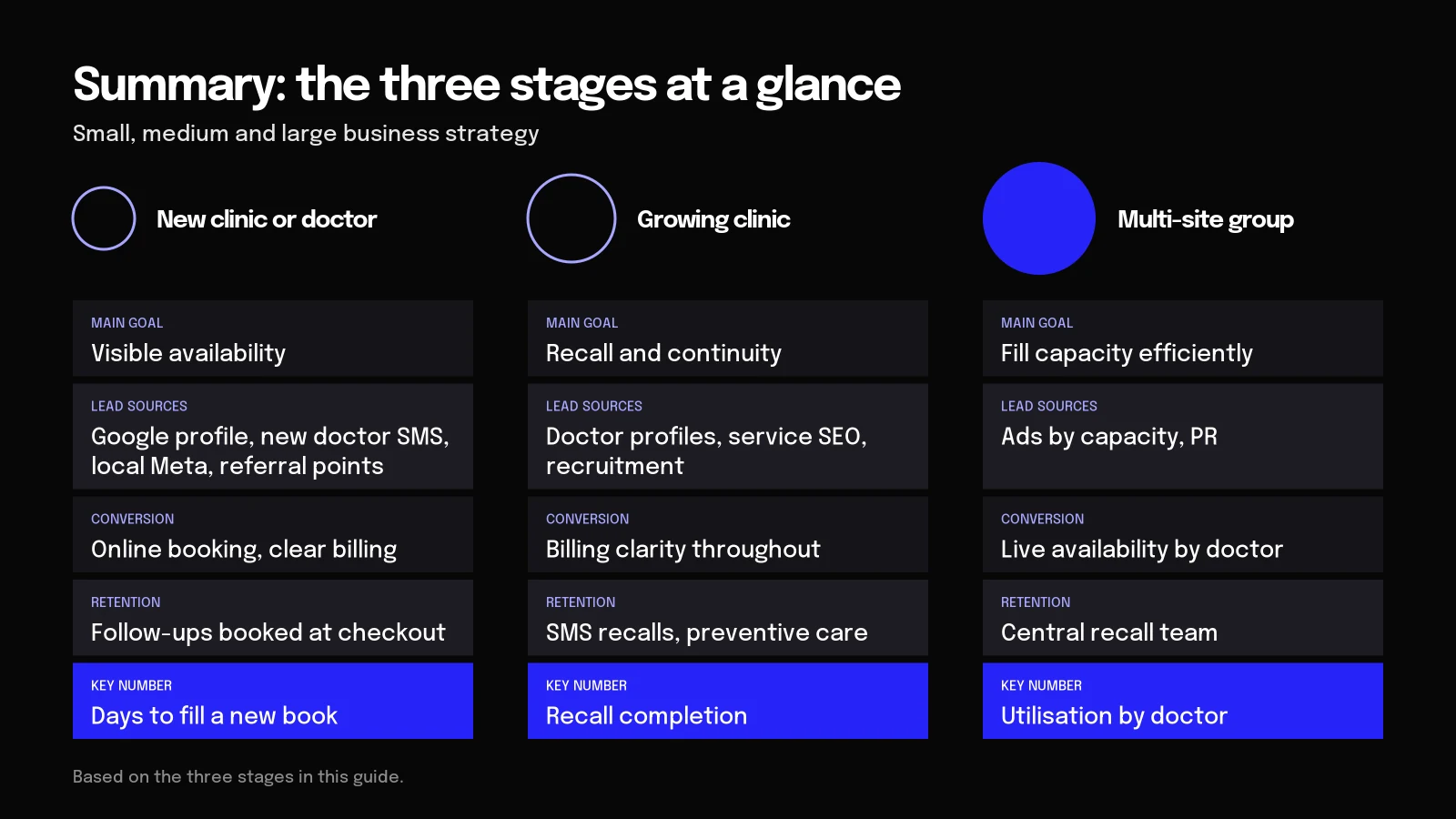
Summary: the three stages at a glance
| New clinic or doctor | Growing clinic | Multi-site group | |
|---|---|---|---|
| Main goal | Visible availability | Recall and continuity | Fill capacity efficiently |
| Lead sources | Google profile, new doctor SMS, local Meta, referral points | Doctor profiles, service SEO, recruitment | Ads by capacity, PR |
| Conversion | Online booking, clear billing | Billing clarity throughout | Live availability by doctor |
| Retention | Follow-ups booked at checkout | SMS recalls, preventive care | Central recall team |
| Key number | Days to fill a new book | Recall completion | Utilisation by doctor |
Do ads pay for medical practices?
It depends on what the visit is worth. Quinn Marketing’s Australian keyword research (October 2024) puts “GP near me” at about $10 a click (AUD), with about 90,500 monthly searches (Quinn Marketing). In the US, LocaliQ puts the average cost per lead for general practice and family medicine at US$62.80 (LocaliQ).
For a bulk billed consult, search often does not pay on a single visit. In our experience, ads work best when they promote doctors with capacity and special interest services, and focused Google Ads management keeps them on target, with recall carrying the long-term value. Referrals, word of mouth and a strong review profile can carry a practice a long way with little or no ad spend. For the maths on CPC, cost per lead, break-even and lifetime value, see the Google Ads vs Meta economics section of our industry marketing guide.
Compliance checklist
Medical advertising is closely regulated, so every channel above should be checked against these points.
- Medical Board advertising guidance (Medical Board of Australia) and the RACGP advertising requirements.
- No testimonials about clinical aspects, including reviews reposted on your site or social media (AHPRA testimonial tool).
- Penalties for advertising offences are up to $60,000 for individuals and $120,000 for bodies corporate per offence (AHPRA).
- Google healthcare ad policies apply to search and display ads (Google Ads policy).
- Card surcharges: eftpos, Mastercard and Visa ban card payment surcharges from 1 October 2026, so update fee schedules and signage (Reserve Bank of Australia).
- Spam Act and Privacy Act for patient SMS. Care-related recalls are treated differently from promotional messages, so check your privacy policy (ACMA).
For how people, process and place fit together in a clinic, see our guide to the 7Ps of marketing.
If you’d like your doctors’ books to fill faster, contact us or email hello@thedigitalmarketingconsultants.com.au. We’ll help you find the opportunities already sitting in your practice.