
A family that enrols with you can stay for years, and often brings younger siblings too, so every enrolment is worth far more than a one-off sale. It all starts, though, with a steady flow of enquiries, and for most centres that is the hardest part.
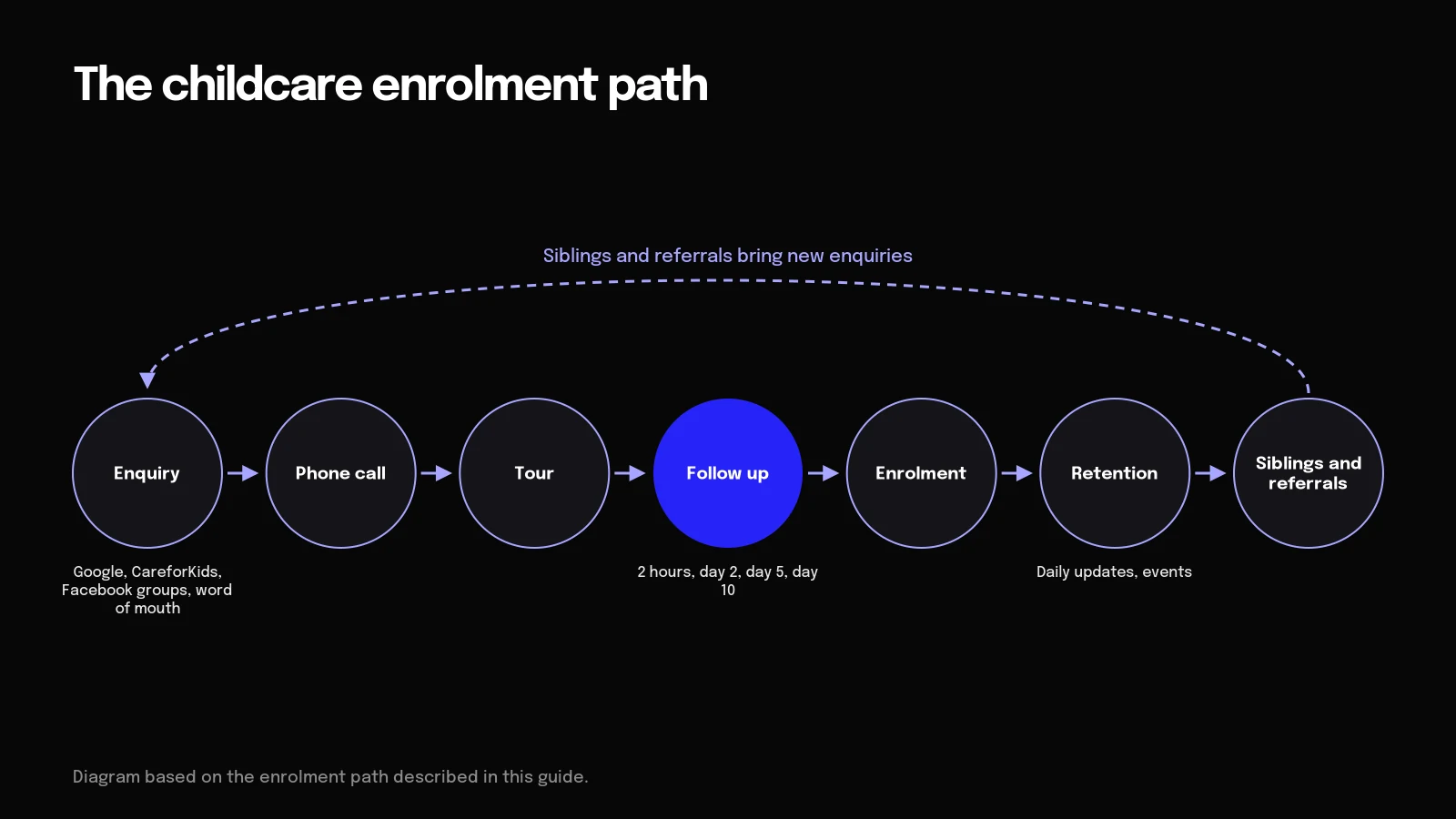
That path from first enquiry to a family who stays is the thread running through this guide to childcare marketing. We set out one plan for each of three stages: a new or small centre, a growing centre and a multi-centre group. Each plan follows that same path.
At a glance
Get enquiries from Google, CareforKids, local parent Facebook groups and word of mouth. Win them on the phone call and the tour. Then keep families through great everyday communication. Conversion and retention multiply every enquiry you earn, but they cannot replace the enquiries themselves.
In this guide:
Enquiries start the journey, but the phone call and the tour decide most enrolments.
How childcare marketing works
Because enquiries come first, it helps to know where parents look. They find centres on Google, on listing sites such as CareforKids, in local parent groups and through friends. Once a parent makes contact, the phone call and the tour decide most enrolments. CareforKids advises offering a choice of tour times on the call and asking confidently about enrolment at the end of the tour, “before they visit a competitor”.
After enrolment, the long-term value sits in retention, as happy families stay for years and siblings follow. Trust begins well before that, though. Many parents check licensing records, staff turnover and ratios before they book a tour, so sharing that information openly builds trust before you have even met.
Why the basics matter, and why they are hard
Every step on that path depends on a few basics: fast replies, good tours and steady reviews. What helps is seeing the evidence and finding easier ways to make them happen.
Speed is the clearest example. In a Harvard Business Review audit of 2,241 US companies, only 37% replied to a web enquiry within an hour, yet firms that did were nearly seven times as likely to qualify the lead (HBR, as summarised by Rework). Parents compare several centres at once, so the first warm reply often wins the tour. Reviews matter too: BrightLocal’s 2025 survey of 1,026 US adults found 71% always or regularly read reviews for local businesses (BrightLocal Local Consumer Review Survey).
The challenge is time. Directors run tours in between ratios, compliance and staffing gaps, and Jobs and Skills Australia’s 2025 list found 29% of occupations in shortage, with low pay, poor conditions and retention problems driving shortages in care roles (Jobs and Skills Australia). When one director carries every tour, follow-up and the waitlist, things slip, so sharing the load is the real fix.
Fortunately, that does not take much. Turning on the CareforKids Book a Tour feature lets parents book themselves in, and scheduled follow-ups in your CRM (customer relationship manager, the system that holds enquiries) mean nothing depends on memory. From there, train a second staff member to run tours with the same script, and give one person ownership of the waitlist, with 30 minutes a week blocked out for it.
Stage 1: New or small childcare centre
Recommended strategy: build a pre-opening waitlist, and make every tour count.
A new centre has the advantage of a fresh start, and we recommend starting about 3 months before you open. Set up a complete Google Business Profile and a CareforKids listing with Book a Tour switched on, so local SEO brings Google enquiries in from day one. From there, run Meta (Facebook and Instagram) ads to local parents. Short director walk-through videos work well because they show the real people and rooms, and our Facebook and Meta ads guide explains how to set these up. Share updates in local parent Facebook groups too, and hold two open days before opening. Keep offers within the rules: a free stay and play session, an orientation visit or an accurately reported fee discount all work, while cash, vouchers and giveaways do not, as the goodie bag section explains.
If you are taking over an existing centre, begin by finding where families drop away: at the enquiry, the tour or the enrolment. Then compare your pricing, subsidy acceptance and infant places with nearby centres, understand the previous owner’s reputation, and let families know the centre is under new management.
Either way, enquiries become enrolments on the phone and at the tour, and a simple script keeps every call consistent. Ask the child’s age and the days needed, name the room and a long-serving educator, then offer two tour times. CareforKids suggests checking availability and telling the parent you have “a space, not ten”. Aim to book every enquiry in for a tour within the week, and ask about enrolment at the end of it.
Once a family enrols, they stay when they feel connected, which daily updates through your family app, monthly family events and sibling priority on the waitlist all support. A positive milestone, such as the first month settled, is the best time to ask for a review, with a direct link by SMS or email. Then track enquiries by source, tours booked, tour to enrolment rate and the waitlist by room.
Stage 2: Growing centre
Recommended strategy: lift tour conversion and keep families through to school.
As a centre grows, the focus moves to converting more of the enquiries it already receives. Keep Google and CareforKids current, keep Meta running for rooms with vacancies, and start an SEO (search engine optimisation) habit with pages for each age group and your suburb. Our guide to what SEO is and how long it takes is a good starting point. We also recommend publishing what parents check: educator tenure, ratios, your National Quality Standard rating and how you communicate about injuries and incidents. Parents look for this on licensing portals, Google and parent groups, so being open about it helps your centre stand out.
The tour is where that openness pays off. Brief the team before every tour, and walk parents into the room rather than past the window, as CareforKids recommends. Then follow up at 2 hours, day 2, day 5 and day 10. A 2 hour SMS might read: “Lovely meeting you and [Child] today. I’ve emailed the fees and enrolment form. You mentioned [concern]; happy to chat any time.” We also suggest welcoming a second, unannounced visit, because parents who worry that tours are staged will trust you more for it.
Families waiting for a place need care at this stage too. Update them every 6 to 8 weeks with honest timeframes, and plan your transition to school communication well ahead, so families stay with you through their final year. Ask for reviews after milestones such as graduation, and reply to every review in a warm, human way. Then watch tour to enrolment rate by staff member, days from enquiry to start, and family retention through to school.
Stage 3: Multi-centre group
Recommended strategy: market by occupancy, room by room.
With several centres, marketing should follow vacancies. We recommend a weekly vacancy report by room and centre, with paid advertising and offers placed only where a room has spaces. Run Google Ads for each centre where tracked enrolments justify the spend; our Google Ads complete guide covers setup and tracking. Local PR on programs such as bush kinder or school readiness adds reach, and ACECQA provides media release templates for promoting your rating.
The next task is keeping quality even across centres. A central enquiry line using the same script keeps conversion consistent, tracking response time keeps it fast, and at least two trained tour hosts per centre means no tour depends on one person. Quality can shift when a director changes, so plan director handovers carefully and tell families early. Give each centre its own Google Business Profile, use a standard milestone review request across the group, and focus on occupancy by room, cost per enrolment and enquiry response time.
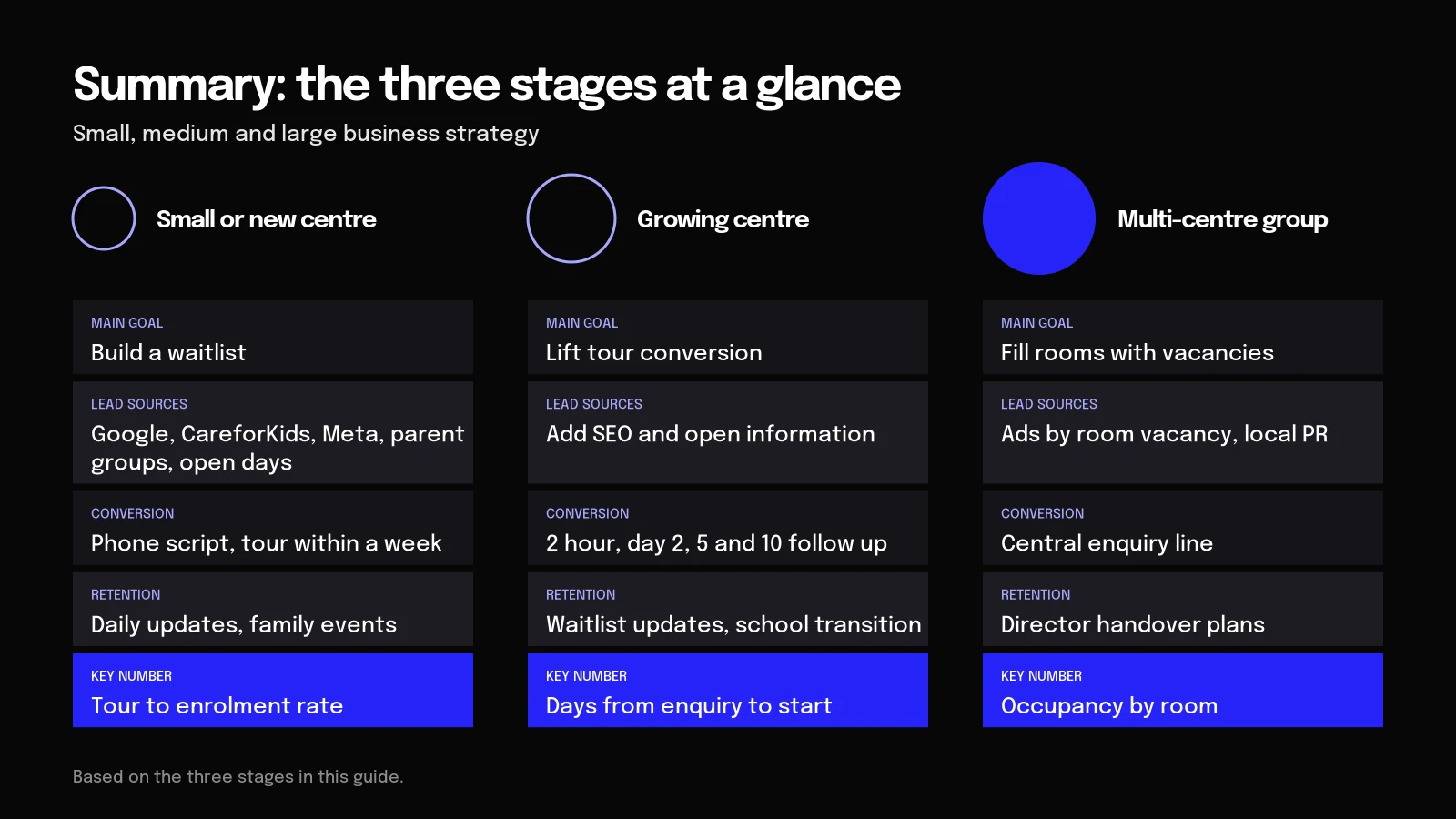
Summary: the three stages at a glance
Seen side by side, the three plans follow the same path, with each stage adding more structure.
| Small or new centre | Growing centre | Multi-centre group | |
|---|---|---|---|
| Main goal | Build a waitlist | Lift tour conversion | Fill rooms with vacancies |
| Lead sources | Google, CareforKids, Meta, parent groups, open days | Add SEO and open information | Ads by room vacancy, local PR |
| Conversion | Phone script, tour within a week | 2 hour, day 2, 5 and 10 follow up | Central enquiry line |
| Retention | Daily updates, family events | Waitlist updates, school transition | Director handover plans |
| Key number | Tour to enrolment rate | Days from enquiry to start | Occupancy by room |
The goodie bag question: what the rules allow
Offers and gifts come up at every stage, and one popular idea shows why the rules deserve a careful look. CareforKids suggests “offering a small goodie bag to keep their child entertained throughout the tour”. It is a kind idea, so we checked it against the rules.
What the Department of Education states: providers must not offer inducements that are financial or not directly related to the quality or delivery of education and care. Banned examples include cash, vouchers, gift cards, electronic devices and “other gifts or giveaways”. Allowed: free site visits and trial periods, discounted or free care reported correctly for CCS (Child Care Subsidy), and “marketing merchandise worth up to $30 for each complying written arrangement” (Department of Education: how to advertise your service).
A take-home goodie bag for a family that has not enrolled is likely to count as a giveaway, so we recommend skipping it. Use a tour activity basket instead, with centre toys, puzzles or drawing materials the child plays with during the tour and that stay at the centre. Better still, invite the child to join a room activity. Save branded merchandise for after enrolment, as a welcome pack worth up to $30 once a complying written arrangement is in place. Keep everything age appropriate and safe, in line with ACECQA’s National Quality Standard on children’s health and safety, and if you are unsure, ask the CCS Provider Helpdesk before you launch.
Do ads pay for childcare?
With the rules clear, the remaining question is cost, and ads can pay in the right context. Quinn Marketing’s keyword research (October 2024, averaged across five capital cities) puts “childcare services” at about $8 a click, with about 320 monthly searches for that phrase (Quinn Marketing). Treat that as one agency’s estimate and check your own suburb in Google Keyword Planner.
Because a family can stay for years, the lifetime value of one enrolment can justify a higher cost per enquiry. In our experience, Meta to local parents is usually cheaper for creating demand, while Google captures parents who are already searching. We recommend testing both, tracking cost per enrolment and keeping what works. For the maths on CPC, cost per lead, break-even and lifetime value, see the Google Ads vs Meta economics section of our industry marketing guide.
Compliance checklist
These are the main rules to check before any campaign goes live.
- No inducements to enrol, as above. Inducements can include offers to enrolled families if they encourage another family to start care, so check referral rewards carefully.
- Report fee discounts correctly for CCS (Department of Education: third-party payments and discounts).
- State your rating accurately. It is an offence to falsely represent your National Quality Standard rating (regulation 72), and ACECQA’s rating logos must match your current overall rating (ACECQA).
- Get written consent before using images of children.
- Card surcharges: eftpos, Mastercard and Visa ban card payment surcharges from 1 October 2026 under their network rules (Reserve Bank of Australia).
- Spam Act for SMS and email (ACMA).
These rules protect the trust that the whole enrolment path depends on, from the first enquiry to the sibling who follows. For how product, price, place and people fit together, see our guide to the 7Ps of marketing.
Looking to fill your rooms and keep families for years? Contact us or email hello@thedigitalmarketingconsultants.com.au and we’ll help you turn more enquiries into enrolments.