
Every dental practice needs a steady flow of new patients, and dental marketing starts with where they come from: for most practices that is Google, your Business Profile, your reviews and, for many, Google Ads. Winning a new patient is only the first step, though. What happens after that first visit decides how much each patient is worth.
That is why this guide gives as much attention to keeping patients as to finding them. Rebooking, recall and following up unfinished treatment plans multiply the value of every patient you win. We set out one recommended strategy for each stage of a practice, then explain how SEO for dentists fits in.
At a glance
- Win new patients through Google first, then test Meta where search volume is thin.
- Rebook at checkout and run recall reminders, because a check up and clean rarely covers its acquisition cost on its own.
- Build reviews with an automated SMS or email link.
- Measure new patients by source and treatment started, not just clicks.
In this guide:
- How patients choose a dentist
- The three stages at a glance
- Small practice (early stage): new patient flow, multiplied by recall
- Medium practice (growth): grow new patients and fill the gaps you already have
- Large practice or group: run it by the numbers per chair and site
- Why the basics matter, and the easy way to do them
- Do Google Ads pay for a dental practice?
- SEO for dentists
- Offers and membership plans
- Compliance checklist
Every new patient is worth more when they rebook before they leave and come back for recall.
How patients choose a dentist
The right channel depends on what the patient needs and how far they are willing to travel. A family looking for a regular dentist behaves very differently from someone with a toothache, and both behave differently from someone considering implants. The table below shows what usually works in each situation.
| Situation | What usually works |
|---|---|
| Suburban general practice | Google Business Profile, reviews and “dentist near me” searches worth testing, plus Meta with a value offer |
| Urgent need (emergency, toothache) | Google search, even in smaller areas |
| High value treatment (implants, aligners) | Google search plus retargeting and educational video for 6 to 12 months, because these are slow decisions |
| Metro wide specialist | Enough search demand to run Google Ads properly |
Two patterns stand out. Urgent needs send people straight to Google, wherever they live, while high value treatments involve slower decisions that reward patient, steady follow up. Keeping both in mind makes the stages below easier to follow.
The three stages at a glance
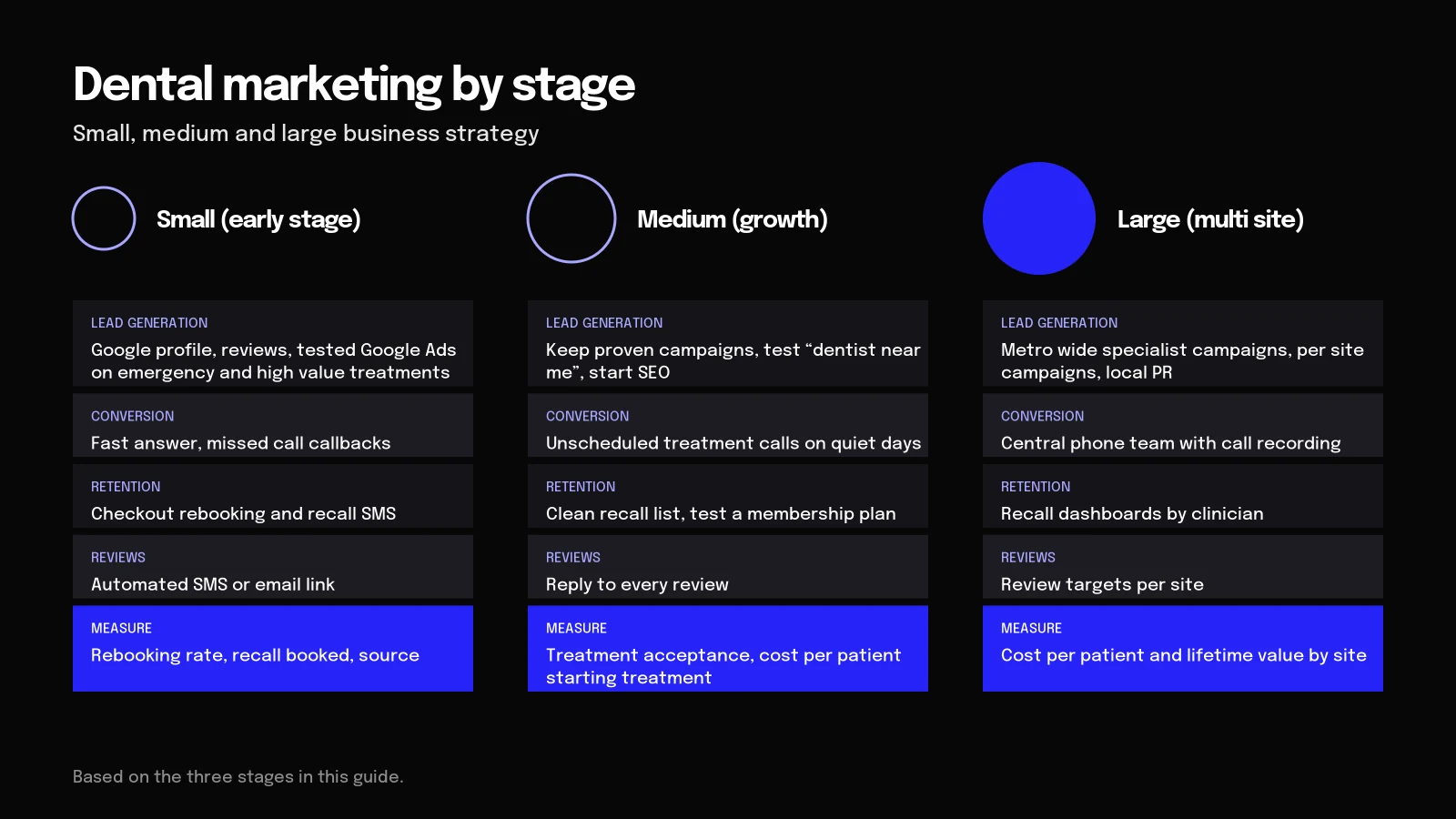
The table gives an overview of the three stages before we look at each one in turn. Each stage keeps what worked before and adds a little more structure.
| Small (early stage) | Medium (growth) | Large (multi site) | |
|---|---|---|---|
| Lead generation | Google profile, reviews, tested Google Ads on emergency and high value treatments | Keep proven campaigns, test “dentist near me”, start SEO | Metro wide specialist campaigns, per site campaigns, local PR |
| Conversion | Fast answer, missed call callbacks | Unscheduled treatment calls on quiet days | Central phone team with call recording |
| Retention | Checkout rebooking and recall SMS | Clean recall list, test a membership plan | Recall dashboards by clinician |
| Reviews | Automated SMS or email link | Reply to every review | Review targets per site |
| Measure | Rebooking rate, recall booked, source | Treatment acceptance, cost per patient starting treatment | Cost per patient and lifetime value by site |
Small practice (early stage): new patient flow, multiplied by recall
A new or small practice does best when it starts with the channel patients already use. That means completing your Google Business Profile with your hours, treatments, photos and booking link. From there, run a small, tracked Google Ads test on emergency and high value treatments, with call tracking so you know which calls came from ads. Where local search volume is low, test Meta ads with a value offer, such as a clearly priced first visit with the terms stated, rather than a deep discount.
Once the phone starts ringing, conversion depends on how you answer it. Answer every call you can, and ring back quickly when you miss one. Callers are often pleasantly surprised by a prompt callback, and many go on to book. Online booking then catches the enquiries that come in after hours.
Retention is where a small practice gains most of its value, because a patient who rebooks costs nothing to win again. A one line script at checkout makes rebooking feel natural: “The dentist would like to see you in six months. Does a Tuesday morning or Thursday afternoon suit?” SMS reminders then do the rest, sent at about five and a half months for six monthly recalls, or 11 months for annual ones.
Reviews build on the same moment. Send an automated request by SMS or email after the visit. BrightLocal’s 2025 survey suggests people expect healthcare requests about three days to a week after the visit, so it is worth testing that timing against a same day request.
To see whether all of this is working, measure three things: your rebooking rate at checkout, recalls due against recalls booked, and new patients by source. Making “how did you hear about us” a compulsory field keeps the source data reliable.
Medium practice (growth): grow new patients and fill the gaps you already have
A growing practice can build on what is already working. Keep the Google Ads campaigns that produce tracked patients who start treatment, and test widening into “dentist near me” terms. This is also the right time to begin SEO, with one page for each treatment and each suburb you serve. For implants and aligners, which are slow decisions, retargeting and short educational videos over 6 to 12 months keep you in mind while patients decide.
At this stage, the biggest conversion gain usually comes from treatment that has been diagnosed but not yet booked. Give one front desk team member 30 minutes on a quiet morning each week to call these patients. We recommend they ask whether the patient has had a chance to think it over, then offer a short consultation where the dentist explains the treatment stages again. Because the call comes from the front desk, or the topic is raised at the next recall visit, it feels helpful rather than pushy.
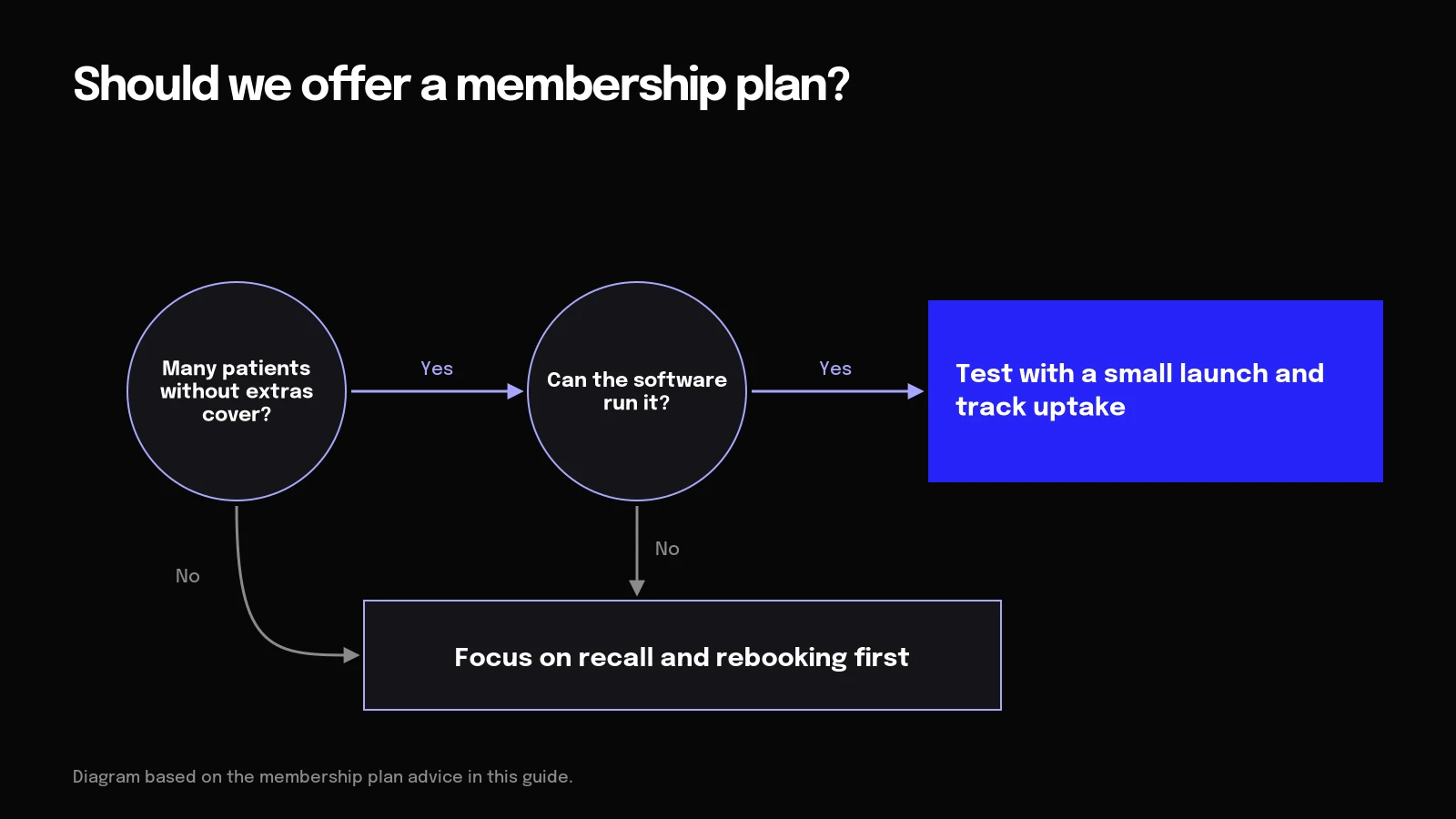
Recall also becomes more valuable as the practice grows, but only if the recall list is accurate. Over time, lists fill up with patients marked active who have not visited for years, so reminders reach the wrong people and the numbers look better than they are. Once the list is up to date, you can consider testing an annual membership for patients without extras cover.
Reviews deserve the same steady care. Reply to every review in a warm, natural way, without confirming that anyone is a patient. At this stage, measure new patients by source, treatment acceptance, membership numbers and cost per patient who starts treatment.
Large practice or group: run it by the numbers per chair and site
With more sites and more chairs, a large practice or group has the volume to run metro wide Google Ads for specialist services, along with campaigns for each site where tracked results justify them. Local PR also works well at this size, particularly stories about community work such as school programs or free clinic days.
Conversion at this scale depends on a well organised phone team. A central team with call recording lets you coach staff and find missed bookings. Where you can, separate the roles: booking and payments at the front desk, billing away from it, and a dedicated person for confirmations and outbound calls. Each task then gets proper attention instead of being squeezed between interruptions.
Retention at this size runs on data. Recall and rebooking dashboards by clinician show where patients are slipping away, and membership can become a core product where uptake supports it. Set review targets and reply standards for every site, then measure new patients and cost per patient by site, hygiene reappointment rate, active patient base and lifetime value by source.
Why the basics matter, and the easy way to do them
Across all three stages, the same basics keep appearing: answering the phone, rebooking and asking for reviews. You already know these matter. The real challenge is doing them consistently while the front desk handles phones, payments and complaints.
The evidence shows why the effort is worthwhile. Only 4% of consumers say they never read online reviews (BrightLocal 2025). Vendor call studies of dental practices report roughly 23% to 38% of calls going unanswered in business hours (for example, Peerlogic), although these come from companies that sell call tools, so treat them as indicative.
The difficulty is just as real. A British Dental Journal survey found that 41% of UK dental practice managers and receptionists scored high on emotional exhaustion, and a new recall system usually takes many reminder calls before it runs smoothly.
The easiest answer is to let software carry the load. Automated review and recall messages, a text back for missed calls and online booking for busy periods all reduce the pressure on the front desk. One named person who owns the unscheduled treatment list then makes sure nothing falls through the gaps.
Tip: Put the rebooking script on a card at the front desk. When anyone can say it, it stops depending on who is on shift.
Do Google Ads pay for a dental practice?
The basics also decide whether advertising pays, because the answer depends on the treatment and on recall. Quinn Marketing’s keyword research estimates about $22 a click for “dentist near me” and $30 for “cosmetic dentistry” (AUD, October 2024, so check your own suburb). In the US, WordStream’s 2025 data puts the Meta cost per lead for dentists at $76.71, close to Google’s $83.93, so Meta is not much cheaper in dental.
At those prices, a check up and clean often does not cover its acquisition cost on the first visit. Recall and treatment acceptance, supported by careful Google Ads management, are what make Google pay over time, while implants, aligners and emergencies are the treatments most likely to pay on the first visit. You can run the numbers for your own practice with our Google Ads vs Meta economics worked example, and our complete guide to Google Ads and guide to Facebook and Meta ads cover each platform in detail.
SEO for dentists
Where ads are costly, SEO offers a way to earn visibility over time. In dentistry, the competition is mostly about volume, because there are many practices in each metro area. That is good news, since you can win with steady, specific work rather than years of history, which is how we approach SEO for practices.
In practice, that means one page for each treatment, such as implants, Invisalign, emergency care and children’s dentistry, and one page for each suburb you genuinely serve, with real local detail. Pair those pages with a fast, mobile friendly site, a complete Google Business Profile and a steady flow of reviews, the core of local SEO. A practice with a fast site often sees movement in about six months. Our guide to what SEO is and how it works covers the basics.
Offers and membership plans
Offers and memberships can both support growth, as long as they are set up with care. In our experience, deep new patient specials tend to attract people who will always look for the next deal. A clearly priced value offer works better, and it suits practices with spare capacity best when someone owns the follow up and tracks who returns.
An in house membership plan takes the same thinking further. It can suit practices with many patients who do not have extras cover, and members tend to be loyal. However, a plan can lose money on members who only use their included cleanings, so price it from your own costs. Start with a small launch, track uptake and loyalty, and make it a core product only once the numbers work. Our guide to the 7Ps of marketing shows how price, people and process fit together in a practice.
Compliance checklist
All of this marketing sits within the health advertising rules, so it is worth checking each campaign before it goes live.
- Follow the Dental Board guidelines for advertising, including stating the terms of any offer.
- Do not use testimonials about clinical aspects, including reviews reposted on your site or social media. The AHPRA testimonial tool helps you check.
- Penalties can reach $60,000 for individuals and $120,000 for bodies corporate per offence.
- Recall SMS and emails must meet the Spam Act and the Privacy Act.
This guide is general information, not legal advice. Check the current Dental Board and AHPRA guidelines before advertising.
If you’d like a hand turning more of your new patients into long term patients, get in touch with our team or email hello@thedigitalmarketingconsultants.com.au. We’ll show you where your next patients are most likely to come from.