
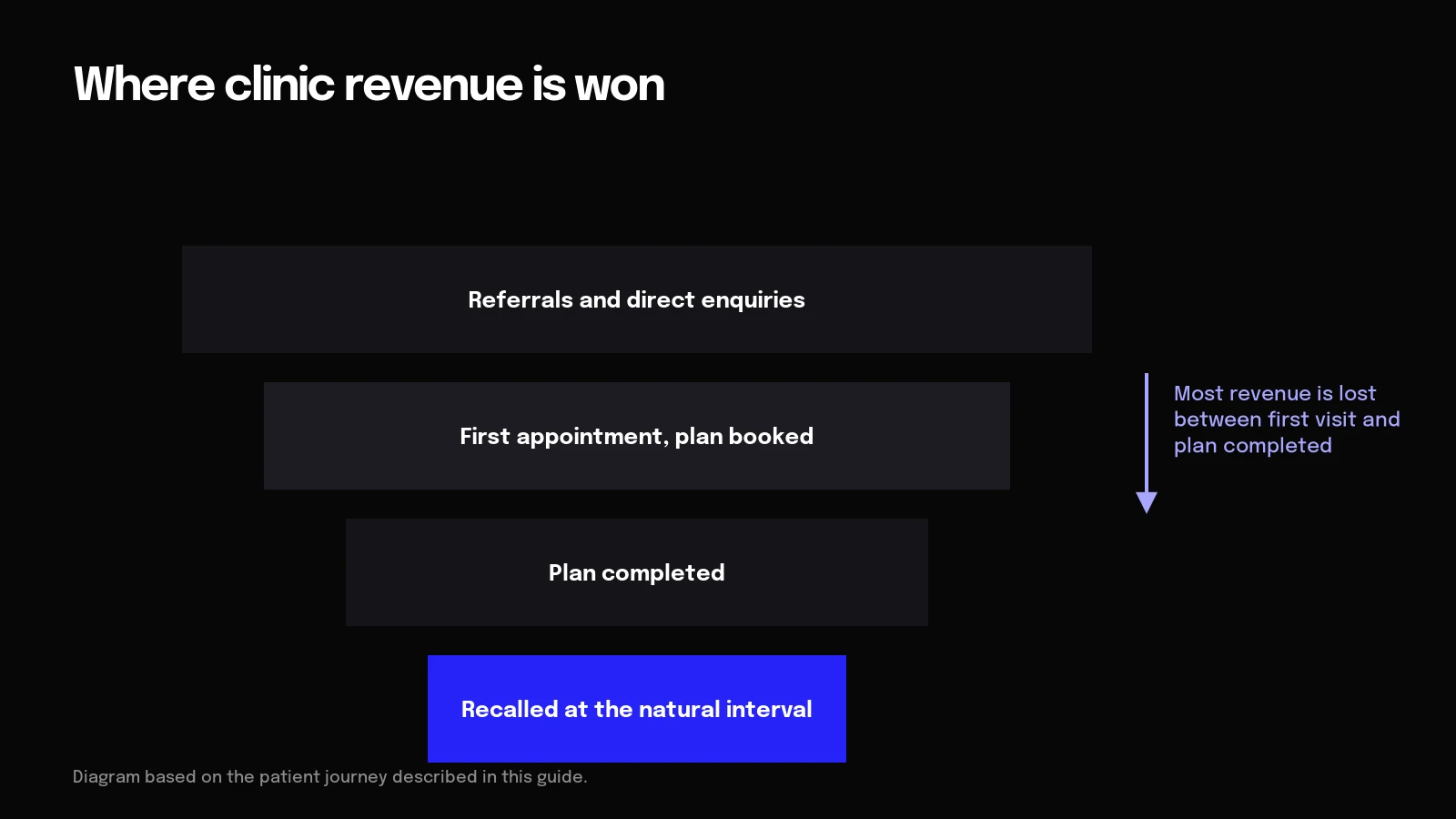
Good allied health marketing helps a clinic grow through two doors at once. One is referrers, such as GPs, who send patients your way. The other is patients who find you directly through Google and ads. Once patients arrive, the biggest opportunity lies in helping them finish their care plan and come back when they need you again.
This guide covers psychology, podiatry, dietetics, chiropractic, occupational therapy and similar clinics. For physiotherapy, see our dedicated physio marketing guide.
At a glance
- Build both lead sources: referrers and direct patients.
- Book the full care plan at the first appointment as a clinical recommendation.
- Lead with what is unique when approaching GPs: your niche, wait time and outcomes.
- Free up admin time first, then ask the team to run recall and reviews.
In this guide:
- Where allied health patients come from
- The three stages at a glance
- Small clinic (early stage): book the full plan, then build referrers
- Medium clinic (growth): recall flows and niche demand
- Large clinic or group: central intake, referrers and paid search
- Why the basics matter, and the easy way to do them
- Do Google Ads pay for allied health?
- What we recommend by profession
- Compliance checklist
Patients who finish their care plan, and GPs who know exactly what you do, are the engine of a growing clinic.
Where allied health patients come from
Before choosing where to spend your time, it helps to understand where patients usually come from. Most clinics draw them from four places: referrers, direct search, professional directories and Meta ads. Each works in a different way, as the table shows.
| Source | What works | Notes |
|---|---|---|
| GPs and other referrers | A one page sheet with what you see, wait times, fees and how to refer | Lead with what is unique |
| Direct search | Complete Google profile, online booking, condition pages | Stronger where a site serves a large population |
| Professional directories | Your profession’s “find a practitioner” listing | Results vary widely, so track what it brings |
| Meta ads | A clearly priced first assessment with terms stated | Good for demand creation in local areas |
The mix also varies by profession. In psychology, for example, demand often exceeds supply, so the opportunity lies in a clear niche and referral pathway rather than in attracting more enquiries.
The three stages at a glance
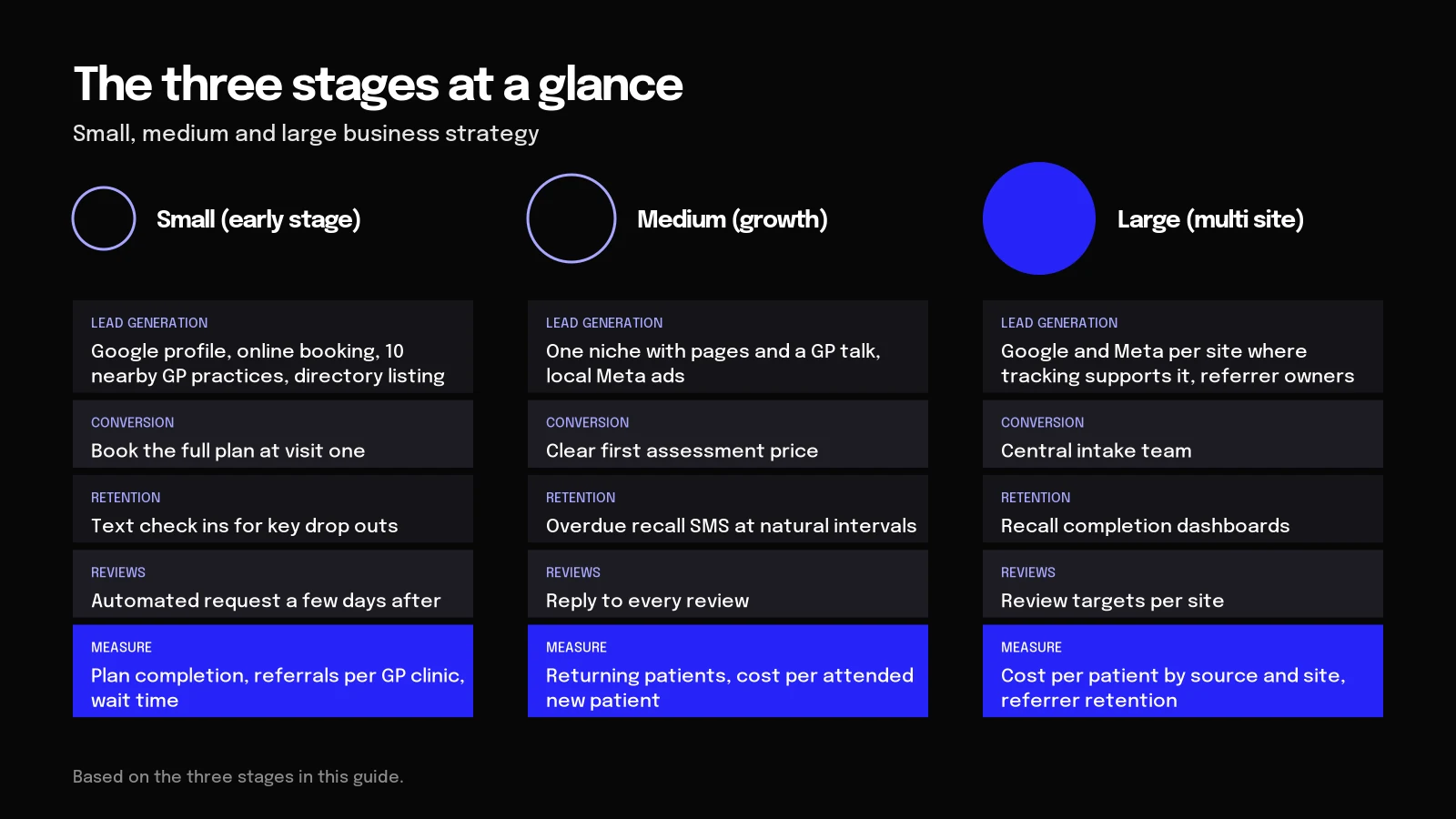
The table gives an overview of the three stages before we look at each one in turn. Each stage keeps what worked before and adds a little more structure.
| Small (early stage) | Medium (growth) | Large (multi site) | |
|---|---|---|---|
| Lead generation | Google profile, online booking, 10 nearby GP practices, directory listing | One niche with pages and a GP talk, local Meta ads | Google and Meta per site where tracking supports it, referrer owners |
| Conversion | Book the full plan at visit one | Clear first assessment price | Central intake team |
| Retention | Text check ins for key drop outs | Overdue recall SMS at natural intervals | Recall completion dashboards |
| Reviews | Automated request a few days after | Reply to every review | Review targets per site |
| Measure | Plan completion, referrals per GP clinic, wait time | Returning patients, cost per attended new patient | Cost per patient by source and site, referrer retention |
Small clinic (early stage): book the full plan, then build referrers
A small clinic does best when it makes it easy for both kinds of patient to reach it. For direct patients, that means completing your Google Business Profile and turning on online booking, the first steps in local SEO and a strong base for wider SEO. For referrers, it means visiting the practice managers at about 10 nearby GP clinics (our medical practice marketing guide shows how GP clinics think about referrals) with a one page sheet and a referral pad. A short script keeps the visit natural: “Hi, I’m [Name], the [profession] at [clinic] nearby. Here’s a one page sheet with what we see, our current wait time, fees and how to refer. Who’s the best person to send updates to?”
The way you approach GPs matters as much as the visit itself. GPs rarely have time for lunch sessions, so a sheet left with the practice manager usually works better than asking for a meeting. Lead with what makes you different, such as a niche, a short wait time or particular outcomes, because most GPs already have someone in mind for general referrals. It is also worth listing on your profession’s directory, such as the APS “Find a Psychologist” or Dietitians Australia “Find a Dietitian”, and tracking what each listing brings.
Once patients start arriving, conversion happens in the first appointment. Book the next visit before the patient leaves, and schedule the whole care plan at that first session. Afterwards, send the GP a one page report covering your working impression, the plan, the expected number of sessions and one line on how the GP can help. That report is often what earns the next referral.
Retention at this stage does not mean following up with everyone. Focus on post-op patients and those who were progressing well and suddenly stopped, and send them a friendly text to check in. Reviews can be largely automated, with requests sent about three days to a week after the visit, which is when BrightLocal’s 2025 survey finds people expect healthcare requests. To see what is working, measure plan completion rate, referrals per GP clinic and your current wait time.
Medium clinic (growth): recall flows and niche demand
Once referrers know who you are, a growing clinic gets the most from a clear specialty. Choose one niche, such as perinatal mental health, diabetic foot care or sports dietetics, then build web pages about it and a short talk for GP practices. Local Meta ads with a clearly priced first assessment, with the terms stated, add direct demand alongside referrals. It also pays to approach GP practices whose own books are closed, along with community programs and NGOs that refer clients on when their programs finish.
More enquiries are only useful if patients feel confident booking, so make the practical details easy to find. Show Medicare or health fund rebate information and telehealth options on every service page.
Recall then becomes a system rather than a task. Send recall SMS to overdue patients at the natural interval for each profession, for example around 30 days after discharge, then at 3, 6 and 12 months. A simple template works well: “Hi [Name], it’s [clinic]. It’s been [interval] since your last session for [reason]. [Practitioner] suggests a check in. Book here: [link] or reply and we’ll call.”
Reviews need the same steady attention. Reply to every review warmly, without confirming that anyone is a patient. At this stage, measure returning patients, cost per attended new patient and referrals by niche.
Large clinic or group: central intake, referrers and paid search
With several sites, a large clinic or group can run Google and Meta ads for each location, scaling them where tracked attended patients justify the spend. Ads are strongest where a site serves a large population. Referrers still matter at this size, so keep a referrer list for each clinic, give each referrer a named relationship owner and send a quarterly update on wait times.
Consistency becomes the main conversion goal. One booking team answering throughout business hours gives every patient the same experience across sites. Recall completion dashboards by practitioner and site then show where patients are slipping away, and review targets and reply standards apply to every site. Measure attended new patients and cost per patient by source and site, along with referrer retention and recall completion.
Why the basics matter, and the easy way to do them
At every stage, the same basics decide whether a clinic grows: booking the plan, following up and recall. Yet clinicians are fully booked, and many understandably dislike anything that feels like chasing patients. A full day of back to back sessions leaves little time for follow up.
Even so, the basics are worth protecting. Plan completion and recall determine whether a new patient is profitable, as the economics worked example in our hub guide shows. Patients also notice when nobody follows up after they stop, and a simple, caring message is often welcome.
The practical obstacle is usually admin. Small clinics lose hours to chasing unpaid invoices, rescheduling around sick days and entering the same data into several systems. The answer is to free up that time first. Add a payment link to the SMS confirmation and turn on automatic overdue reminders in your accounting software.
With that time back, the team can focus on the habits that keep patients. Book the plan at visit one, automate recall SMS and give reception a weekly list of patients who have not rebooked. A text usually gets a better response than a phone call.
Tip: Frame plan booking as a clinical recommendation: “To get the result we talked about, I’d like to see you weekly for four weeks. Let’s lock those in now so you get the times you want.”
Do Google Ads pay for allied health?
Once plan completion and recall are in place, advertising becomes much easier to justify, because Google Ads usually pay only across a full care plan. With plan completion in place, focused Google Ads management can turn that maths in your favour. Single sessions earn modest gross profit. Quinn Marketing’s keyword research estimates about $9 a click for “counseling services” and “mental health services”, and $6.45 for “chiropractor near me” (AUD, October 2024, so check locally). In the US, LocaliQ’s healthcare benchmarks put the median cost per lead at $141.17 for mental health and $32.79 for physical therapy.
You can run your own numbers with the Google Ads vs Meta economics section of our hub guide, and our complete guide to Google Ads and guide to Facebook and Meta ads cover each platform.
Organic search offers a slower but lasting alternative. Allied health SEO is mostly a contest of volume, with many clinics competing in each area, so condition and suburb pages plus steady reviews usually move results in about six months. Our guide to what SEO is and how it works explains the basics, and our guide to the 7Ps of marketing shows how people, process and price fit together in a clinic.
What we recommend by profession
The principles above apply across allied health, but a few points are worth adding for specific professions. For psychologists, one of the best ways to start is an in-service at the local community mental health team, with a clear and easy referral pathway. Pair it with regular contact with GP practice managers. Professional directories can be worth trying, but results vary widely, so track what each listing brings before you renew it.
For chiropractors and other clinics with ongoing care, retention depends on earning the next visit every time. When patients tend to leave as soon as the pain is gone, the answer usually lies in the first appointment, where you explain what the full plan achieves. Newsletters and birthday emails can help you keep in touch, and they work best alongside personal recall messages rather than in place of them.
Compliance checklist
All of this marketing sits within the health advertising rules, so it is worth checking each campaign before it goes live.
- Follow the AHPRA advertising rules. The Medical Board page on advertising a regulated health service explains the limits, and section 133 of the National Law sets them out.
- Do not use clinical testimonials, including reposted reviews. Use the AHPRA testimonial tool to check.
- Penalties can reach $60,000 for individuals and $120,000 for bodies corporate per offence. The rules also apply to agencies.
- Do not offer gifts or inducements to referrers, and make sure offers do not encourage unnecessary treatment.
- Recall messages must meet the Spam Act and the Privacy Act.
- Some professions, such as dietitians, are self regulated rather than AHPRA registered, but Australian Consumer Law still applies.
This guide is general information, not legal or clinical advice. Check your profession’s advertising rules before you advertise.
If you’d like help building referrers and keeping patients through their full care plan, talk to us or email hello@thedigitalmarketingconsultants.com.au. We’ll point you to the quickest wins for your clinic.