
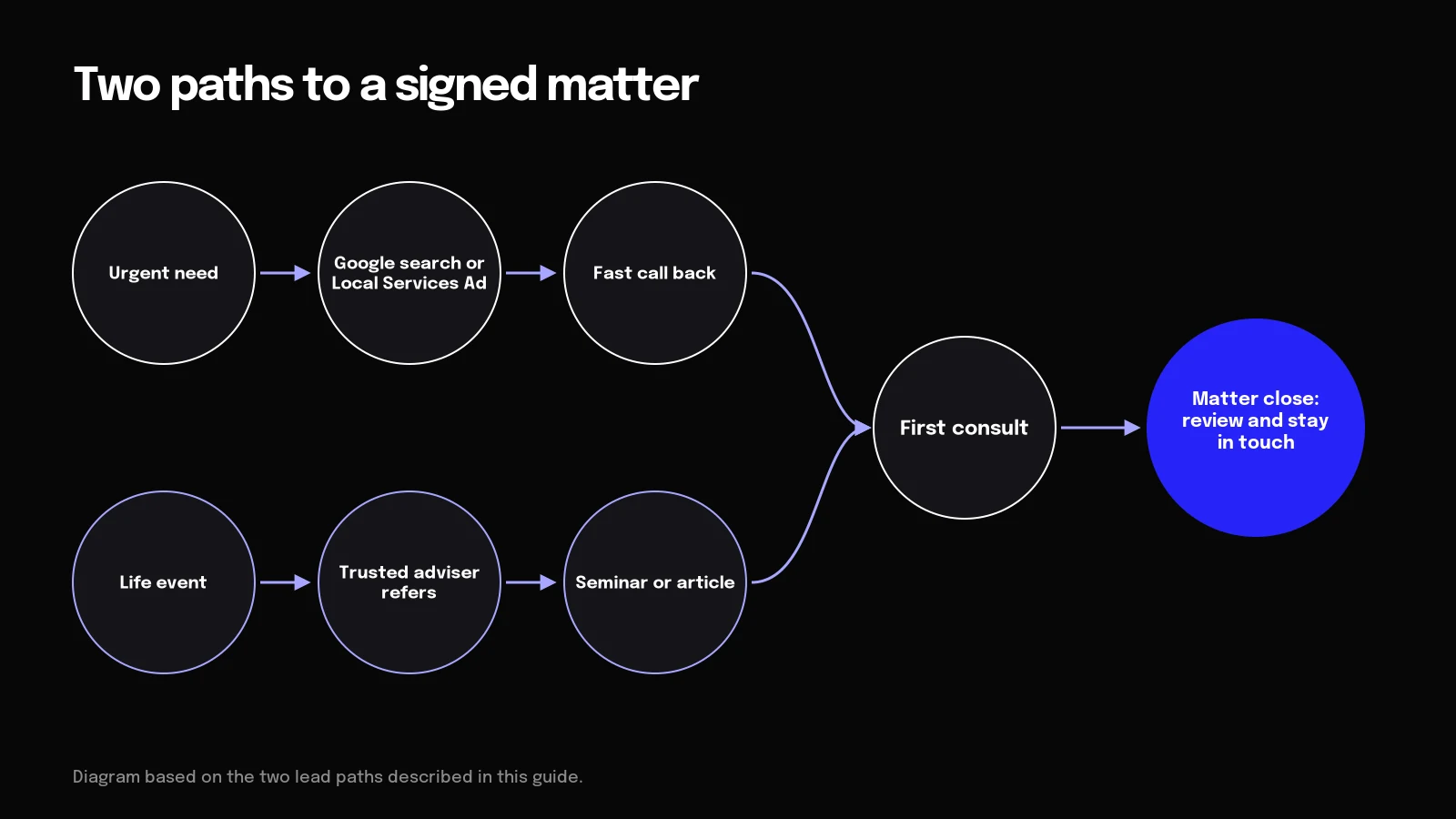
Every law firm needs a steady flow of new enquiries, but where they come from depends on the kind of law you practise. A person who has just been charged or injured usually searches for a lawyer straight away, while a person who needs a will is more likely to ask someone they trust.
That difference is the thread running through this guide to law firm marketing. Once you understand how your clients look for you, choosing a channel becomes much simpler, and the rest of your marketing can grow from that choice in stages.
At a glance
- Match your main lead source to your practice area.
- Urgent matters: Google search and Local Services Ads on tight, exact terms.
- Estate, property and commercial: referral partners, seminars and a personal brand.
- Answer every enquiry fast, check in with past clients and ask for a review at matter close.
In this guide:
- Which channel suits your practice area?
- The three stages at a glance
- Small firm (early stage): a lead source that fits your practice area, plus a referral engine
- Medium firm (growth): personal brand, content and search
- Large firm: practice area profit and loss and partner led thought leadership
- Why the basics matter, and the easy way to do them
- Do Google Ads pay for law firms?
- SEO for lawyers
- Building a personal brand as a lawyer
- Compliance checklist
Match your channel to how clients look for you: search for urgent matters, trusted referrers for planned ones.
Which channel suits your practice area?
The most useful question to ask about any practice area is whether your future client is already looking for a lawyer. If they are, Google search and Local Services Ads put you in front of them at the moment they need help. Criminal, family and personal injury work follows this pattern, because people search as soon as the problem arrives.
If they are not yet looking, the work shifts to people and reputation. Clients with estate, property and commercial matters rarely search in a hurry. They ask their financial adviser or accountant, and go to the lawyer that person recommends. In these areas, referral partners, seminars and a personal brand do far more than any ad.
Larger matters, such as a separation or a commercial dispute, combine both patterns. Clients often search early and then take months to decide, so search brings them in while content and retargeting over 6 to 12 months keep you in mind.
The table below brings these patterns together by practice area.
| Practice area | Main lead source | Why |
|---|---|---|
| Criminal, family, personal injury | Google search and Local Services Ads | People search the moment they need help |
| Wills and estates | Financial advisers, accountants, seminars | Clients rarely search urgently, and trusted advisers refer |
| Property and commercial | Referrers such as accountants and brokers | Clients ask people they already trust |
| Large matters (separation, disputes) | Search plus 6 to 12 months of content and retargeting | Slow decisions that need a steady presence |
Retention follows the same logic. In law, it means staying in touch, so past clients return at their next life event and recommend you to friends. With that foundation in place, we can look at how the plan grows with your firm.
The three stages at a glance
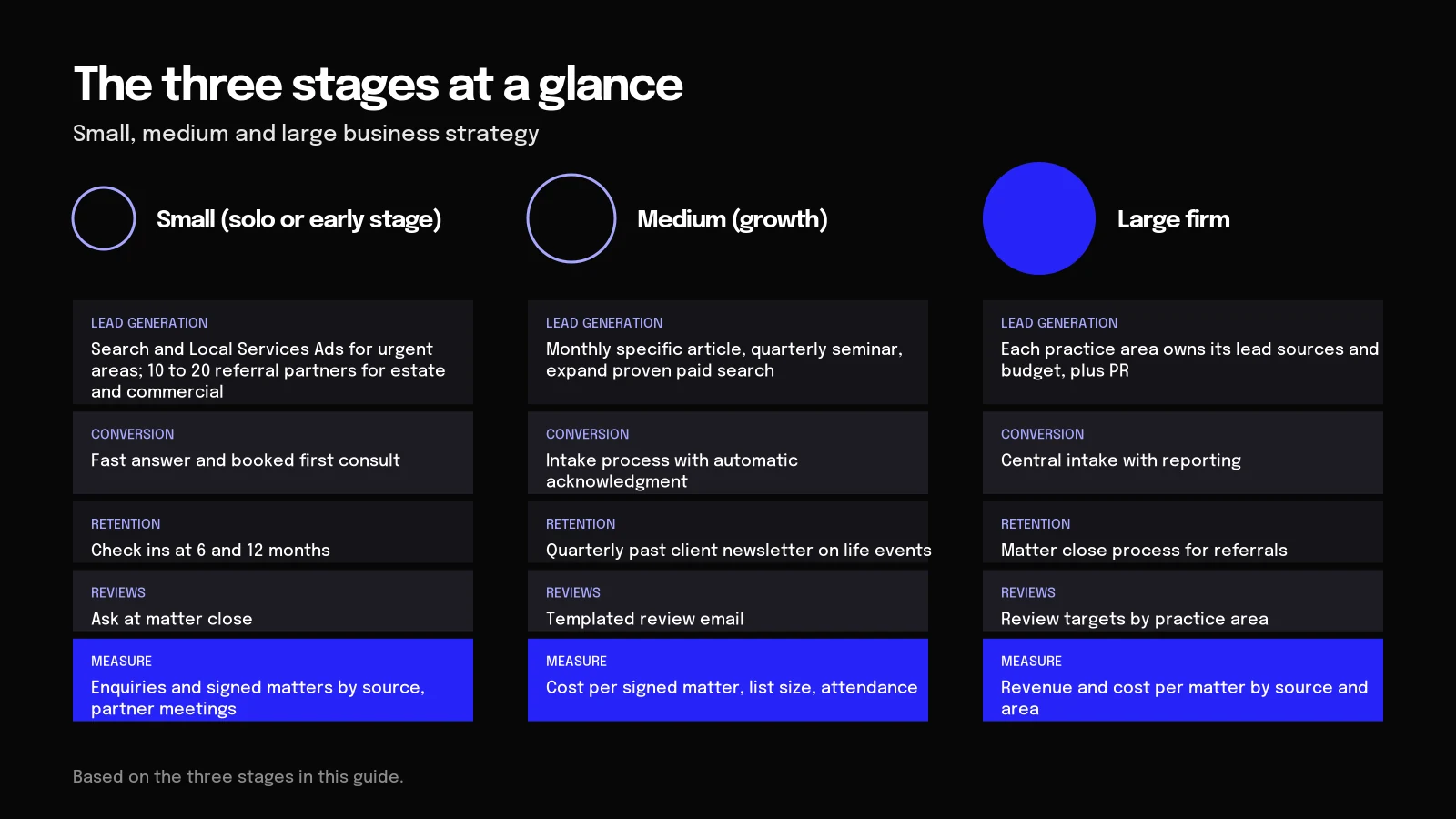
The table gives an overview of the three stages before we look at each one in turn. As you read across, notice that each stage keeps what worked before and adds a little more structure.
| Small (solo or early stage) | Medium (growth) | Large firm | |
|---|---|---|---|
| Lead generation | Search and Local Services Ads for urgent areas; 10 to 20 referral partners for estate and commercial | Monthly specific article, quarterly seminar, expand proven paid search | Each practice area owns its lead sources and budget, plus PR |
| Conversion | Fast answer and booked first consult | Intake process with automatic acknowledgement | Central intake with reporting |
| Retention | Check ins at 6 and 12 months | Quarterly past client newsletter on life events | Matter close process for referrals |
| Reviews | Ask at matter close | Templated review email | Review targets by practice area |
| Measure | Enquiries and signed matters by source, partner meetings | Cost per signed matter, list size, attendance | Revenue and cost per matter by source and area |
Small firm (early stage): a lead source that fits your practice area, plus a referral engine
A small firm has limited time, so it does best when it focuses on the one lead source that suits its practice area. For urgent consumer work, that means completing your Google Business Profile, setting up Local Services Ads and running search ads on exact terms from day one. Keep the targeting tight until you can see which searches sign matters, because broad and phrase match keywords tend to use up a legal budget quickly.
For estate, property and commercial work, the engine is referrals. We suggest listing 10 to 20 professionals who serve the same clients as you, then meeting them regularly with a simple outreach goal. Financial advisers are often the strongest source for estate work, and a useful update each month keeps you in mind between meetings.
Whichever source you choose, enquiries only become clients when you respond well. At this stage, that comes down to speed and clarity. Answer or return every call quickly, and book the first consult while the person is on the phone. Web enquiries should receive an automatic reply that explains the next step.
The same care continues after the matter closes. Checking in at 6 and 12 months keeps you in mind for the client’s next life event, and a review link in your closing email makes it easy for happy clients to say so. To see what is working, track enquiries and signed matters by source, partner meetings held and referrals by partner.
Medium firm (growth): personal brand, content and search
Once a firm has a reliable lead source and a circle of referral partners, it can invest in something that grows in value over time: its reputation. A good place to start is a monthly article that answers a real client question, such as “how long does probate take in WA”. An answer like this helps people who search, and gives your referral partners something to share.
Seminars bring the same idea into the room. A quarterly talk with a referral partner introduces you to their clients with that partner’s trust behind you, and collecting email addresses at the event builds your list.
As your reputation grows, paid channels can grow alongside it, provided each one earns its place. Expand search or Local Services Ads wherever the cost per signed matter holds up. Meta and YouTube are worth a small test for clients who do not yet know they need a lawyer, although results vary widely. Check placements too, because Instagram can show ads to suggested audiences outside your area.
More enquiries call for a clearer intake process. Decide who answers, how quickly they respond and what a first consult costs. Our guide to the 7Ps of marketing explains how people and process shape a client’s first experience of your firm.
Retention can now become a regular habit too. A quarterly newsletter built around life events, such as marriage, separation, a new child or buying a business, reminds past clients that you can help with what comes next. A templated matter close email with your review link keeps reviews coming in. At this stage, measure enquiries by source, list size, event attendance and, above all, cost per signed matter.
Large firm: practice area profit and loss and partner led thought leadership
As a firm grows, one marketing plan can no longer suit every team. That is why we recommend giving each practice area its own lead sources and budget. When each area sees its own results, it becomes clear where the next dollar should go.
That clarity lets each channel play to its strengths. Paid search can run at scale for consumer practice areas where tracking supports it, while media commentary and PR showcase your partners’ expertise. For high value matters, retargeting over 6 to 12 months keeps the firm visible through a long decision.
Consistency matters more at this size, so central intake with call recording and reporting by practice area keeps conversion steady. A matter close process then asks every client for a review and a referral, and adds them to the newsletter. Measure revenue and cost per matter by source, along with your repeat client rate.
Why the basics matter, and the easy way to do them
A plan is only useful if there is time to carry it out. Lawyers bill their time, so every hour of marketing has a real cost, and many would rather avoid networking and selling altogether. That is completely understandable.
Even so, the basics repay the effort, and speed is the clearest example. Harvard Business Review research, as summarised by Rework, found that firms that tried to contact a web lead within an hour were nearly seven times as likely to qualify it as those that waited longer.
Referral networking repays the effort too, although more slowly. It works best as a routine: identify partners, set an outreach goal, book meetings and follow up.
Fortunately, neither habit needs much of your own time. A receptionist or intake service can book first consults, referral meetings can sit in your calendar as a recurring block, and your newsletter can grow from the questions you already answer each week.
Tip: Keep a running list of the questions clients ask you each week. It becomes your article plan, your newsletter and your seminar topics.
Do Google Ads pay for law firms?
Because Google charges for every click, the cost of that click deserves a closer look. For urgent, high value matters, Google Ads can pay well, especially with careful Google Ads management. Quinn Marketing’s keyword research estimates about $40 a click for “lawyer near me”, $35 for “family lawyer”, $42 for “criminal defense lawyer” and $25 for “estate planning lawyer” (AUD, October 2024, so check current prices locally). In the US, WordStream reports a Google cost per lead of $131.63 for legal services, compared with $18.17 on Meta, although Meta leads usually come earlier in the decision.
These prices show why your practice area matters so much. At $25 to $40 a click, winning a simple will client can cost more than the fee, while an injury, family or criminal matter can carry that cost comfortably. Our Google Ads vs Meta economics worked example lets you test the numbers for your own firm, and our complete guide to Google Ads and guide to Facebook and Meta ads explain each platform in depth.
SEO for lawyers
Paid search buys visibility today, while SEO builds visibility you own over time. In law, the challenge is the strength of the competition, because established firms hold years of content and links. The opportunity for a smaller firm lies in very specific question pages that those firms have not written, and that focus sits at the heart of our SEO services.
That means writing for the exact question a client asks, such as “how long does probate take in WA” or “what happens to a family business in a divorce”. Build one page for each practice area, and one for each region where you genuinely work. Naming the lawyer behind each article also builds trust.
As with every channel, how much SEO pays depends on your practice area. In business and property law, where clients usually ask someone they trust, content written for your referrers often works better than content written for clients. Our guide to what SEO is and how it works covers the basics.
Building a personal brand as a lawyer
In practice areas that run on referrals, your personal brand does the job that search does elsewhere. A personal brand simply means being known for one thing by one group, such as “the lawyer accountants send their small business clients to”. Once you have chosen both, speak at their events, write for their newsletters and post a short explainer each week.
Specialising makes this easier. Simple wills are a crowded market, while niches such as special needs trusts or guardianship give you something distinctive to be known for. And because estate planning clients often wait months before acting, staying in touch matters as much as the first meeting.
Compliance checklist
All of this marketing sits within the rules on how lawyers advertise, so it is worth checking each campaign against them before it goes live.
- Follow Rule 36 of the Australian Solicitors’ Conduct Rules on advertising. The Queensland Law Society summary explains it clearly, and you can read the rule on AustLII.
- Western Australia has been under the Legal Profession Uniform Law since 1 July 2022.
- Principals are responsible for website content, as the Law Society Journal explains.
- Protect client confidentiality and avoid comparisons with named practitioners (LIV guidance).
- Check referral arrangements against the conduct rules, check your state’s limits on personal injury advertising, and follow the Spam Act for newsletters.
This guide is general information, not legal advice. Check the conduct rules that apply in your state before advertising.
Want a clear plan for winning more of the right matters? Contact us or email hello@thedigitalmarketingconsultants.com.au and we’ll map out the opportunities for your firm.