Most households don’t decide to cut back. The decision is made for them by the bills that can’t be avoided. In the year to August 2026, the ABS found prices of non-discretionary items rose 4.7% while discretionary items rose 3.0%. Automotive fuel was up 13.5% and electricity 13.2%. Add mortgage rates that have risen four times this year, and the money left over for everything else shrinks.

At a glance
Rising essential costs are quietly deciding where household money goes. This article tracks the shift toward smaller purchases, clear value, fast food, closer trips and health, plus who is cutting back and who is winning. It helps business owners work out where they sit and how to position their offer.
Working out where your business sits in that shift is a sensible first step, and a common one in consulting sessions with owners.
Essentials take a bigger bite
CommBank’s card data shows the result. In August, spending on essentials grew 4.8% over the year and overtook discretionary spending, which grew 3.3%. Petrol station spending rose 3.4% in a single month.
It’s important to see what this means. Much of the “extra” spending in the headline numbers isn’t extra at all. It’s the same household paying more for fuel, power and insurance. What’s left is spent more carefully, and that’s where the opportunities are.
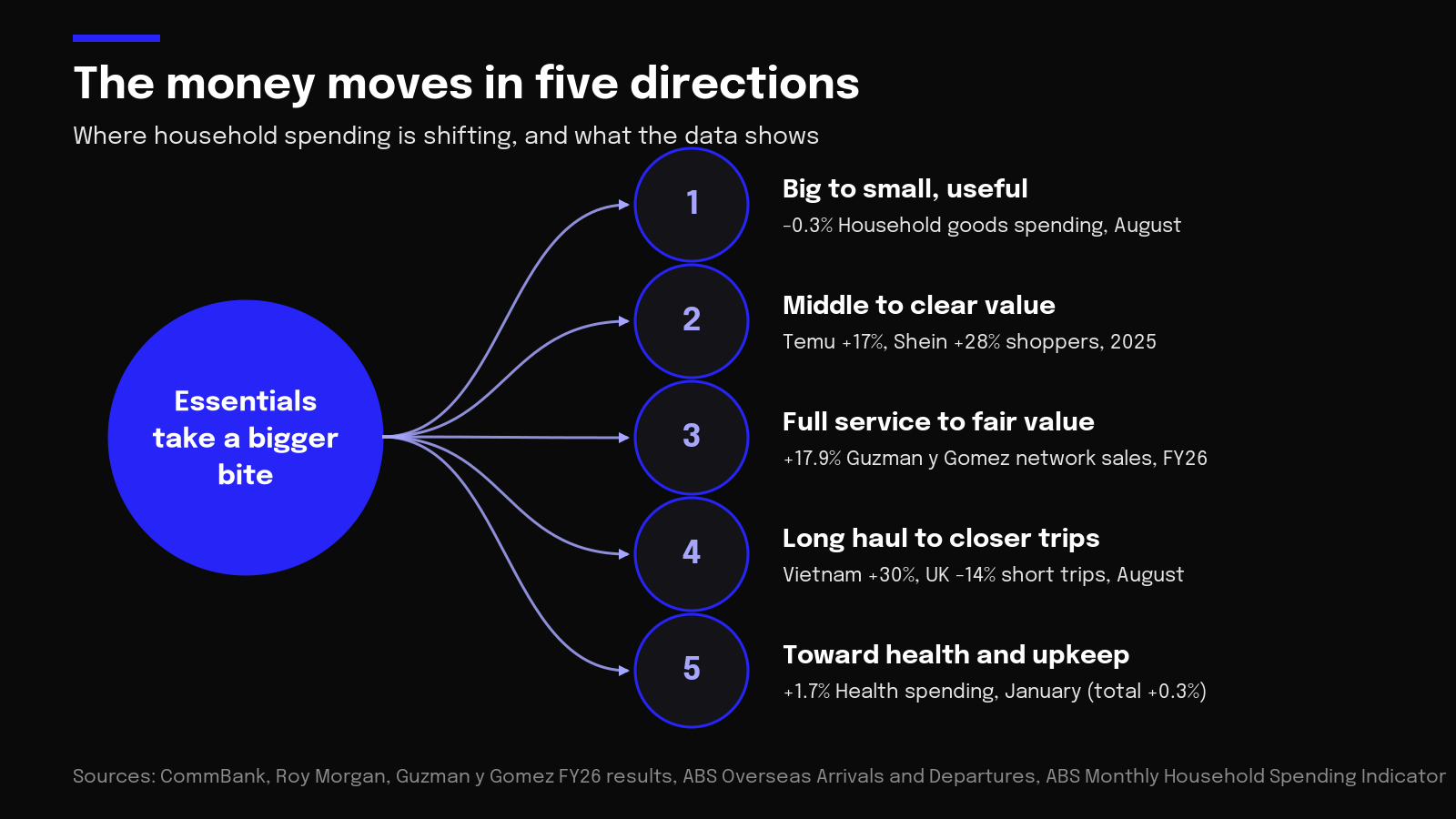
The money moves in five directions
From big purchases to smaller, useful ones
The first thing to go is the large, postponable purchase. CommBank found household goods spending fell 0.3% in August, and its economists noted this is “generally the first area we expect to see a pullback”. The Westpac-Melbourne Institute’s “time to buy a major household item” index sat at 83 in October, a full 40 points below its long-run average.
People still buy. They just buy smaller and more practical. Clothing and shoes top this year’s Christmas gift plans at a record 51% in the Retail Safari and Swinburne University survey, while experiences fell nine points to 33%.
From the middle of the market to clear value
Roy Morgan’s shopper data for 2025 shows shoppers moving to the ends of the market. Kmart grew its shopper numbers 3% and Bunnings 2%. Temu reached 5 million Australian shoppers (up 17%) and Shein 2.9 million (up 28%). Mid-tier department stores and some long-established online retailers lost shoppers. Roy Morgan’s Catherine Jolley summed it up: retailers need “to either compete decisively on value or clearly differentiate through experience, brand, quality or exclusivity”.
From full-service dining to fast, fair-value food
Eating out is a classic cut-back, but the money doesn’t all disappear. Some of it moves to formats that feel like good value. Guzman y Gomez reported Australian network sales up 17.9% in FY26, with transaction growth outpacing comparable sales growth of 5.3%. It deliberately kept “menu price growth well below the level of cost growth”. In plain terms, more people came more often because the price felt fair.
From long-haul holidays to shorter, closer trips
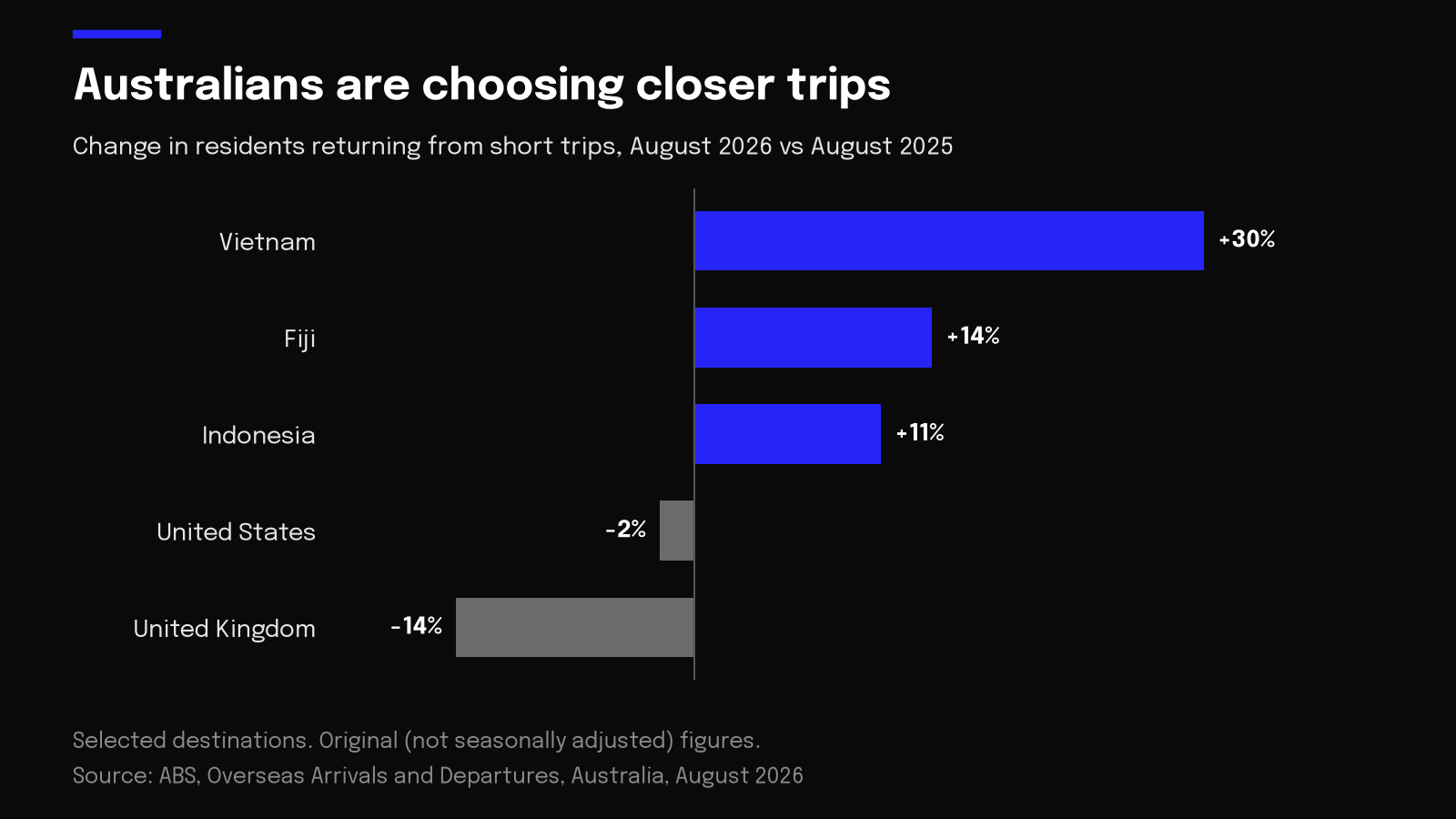
Travel shows the same pattern. In August 2026, ABS figures show Australians returning from short trips to Vietnam rose 30% on a year earlier, Fiji 14% and Indonesia 11%, while returns from the United Kingdom fell 14% and from the United States 2%. Australians haven’t stopped travelling. More of them are choosing shorter, closer destinations where their money goes further.
Toward health and upkeep
Some spending holds firm because it can’t wait, or because people see it as protecting what they already have. In January this year, ABS data showed health spending rose 1.7% in a month when overall spending rose 0.3%, and spending on services rose 1.0%, helped by health and vehicle repairs and maintenance. APRA reports that 45.8% of Australians held private hospital cover at 30 June 2026, with the number of people covered still rising.
Who is doing the cutting
It’s tempting to picture “the squeezed household” as one type of person. The reality is more uneven.
Mortgage holders
Households with a mortgage carry the direct cost of rate rises. The RBA estimates about 35% of households are mortgagors, and that households aged 30 to 54 take the biggest hit to their cash flow. These are the families most likely to be trading down on groceries, dining and gifts.
Renters and outright owners
Renters face rising rents, but rate rises themselves have little direct effect on their cash flow. Outright owners, about a third of households and mostly older, typically gain a little from higher deposit rates.
Regional differences
Region matters too. Western Australia’s unemployment rate was 4.2% in September, below the national 4.7% and the rates in NSW (4.7%), Victoria (5.1%) and Queensland (4.5%), and short-term overseas trips by WA residents were up 4.7% in August while those from NSW and Victoria were slightly down. WA households are still careful, but a larger share have room to keep spending.
The US pattern
In the United States, the pattern is similar but sharper. Adobe found that between 1 November and 1 December 2025, strong discounts encouraged shoppers to trade up, and the share of units sold for the most expensive goods rose 19%. Comfortable households buy premium products when the price is right, while stretched households trade down.
Who is winning
Put these shifts together and a clear picture forms of the businesses doing well:
- Value leaders with a clear promise. Shoppers know exactly what they’ll get and what it will cost.
- Specialists with a reason to exist. Businesses that offer expertise, quality or service that a mass retailer or marketplace can’t copy.
- Fast, fair-priced formats. In food, retail and services, the “good enough, done well” option is attracting customers who used to spend more.
- Nearby and short-stay options. Short-haul travel, local leisure, day trips and weekend activities.
- Maintenance, repair and health. Anything that protects what people already own or keeps them well.
The businesses finding it hardest are those caught in the middle: not the cheapest, not clearly the best, and without a story about why they’re worth it.
Our look at where shoppers are still spending this Christmas applies the same pattern to the festive season, and if you’re competing on quality rather than price, our guide to raising prices without losing your best customers is a useful companion. For the economic forces behind this, see which customers are still spending after the 2026 rate rises.
What to do now
- Decide which end of the market you’re competing at, and make it obvious in your messaging. Either be clearly good value, or clearly better.
- Offer a smaller, lower-priced entry point (a starter kit, a smaller size, a first visit) so customers who are cutting back can still say yes.
- Reframe discretionary products as useful, durable or money-saving where that’s genuinely true.
- Promote maintenance, servicing and upkeep. “Look after what you’ve got” is a message that suits the mood.
- Target your advertising by life stage. Mortgage-age families respond to value, while older outright owners respond to quality and service.
- If you’re in travel or leisure, lean into short, nearby and good-value options rather than long, expensive ones.
Choosing which end of the market to compete at is a core part of any marketing strategy.
For help working out where your business sits as customer spending shifts, contact us or email hello@thedigitalmarketingconsultants.com.au.