
On paper, this should be a gloomy Christmas. The Reserve Bank lifted the cash rate to 4.60% in September, its fourth rise this year. Annual inflation reached 4.0% in August, with automotive fuel up 13.5% and electricity up 13.2% over the year. The Westpac-Melbourne Institute consumer sentiment index fell to 80.4 in October, and to just 67.2 among people surveyed after the September rate decision. Anything below 100 means pessimists outnumber optimists.

At a glance
Australian households are cautious heading into Christmas 2026, but they’re still spending, just more carefully. We look at what people plan to spend, who is under the most pressure, which gifts are rising or falling and how they’ll shop. Retailers and service businesses can use it to plan a sharper Christmas campaign.
- Households are cautious but still spending, just more deliberately.
- Gift budgets are up about 5%, but barely in real terms.
- Families aged 35 to 54 have the biggest budgets and the most pressure.
- Lasting gifts are up while experiences and gift cards are down.
- Most shoppers will buy early and mix online with in-store.
Reading the season correctly is where good Christmas marketing starts, and retailers and service businesses often raise it with our consulting team.
The big picture: cautious, but still spending
Yet the spending figures tell a more nuanced story. ABS data shows household spending in August 2026 was 6.8% higher than a year earlier, even though it was flat for the month. Some of that is simply higher prices. But it also shows that households are still spending. They’re being more deliberate about where.
The clearest signal of that shift comes from CommBank’s card data for August, where spending on essentials grew 4.8% over the year and overtook discretionary spending, which grew 3.3%. Household goods fell 0.3% in the month, which CommBank’s economists noted is “generally the first area we expect to see a pullback”.
What Australians say they’ll spend
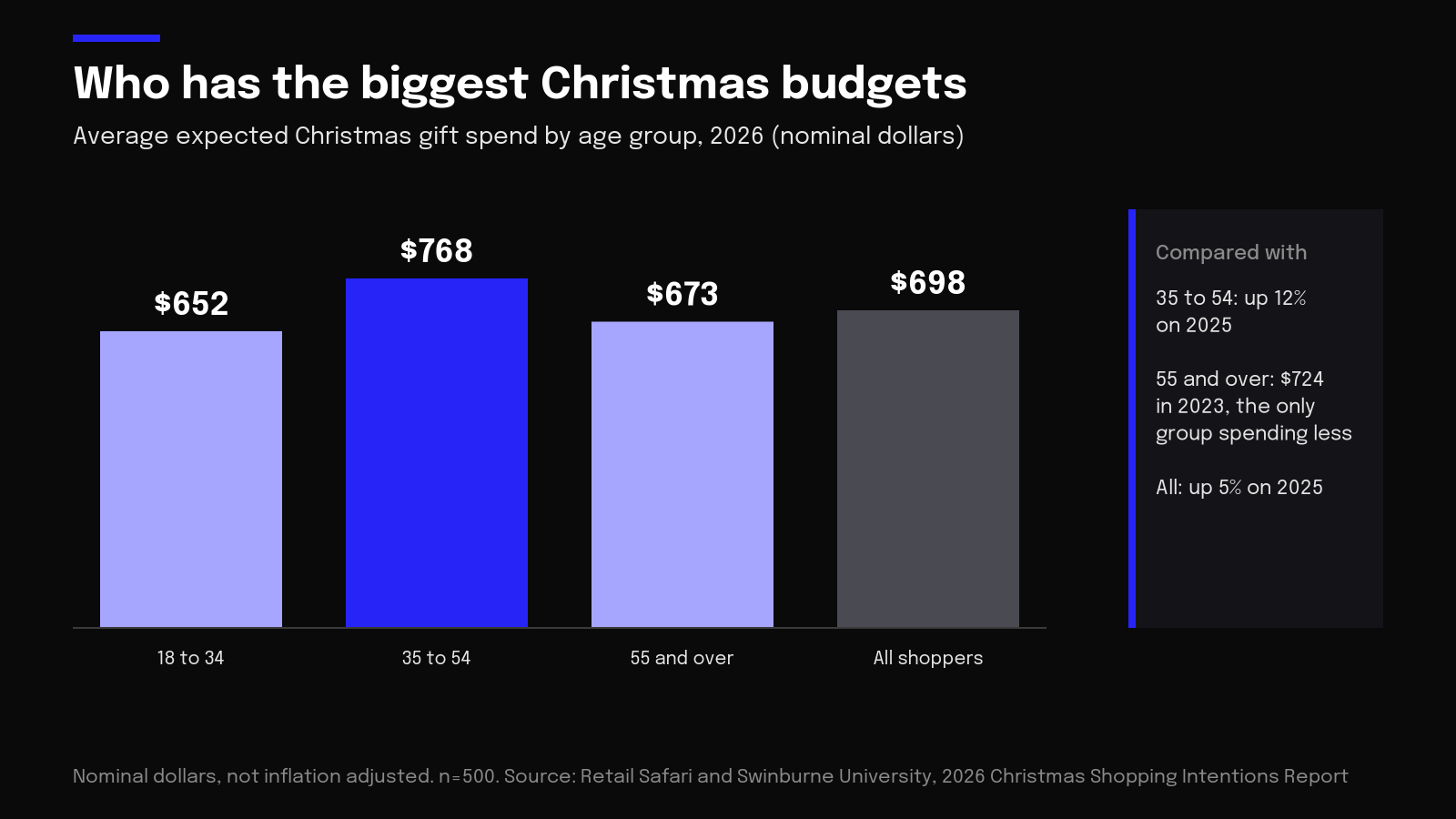
The 2026 Christmas Shopping Intentions report from Retail Safari and Swinburne University surveyed 500 gift shoppers in late July and early August. More than a third (35%) plan to spend more on gifts than last year, the highest share since 2016. The share planning to spend less was steady at 22%. The average expected gift budget rose 5% to $698.
Two cautions are worth keeping in mind. First, the survey was taken before the September rate rise, so treat it as a best case. Second, once inflation is taken into account, the average budget is up less than 1% on last year. In other words, people intend to keep Christmas about the same size in real terms. They aren’t planning to cut it, but they aren’t planning a splurge either.
Not everyone is in the same position
Averages hide very different households, and this is where it gets useful for marketing.
| Group | Average gift budget | What they respond to |
|---|---|---|
| Families aged 35 to 54 | $768, up 12% | Comparison, sales and gifts that will last |
| Shoppers aged 18 to 34 | $652, the lowest of the three | More, smaller purchases, often online and during sales events |
| Shoppers aged 55 and over | $673, steady | Quality, service and convenience more than countdown timers |
Families aged 35 to 54
This group is split down the middle. They have the highest average gift budget, $768, up 12% on last year, yet they are also the most likely to spend less (31%). Cost of living ranks as a top-three influence for 70% of them. This is the group most likely to have a mortgage, school costs and children’s gift lists all at once. Many will still spend, but they’ll compare harder, buy on sale and want to know that what they buy will last.
Younger shoppers
Almost half of 18 to 34-year-olds (45%) plan to spend more this year. Their average budget, $652, is the lowest of the three age groups, so the extra spending tends to be spread across more, smaller purchases, often bought online and during sales events.
Shoppers aged 55 and over
Most plan to spend about the same as last year (55%). Their average budget held steady at $673, and they’re the only group spending less on average than in 2023 ($724). They’re also the least likely to plan around sales events. For many retailers, this is a steady, less deal-driven audience that responds to quality, service and convenience more than countdown timers.
Where people live
Western Australia continues to outperform. Australia Post found WA online spending grew 18% in 2025 to $9.1 billion, the fastest of any state, ahead of Queensland (15%) and NSW and Victoria (13% each). WA’s unemployment rate was 4.2% in September, against 4.7% nationally, 4.7% in NSW, 5.1% in Victoria and 4.5% in Queensland. WA customers aren’t immune to rate rises, but a stronger jobs market gives more households the confidence to keep spending.
What’s on the list, and what’s dropping off
The gift categories show the “lasting value” mindset clearly. Clothing and shoes top Christmas gift plans at a record 51%, followed by toys (44%), books (43%), cosmetics (42%) and electronics (41%). Toys, cosmetics and electronics each rose about five points.
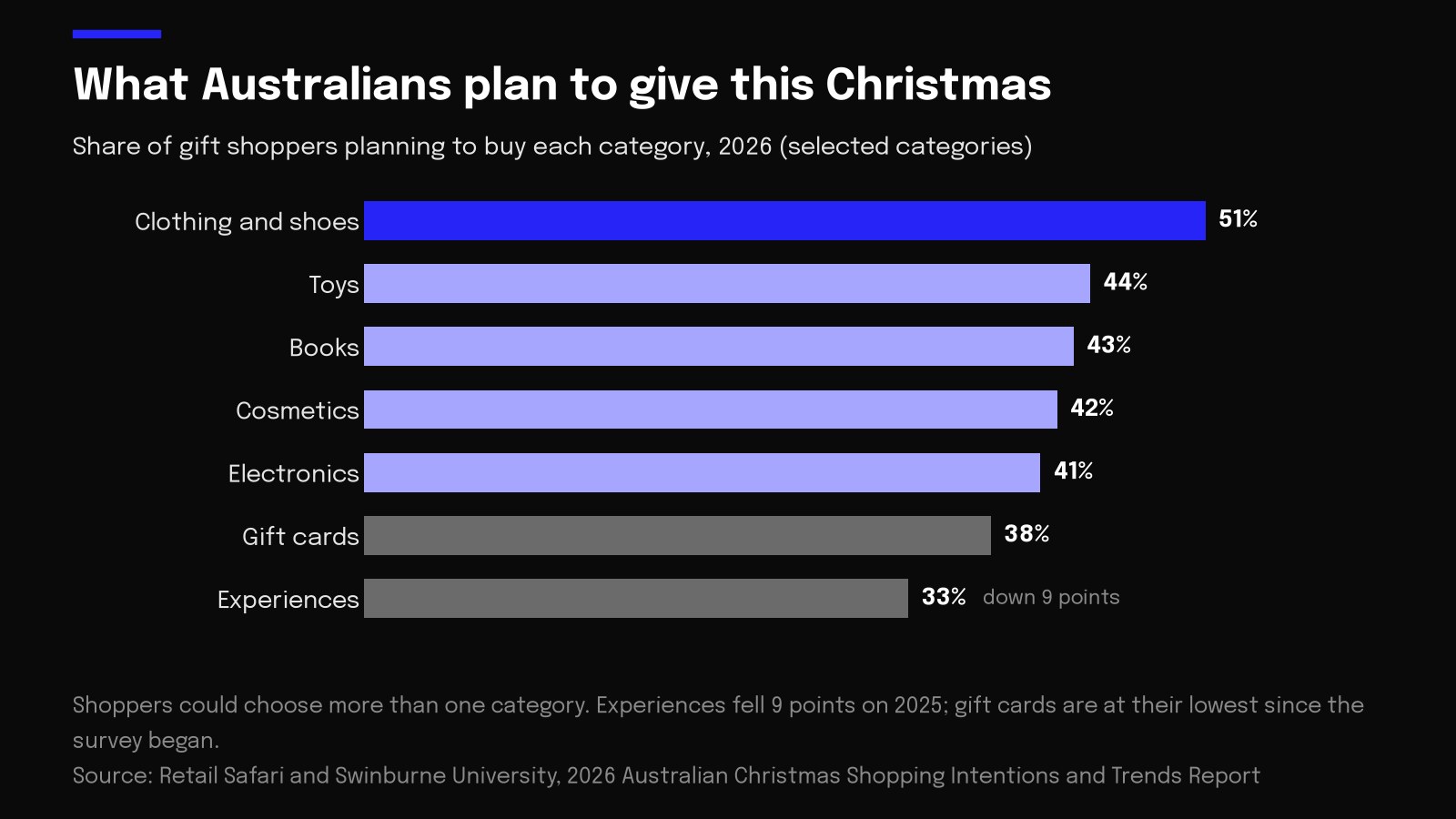
Two categories fell. Experiences dropped nine points to 33%, the largest fall of any gift type, which the researchers suggest reflects a shift “towards gifts that last rather than short-duration experiences”. Gift cards fell to eighth place (38%), their lowest result since the survey began, after ranking first in seven of the eight years from 2016 to 2023.
The second-order effect is worth thinking through. If fewer people buy experience gifts and gift cards, businesses that rely on them (day spas, restaurants, adventure tourism, some clinics) can’t simply wait for Christmas demand to arrive. They’ll need to package their offer as something tangible, give it a clear price and make it easy to give.
How people will shop
Most shoppers will mix channels. The report found 88% plan to buy gifts both online and in physical stores. Online marketplaces (66%) and department stores (58%) are the most popular formats. Six in ten shoppers say they’re more likely to buy Christmas gifts from local rather than overseas retailers during Cyber Weekend, up six points on last year.
Timing is earlier than ever. 71% plan to do most of their gift shopping before December, and late November remains the busiest single period.
That makes delivery deadlines a real selling point. Australia Post’s 2026 Christmas sending dates show Parcel Post between metro areas in different states needs to be sent by Monday 21 December, and within the same state by Tuesday 22 December. Routes into and out of WA close earlier: Friday 18 December for most routes and Thursday 17 December to and from Queensland, with Tasmania and the Northern Territory earlier still. Australia Post delivered almost 111 million parcels in November and December last year, so expect pressure on every network.
The US picture
For businesses selling into the United States, the forecasts are firmer. The National Retail Federation expects November and December retail sales to grow 4.2% to more than US$1 trillion, and Adobe forecasts record US online holiday spending of US$275.1 billion, up 6.7%. The same split by income seen in Australia applies there too: value-focused buyers and comfortable buyers need different messages.
For the offer itself, our guide to smarter Black Friday offers covers how to protect your margin, and retailers with stores can read our guide to growing online sales alongside physical stores. Our piece on staying found in AI search explains why that matters more each year.
What to do now
- Build gift guides by price point (under $50, under $100, under $250). They help squeezed families decide quickly and are easy for search engines and AI tools to surface.
- Lead with lasting value in your messaging: quality, durability and “the gift they’ll actually use”.
- Package experiences and services as tangible gifts with a fixed price, a printed or digital card and a clear description of what’s included.
- Speak to families aged 35 to 54 with bundles and value, and to customers aged 55 and over with quality, service and convenience rather than deadline pressure.
- Show your real delivery cut-off dates on every product page and in your emails, with a click-and-collect or digital gift option after the cut-off.
- If you sell into WA or the US, run separate creative and timing for those markets rather than one national message.
These shifts are worth building into your marketing strategy for the season, not just your Christmas ads.
To talk through what Christmas trading means for your business, contact us or email hello@thedigitalmarketingconsultants.com.au.