
For years, search worked the same way. Someone typed a question, saw a list of links and clicked one. That’s shifting.

At a glance
AI summaries and chat tools are changing how people search, and fewer people click through to websites. Drawing on recent research, we explain what’s shifting, why being quoted now matters more than being listed and what to do about it. Service businesses, retailers and local businesses should all take note.
Good SEO still underpins visibility in AI search, and our guide to SEO covers the foundations.
What’s changing
Search engines now often show an AI-written summary at the top of the page, and many people ask chat tools like ChatGPT or Gemini directly. The answer appears on the screen, sometimes with links to the sources it drew on, and the person may never visit a website at all.
What the research shows
The clearest data so far comes from the United States. The Pew Research Center tracked the actual searches of 900 US adults in March 2025, nearly 69,000 searches in total. Here’s what it found.
Fewer clicks when a summary appears
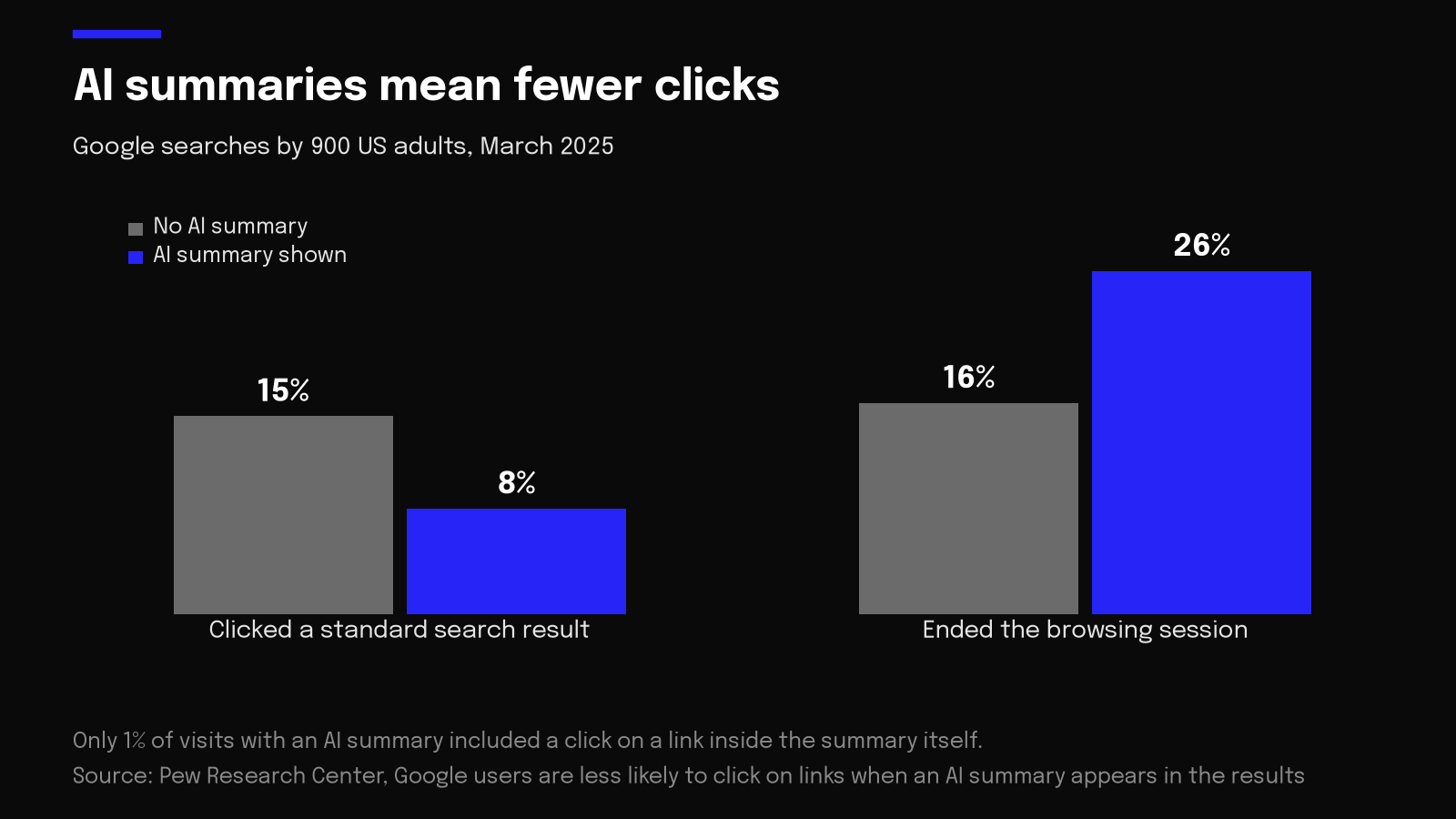
When a Google search showed an AI summary, people clicked on a standard search result in 8% of visits. When no summary appeared, they clicked in 15% of visits. Only 1% of visits with a summary involved clicking a link inside the summary itself.
More searches end without a click
People were also more likely to end their browsing session entirely after seeing an AI summary: 26% of the time, compared with 16% when there was no summary.
Questions trigger summaries most
AI summaries appeared in 18% of searches overall, but far more often for longer and more conversational searches. Only 8% of one or two word searches produced a summary, compared with 53% of searches of ten words or more, and 60% of searches phrased as a question.
Australians are adopting AI shopping tools quickly
Shoppers in both markets are moving the same way. In the US, Pew found 34% of adults had used ChatGPT by early 2025, about double the share in 2023, including 58% of adults under 30. In Australia, Retail Safari’s 2026 Christmas survey found 33% of Australians plan to use AI tools to help with Christmas shopping this year, up 17 percentage points on last year. Use is highest among people aged 35 to 54, at 43%, and lower among those 55 and over, at 22%. Among people planning to use AI, ChatGPT was the most popular tool, followed by Gemini and Google’s AI search.
In the US, Adobe found traffic from AI tools to retail websites rose 760% between 1 November and 1 December 2025, while noting that the base of users remains modest. In other words, it’s growing fast from a small starting point.
Australia Post’s eCommerce Report 2026 puts it simply: “If you’re not visible to AI agents, you’re not converting.”
The chain reaction for businesses
Here’s how those changes flow through to businesses, with each effect feeding the next.
Fewer people click through
For simple questions, many people now get their answer on the search page. A business that relied on publishing basic information to attract visitors may see less traffic, even if it ranks just as well as before. Still, summaries appeared in fewer than one in five searches in Pew’s study, so most searches still return standard results, which is why ranking well remains the foundation and not something AI visibility replaces.
Being quoted matters more than being listed
When an AI tool writes a summary, it draws on a handful of sources. Being one of those sources puts your business in front of the customer, even if they don’t click. Being on page one but left out of the summary is worth less than it used to be.
The clicks that remain are more valuable
People who still click through after reading a summary are likely to have a more specific need. They want to book, compare options in detail or buy. Fewer visitors can still mean good business if those visitors are closer to a decision.
Trust signals carry more weight
AI tools look for clear, credible information. Pew found that government websites made up 6% of the links cited in AI summaries, compared with 2% of standard search results, suggesting these tools lean towards sources they consider authoritative. For a business, that means clear facts, consistent details and genuine expertise matter more.
Who this matters for
Service businesses that answer common questions
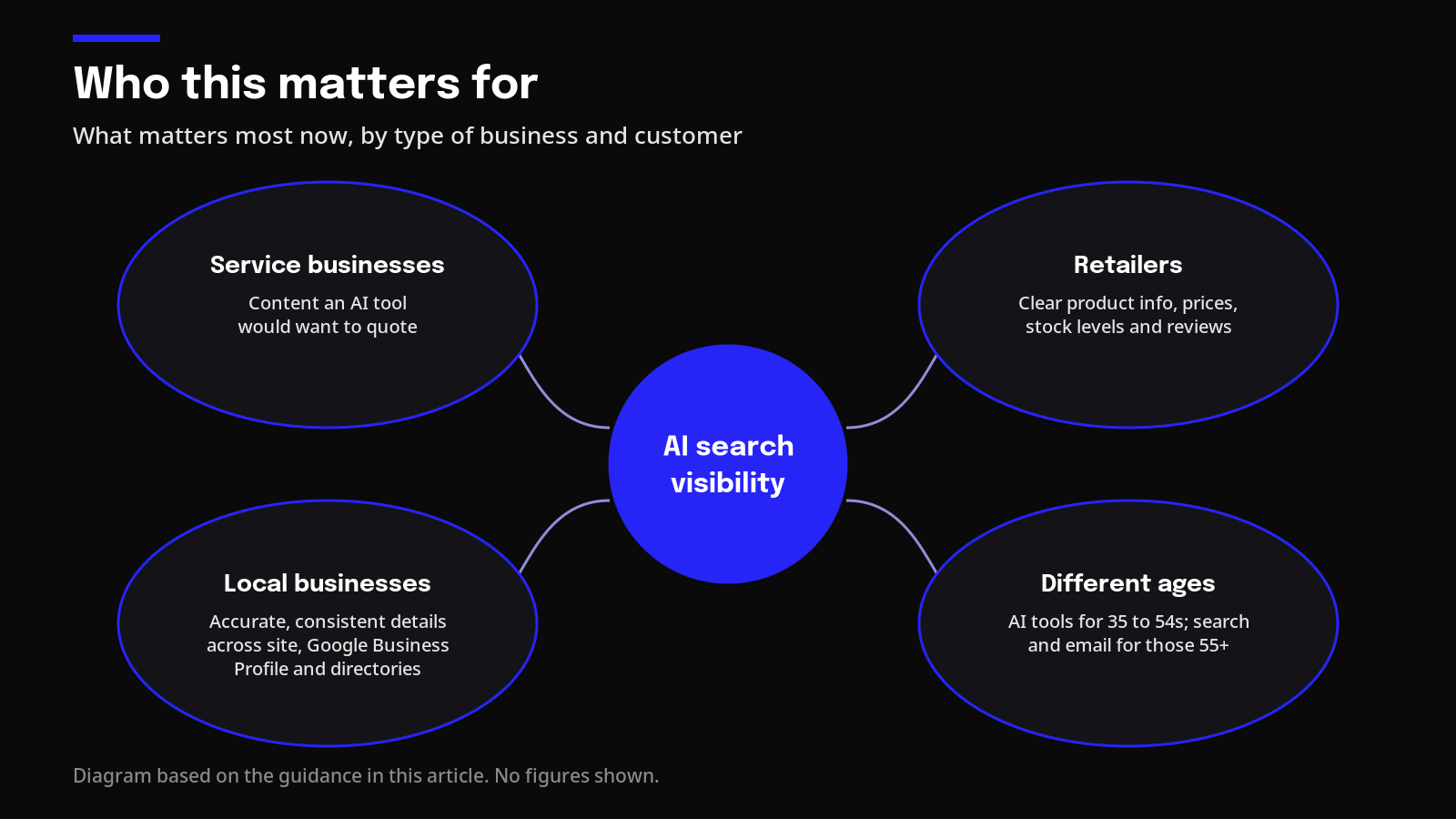
Clinics, trades and professional services often attract visitors with helpful articles answering everyday questions. Those are exactly the kinds of searches most likely to produce an AI summary. The content still matters, but it now needs to be the kind an AI tool would want to quote.
Retailers
Shoppers increasingly ask AI tools for gift ideas and product comparisons. Clear product information, prices, stock levels and reviews make it easier for those tools to recommend you.
Local businesses
For local searches, accurate and consistent business details across your website, Google Business Profile and directories help search engines and AI tools understand who you are, where you are and what you offer.
Customers of different ages
Shoppers aged 35 to 54 are the most likely to use AI tools this Christmas. Those aged 55 and over are far less likely, so traditional search and email still matter a great deal for reaching them. A balanced approach keeps you visible to all of them.
Our guide to AI SEO goes deeper on optimising for AI tools, and our look at where shoppers are still spending this Christmas shows how gift guides help AI tools surface your products.
What to do now
- Search for your main services and products the way a customer would, including full questions, and note whether an AI summary appears and which businesses it mentions.
- Write clear, direct answers to the questions your customers ask most, near the top of the relevant page, in plain language.
- Keep your business details, opening hours, prices and services accurate and consistent across your website, Google Business Profile and directories.
- Show genuine expertise: who you are, your qualifications and experience, and what makes your approach different.
- Make product and service pages easy to understand, with clear prices, inclusions and FAQs.
- Encourage happy customers to leave reviews, and respond to them.
- Before the festive season, make sure your gift ideas, holiday hours and delivery or booking deadlines are easy to find.
- Grow your email list so you have a direct line to customers that doesn’t depend on search at all.
If you want your business to be the one AI tools quote, AI SEO is where to focus next.
To check how your business shows up in AI search, contact us or email hello@thedigitalmarketingconsultants.com.au.