
Retailers with successful physical stores have usually put years into the fit-out, the range, the team and the local reputation. The online channel rarely gets the same investment, and the profit picture across stores and online is often far less clear than the revenue picture. Both are fixable, and both start with treating every channel as part of one system.
At a glance
Physical stores build demand that often ends up converting online, yet the online channel rarely gets the same investment. This guide covers giving each channel a clear job, budgeting online like a new location, finding margin gaps and stress-testing plans. It suits specialist retailers with stores and an online shop.
This is where marketing and retail strategy overlap, and it’s a common consulting topic for specialist retailers in categories such as fishing, 4WD, camping, car parts and boating.
Treat the Store as a Marketing Channel
The strongest retail brands rarely rely on a single channel. Store-only, online-only and wholesale-only models tend to work less well than a deliberate mix, and retail foot traffic is a brand-awareness channel in its own right. People who have visited your store, or driven past it for years, are more likely to trust you online.
Product in hand also converts better than a product page. Retailers who run both often find conversion is higher in store, so the store can do the persuading while the website captures the sale when it suits the customer: late at night, on the weekend or from a campsite three hours away. That means a store’s value isn’t fully shown in its own P&L. One practical check is to compare online sales from postcodes near each store with sales from areas that have no store.
Make the connection deliberate. Collect emails at the counter, through warranty registrations and loyalty programs, especially from tourist and seasonal customers who may never walk in again. Keep your Google Business Profile complete: Google’s local ranking tips explain that local results are based mainly on relevance, distance and prominence. Google Merchant Center also supports local products, so shoppers can see what’s on your shelves before they visit. Our guide to Google Business Profile SEO covers the details.
Budget Online Like a New Location
A common pattern is a retailer who spends hundreds of thousands of dollars on a physical shop and a few hundred on a web store, then wonders why online sales are slow. Building a website doesn’t mean customers will come. You wouldn’t open a second store with a token fit-out, and online deserves the same seriousness.
The biggest hidden cost is product data. Selling online needs good photos, accurate descriptions, specifications and live stock levels for every product you list, and for a retailer with thousands of SKUs that’s a substantial job that owners consistently underestimate. Start with the products that sell well in store, carry healthy margins and are hard to find elsewhere, then expand. business.gov.au’s guide to ecommerce is a useful checklist for the essentials, and solid inventory management keeps store and online stock in sync.
Give Each Channel a Clear Job
| Channel | Main costs to include | What it adds beyond its own sales |
|---|---|---|
| Each store | Rent, staff, fit-out, shrinkage | Awareness, trust, product in hand |
| Own website | Marketing, freight, returns, fees | Reach, customer data, repeat orders |
| Marketplaces | Commissions, fees, freight | Buyers already searching |
| Wholesale | Lower margin, payment terms | Volume and brand presence |
Give every store and the online channel its own profit and loss, with shared costs such as warehousing, marketing and management allocated fairly. Then judge each one on its own profit and on what it contributes to the others. Online can look cheap to run until marketing, freight, returns and platform fees are added, and freight on bulky items alone can change the economics of a whole category. Measure online on contribution margin, not revenue.
Use Lead Generation for Big-Ticket Products
Not every product should be sold with an add-to-cart button. Made-to-order and big-ticket items, such as kitchens, vehicle fit-outs or custom installations, often suit a lead generation approach where the website books a consultation or quote rather than taking payment.
Smaller, low-cost items can open the door. A home products retailer can sell accessories such as soap dispensers and sink strainers online, then follow up those buyers about larger renovation work. A design or quote tool that lets customers plan their project, as large furniture retailers do with kitchen planners, captures intent and contact details for the sales team.
Read Sales Drops Carefully
When online sales fall, check the same weeks in previous years before reacting, and separate your own website from marketplace sales to find where the change really is. Online demand also depends on continuous marketing in a way store traffic doesn’t. A common cause of a sudden drop is simply that advertising was paused, and sales return once it restarts. If you advertise on Meta, our guide on why Meta ads performance declines explains how to keep results steady.
Find the Margin Gap by Channel
At multimillion-dollar revenue, small percentages become large dollar amounts. Consider a retailer with stores and online sales turning over $11M and earning $1.3M in profit against a target of $1.6M to $1.7M. That gap of $300K to $400K is roughly 2.7 to 3.6 percentage points of margin, and it rarely comes from a single cause.
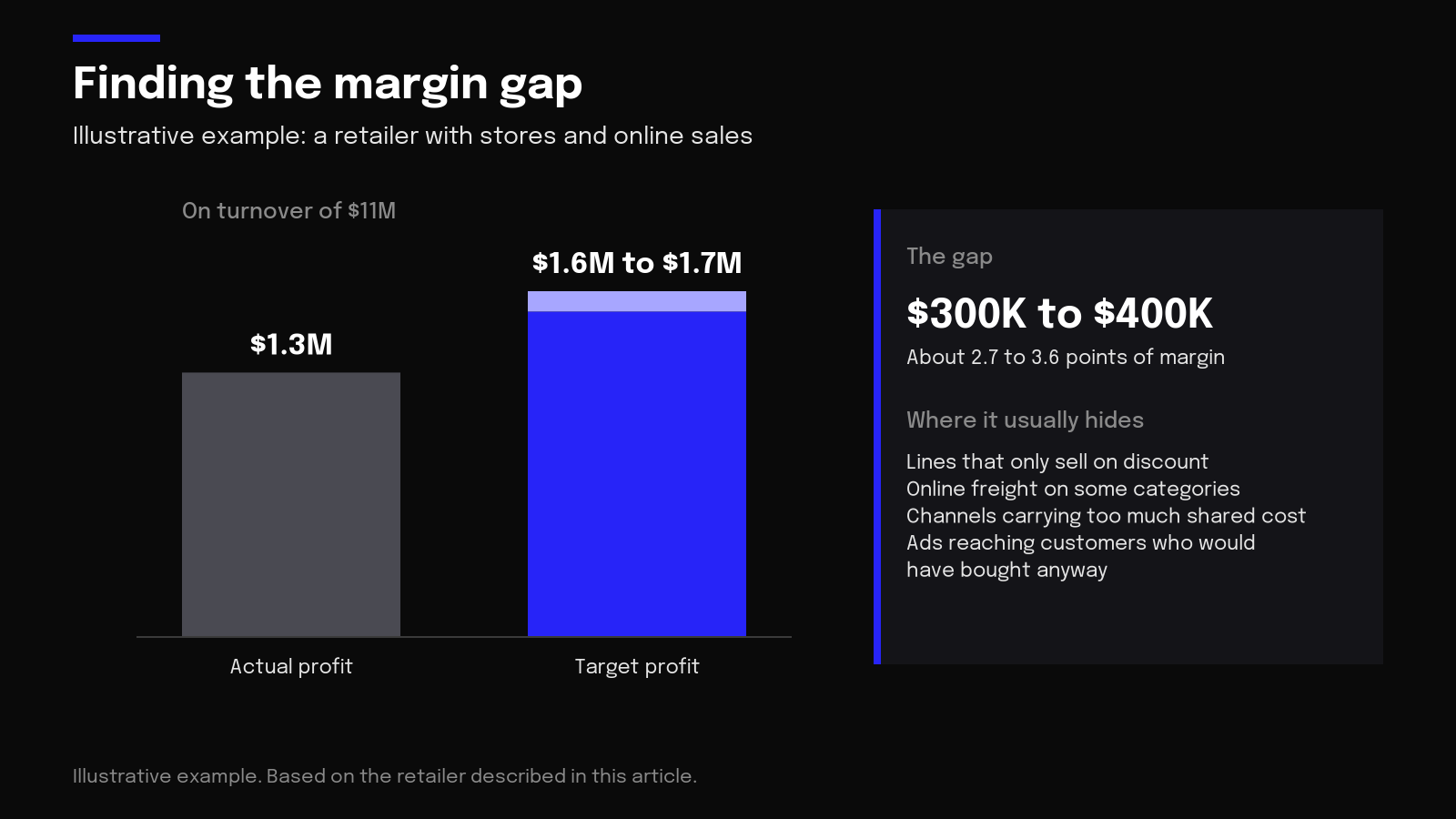
It’s usually spread across several places: lines that only sell on discount, categories where online freight erodes the margin, channels absorbing more shared cost than they earn and marketing spent on customers who would have bought anyway. Split new and returning customers in every channel, and look at sell-through and margin by category. The products customers seek out and pay full price for are where profit lives. Our guides to measuring marketing by profit and raising prices without losing your best customers cover two of the biggest levers.
Focus helps too. Seth Godin’s book This Is Marketing argues for serving a specific group of people well rather than trying to appeal to everyone. For a retailer, that might mean being the go-to store for serious anglers or touring families, stocking what they need and speaking to them directly, which supports full-price selling far better than chasing every sale.
Stress-Test the Plan Before You Commit
Treat online growth, a new store or a new channel like any other investment. Write down your assumptions for traffic, conversion, average order value and margin, then check whether the plan still works at 50 percent and 75 percent of them. If it still breaks even at half your assumptions, you have a resilient plan. If it only works when everything goes right, scale it back before committing.
Use your own customer data to set those assumptions. An online retailer considering a physical store can see from order history where its customers already cluster, and a store considering online expansion can see which products local customers regularly ask staff to order in.
Bringing Stores and Online Together
Done well, online sales extend your stores rather than compete with them. Treat the store as a marketing channel, budget for online like a real location, give each channel a clear job measured on margin, and stress-test plans before committing. That’s what a retail-focused marketing strategy should be built around.
To talk through how your stores and online channel can work together, contact us or email hello@thedigitalmarketingconsultants.com.au.