Most businesses that advertise on Meta go through a stretch where results fade. A common version looks like this: ROAS falls from around 4.5 to 2.1 after the same two ads have run for two and a half months to a 2 to 3 percent lookalike audience. Nothing in the account changed. The audience simply ran out of people who hadn’t already seen the message.
At a glance
Meta ads that once worked well often fade after the same creative runs too long to a narrow audience. Here’s why that happens, how Andromeda changed targeting and what to do instead: build a library of strong ads with different angles and keep the account simple. Useful for any business that’s seen results slide.
Understanding why that happens, and how Meta’s delivery system works now, makes the fix much clearer. It’s also the thinking behind how we approach paid advertising.
Rule Out Seasonality and Measurement First
Before changing strategy, compare results with the same weeks in previous years. A camping or boating retailer will see swings with the weather and school holidays that have nothing to do with the ads. If you sell on your website and a marketplace, look at each separately, and check the account history for paused campaigns, budget changes or billing problems.
Then check what the numbers are measuring. Returning customers inflate ROAS, because loyal buyers who click an ad before reordering are counted as ad-driven sales. Split new and returning orders using your store data rather than relying only on the figures produced by Meta’s attribution system. A falling ROAS can simply mean fewer returning customers are clicking ads, which is a different problem from new customer acquisition slowing.
Finally, judge performance over weeks, not days. Daily results on Meta are volatile, and one bad day can wipe out several good ones on paper.
Why Performance Declines
The main limit on Meta performance, even for brands spending $100K to $1M a month, is creative fatigue. Every ad has a natural pool of people it resonates with. Once most of them have seen it, frequency rises, the system has to reach less responsive people and costs climb.
Narrow audiences speed this up. Running a small number of ads to a 2 to 3 percent lookalike for months limits both who can see them and what the system can learn. Small tweaks to the same idea, such as a new colour or headline, tend to reach the same people again, which is why they rarely revive results.
How Andromeda Changed Targeting
| Aspect | Older approach | Approach that suits Andromeda |
|---|---|---|
| Targeting | Interests and narrow lookalikes | Broad, with Advantage+ audience |
| What finds the buyer | Audience settings | The creative’s angle and hook |
| Creative library | Many tweaks of one idea | About 10 distinct, well-made ads |
| Refreshing | Cosmetic changes | A new angle for a new buyer |
| Structure | Many small ad sets | One campaign, few ad sets |
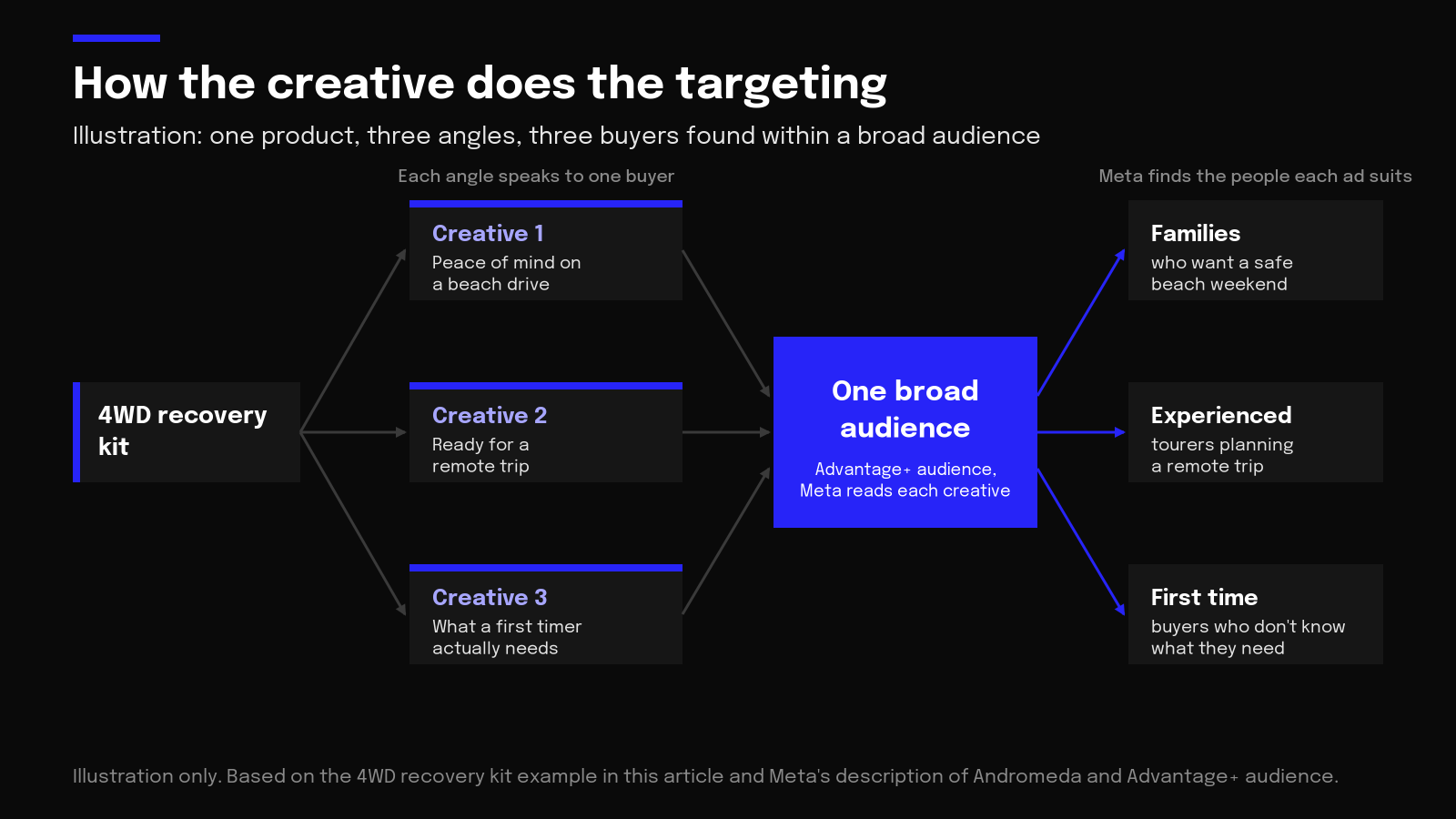
Meta’s engineers describe Andromeda as a personalised ads retrieval engine built to handle far more ads and creative variations, and to power Advantage+ automation. In practice, the system reads your creative to work out who it’s relevant to, then finds those people across a broad audience.
That reverses the old logic. Keep targeting broad, usually through Advantage+ audience, where your age, interest and audience inputs act as suggestions rather than hard limits, and let the creative do the targeting. An ad that speaks clearly to a specific person with a specific problem tells Meta who to find.
Write Different Angles for Different Buyers
The same product can be bought by very different people for very different reasons, and each reason deserves its own ad. Take a 4WD recovery kit. One ad speaks to the family who wants peace of mind on a beach drive, another to the experienced tourer planning a remote trip, and another to the first-time buyer who doesn’t know what they need. Same product, three buyers, three conversations, and Meta can find each group.
Service businesses can do the same by leading with different problems. An engineering or security firm might build one ad around compliance, another around downtime and another around risk. A clinic might speak to a specific concern, to recovery time or to the reassurance of an experienced practitioner, within the advertising rules for health services. Different offers attract different segments too: a bundle for first-time buyers, a premium model for enthusiasts, a service package for people short on time.
Build a Library of About 10 Strong Ads
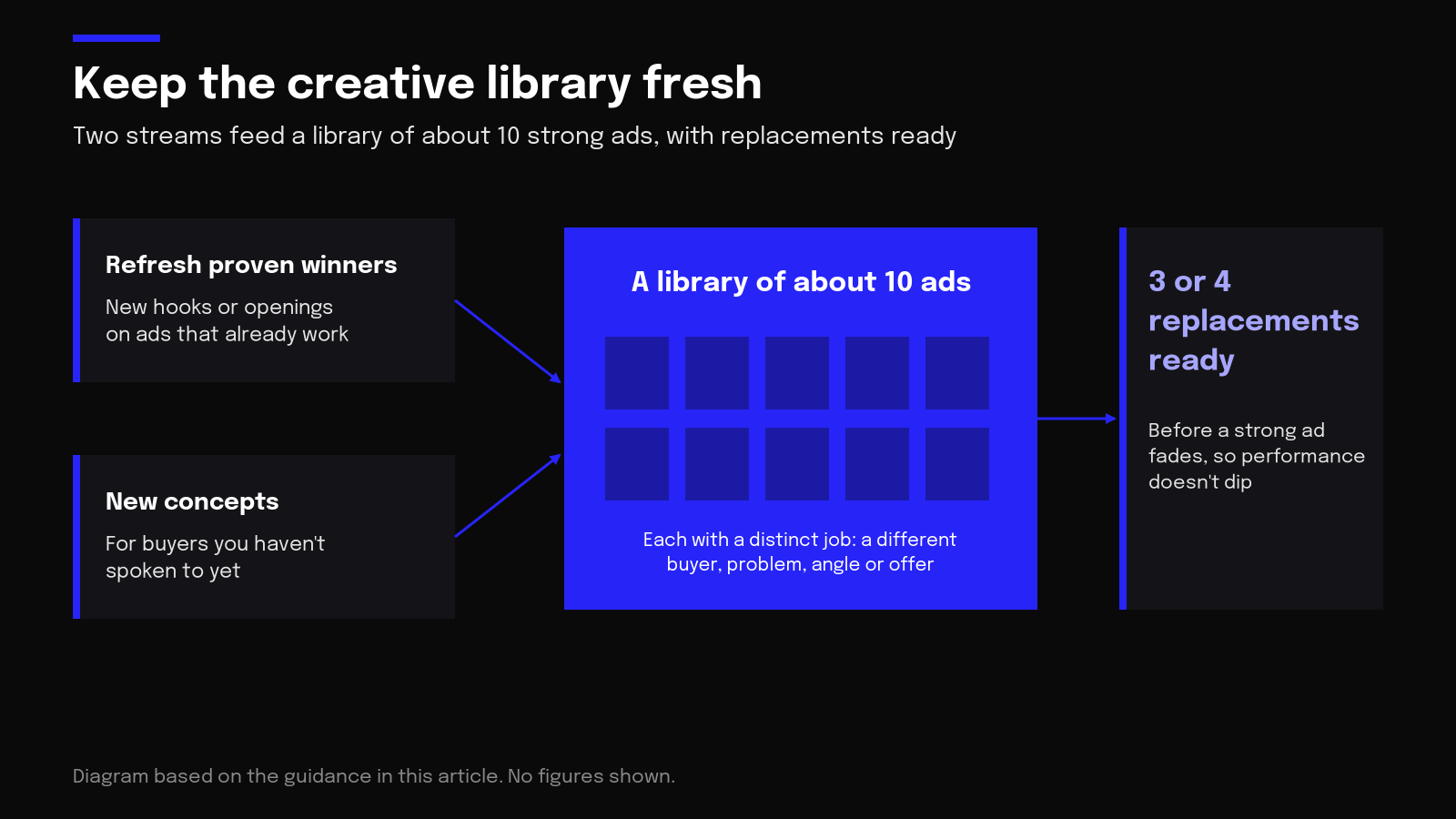
With creative doing the targeting, the quality of each ad matters more than the number of ads. A library of around 10 well-made ads, each with a thought-out script, a strong hook in the first few seconds and two or three clear selling points, will usually outperform dozens of quick variations. Each ad should have a distinct job: a different buyer, problem, angle or offer. That gives Meta genuinely different signals to work with.
Manage the library as two streams. One refreshes proven winners with new hooks or openings. The other introduces genuinely new concepts aimed at buyers you haven’t spoken to yet. Aim to have three or four replacements ready before a strong ad fades, so performance doesn’t dip while new creative is being produced. Our guide to creative testing covers how to introduce and assess new ads in a structured way.
This changes where the budget goes. Since Andromeda, creative does most of the work, so owners often get more from investing in scripting, filming, editing and creative direction, including real customer and staff footage, than from extra time spent adjusting audiences and ad sets.
Keep the Account Structure Simple
Meta’s system learns from volume, so concentrate it. A single campaign with a campaign-level budget and one ad set per country, without mixing different conversion goals, gives the system cleaner signals. Meta’s guidance on the learning phase says an ad set usually stabilises after about 50 results in the week after its last significant edit, and that significant edits restart the process. Fewer ad sets reach that point faster.
If you use a cost per result goal, a common starting point among experienced advertisers is your recent average cost per acquisition plus around 10 percent, which gives the system room to find volume without overpaying. Where order values vary widely, optimising for maximum conversion value rather than maximum conversions is worth testing, because the system then favours buyers likely to spend more. Our guide to budget allocation covers how to split spend as you grow.
Judge Results Against Profit, Not Daily ROAS
Before scaling, work out how far your acquisition cost can rise before a new customer stops being profitable. As budgets grow, each extra customer usually costs more, so taking spend from $1.5K to $15K a day only makes sense if your margins can absorb the higher acquisition cost that comes with it. Our guide to measuring marketing by profit explains how to set that number.
Resist switching ads off when results wobble. A common pattern is a business that has run profitable ads for years, at a steady ROAS above 3, switching them off because daily swings make results feel unreliable. Volatility like that is normal, and momentum is hard to rebuild once it’s gone. Keeping a modest learning budget running preserves what the system has learned while you work on new creative.
Conclusion
When Meta results fade, the answer is rarely narrower targeting. It’s broad targeting and better creative: distinct angles for distinct buyers, a focused library of around 10 well-made ads and a simple structure judged against profit. Our complete guide to Meta Ads covers structure, creative and scaling in more depth, and it reflects how we run Meta advertising campaigns.
For help turning around Meta results that have softened, contact us or email hello@thedigitalmarketingconsultants.com.au.