
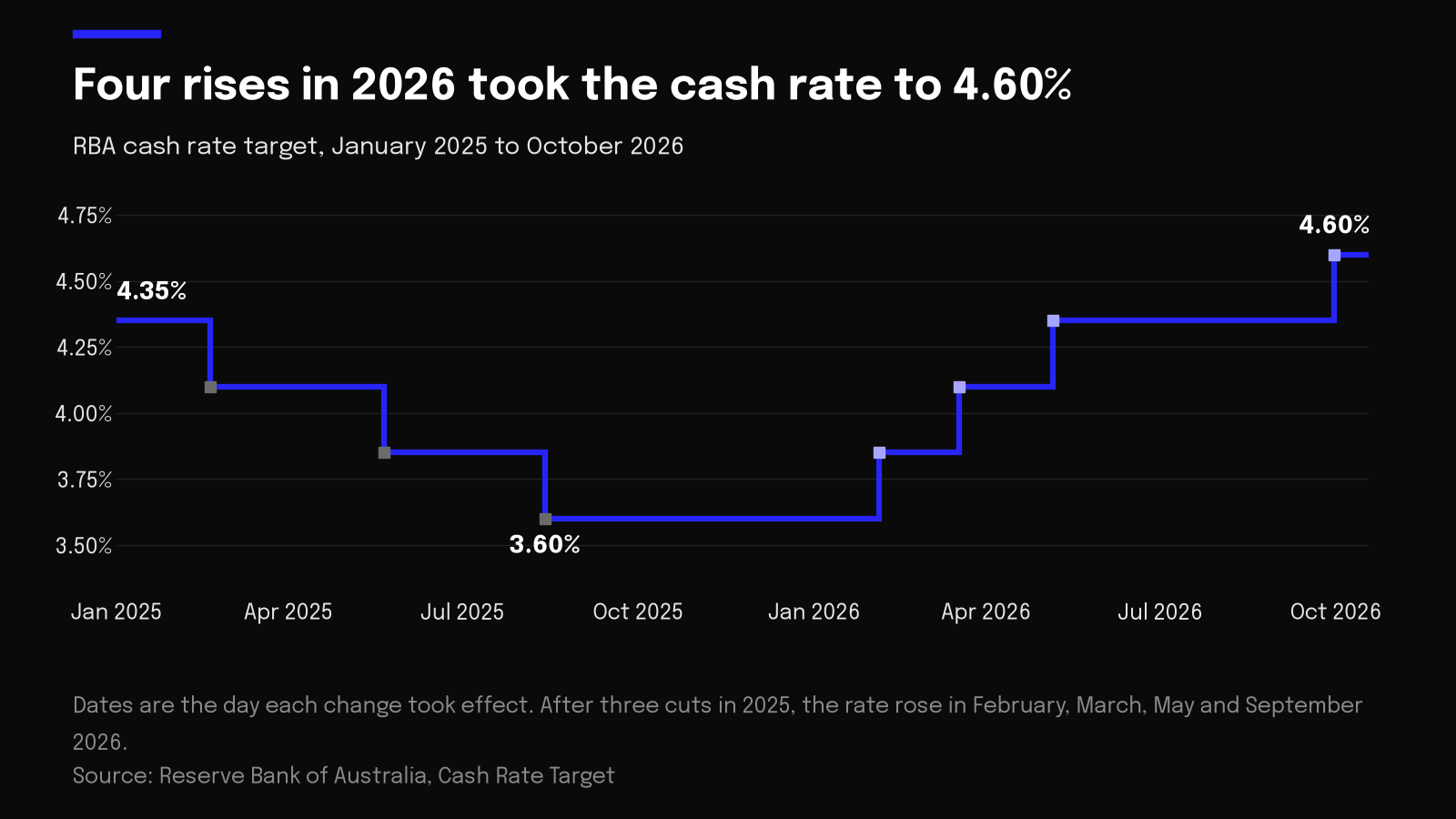
At its September meeting, the Reserve Bank of Australia raised the cash rate to 4.60%, the fourth increase this year. Inflation is still well above target. The ABS reports annual CPI inflation of 4.0% in August, with prices for non-discretionary items, the things households can’t easily avoid, up 4.7%.
At a glance
The Reserve Bank has lifted rates four times in 2026, but the impact varies widely between households. Mortgage holders, outright owners, renters, older savers and WA households are all affected differently. This breakdown helps businesses see who is still spending and adjust their marketing to suit.
Before changing your marketing, it helps to know who is still spending. That question shapes much of our consulting work this year.
The big picture
Confidence has taken a hit. The Westpac-Melbourne Institute Consumer Sentiment Index fell to 80.4 in October. Among people surveyed after the RBA’s decision, it was just 67.2, compared with 86.9 for those surveyed before.
That sounds bleak. But a rate rise works through households in very different ways, and for a business, the average hides more than it reveals.
How a rate rise actually reaches households
The RBA has studied this closely. Its analysis of the household cash-flow channel splits households into three broad groups.
| Household | What a rate rise does |
|---|---|
| Mortgage holders, about 35% of households | Repayments go up. Hardest hit, especially households aged roughly 30 to 54 |
| Outright home owners, about a third of households | Often slightly ahead from extra interest, but gain only about a third as much as a typical mortgage holder loses |
| Renters | Little direct effect, but the same rising prices for food, fuel and power |
Mortgage holders: the hardest hit
About 35% of households have a mortgage. When rates rise, their repayments go up, and money that was spent elsewhere goes to the bank instead. The RBA found the effect is largest for households aged roughly 30 to 54, and that lower-income borrowers tend to have thinner savings buffers to absorb the change.
CommBank’s economists noted another effect this year. Households “who left payments unchanged after the rate cuts in 2025 will now face higher mortgage payments for the first time this year,” according to CommBank’s August Household Spending Insights. Many had built a buffer by keeping repayments high when rates fell. That buffer is now being used up.
Outright home owners: often slightly ahead
About a third of households own their home outright. They tend to be older, have no mortgage, and many hold savings in the bank. When rates rise, they earn more interest. The RBA found the typical outright owner gains, but by much less than the typical mortgage holder loses: around a third as much.
Renters: little direct effect, for now
Renters don’t pay a mortgage, so the RBA found the direct effect on them is small. But they still face the same rising prices for food, fuel and power, so many are under pressure for other reasons.
Why the averages mislead
When you hear that “higher rates help savers”, it’s worth asking which savers.
Two retirees compared
Consider two retirees. One has $50,000 in the bank. A one percentage point rise in deposit rates, if passed on in full, adds about $500 a year, roughly $10 a week. That’s welcome, but it’s quickly absorbed by higher power, insurance and grocery bills. The other has $1 million in savings. The same rise adds around $10,000 a year. That’s a meaningful lift in spending power.
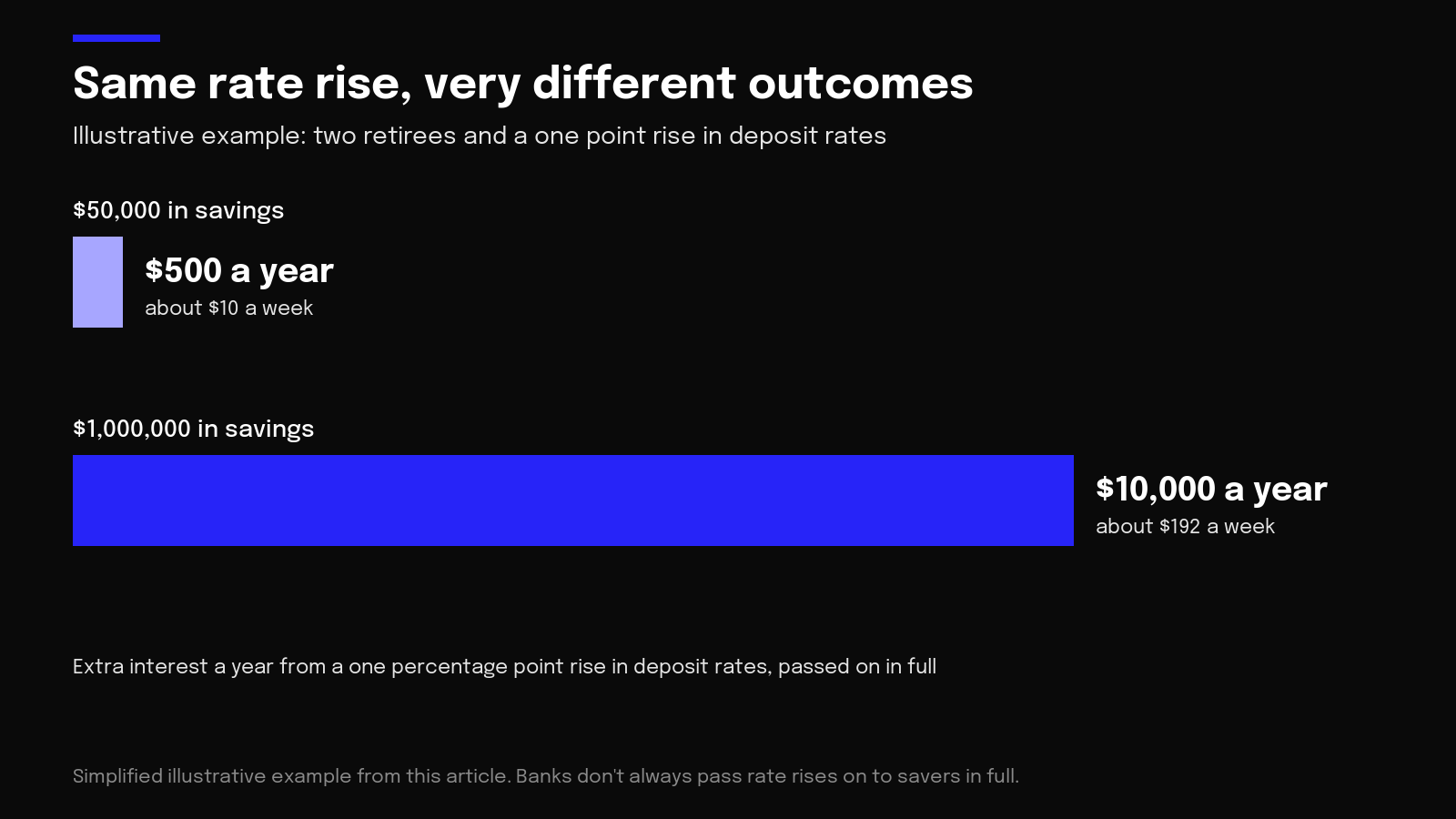
These are simplified examples, and banks don’t always pass rate rises on to savers in full, but the point holds. The benefit of higher rates flows mostly to people who already have a lot of savings. The RBA’s analysis supports this: households in the top wealth group are more likely to benefit from rate rises, while the middle of the wealth distribution tends to be hit hardest.
Borrowers versus savers
There’s another important difference. The RBA found that borrowers respond about three times as strongly as savers when it comes to spending on big-ticket durable items, such as furniture, appliances and cars. So when a mortgage holder loses $300 a month, they cut back quickly. When a saver gains $300, they’re much less likely to go out and spend it. That’s why a rate rise slows spending overall, even though some households gain.
Who is still spending
Older Australians with savings
The data points to older, financially secure customers as a steady group. CommBank’s card data for the 2025 Black Friday period showed spending by customers aged 70 and over grew 8.5%. More older Australians are also working. ABS figures show the number of employed people aged 65 and over rose by about 59,000 in the year to September 2026, roughly a third of all employment growth over that time (our calculation from ABS Labour Force data).
But “older” doesn’t mean “big spender”. Retail Safari’s 2026 Christmas survey found shoppers aged 55 and over plan to spend an average of $673 on Christmas, the only age group with a lower budget than in 2023. Only 54% of them use sales events. They’re steady and careful, not lavish.
Households that are protecting what matters
Many mortgage holders are cutting back, but not across the board. Retail Safari found 31% of shoppers aged 35 to 54 plan to spend less this Christmas, and 70% of shoppers in that age group rank cost of living among the top three influences on their gift buying. Their spending isn’t disappearing. It’s being concentrated on the things they consider most important.
WA households
Western Australia has had a stronger jobs market than the national average. The ABS Labour Force release shows WA’s unemployment rate at 4.2% in September, compared with 4.7% nationally, 4.7% in NSW, 5.1% in Victoria and 4.5% in Queensland. WA households still face the same rate rises, but a stronger jobs market gives more of them the confidence to keep spending.
The second-order effects for business
Follow the chain a little further and some useful patterns emerge.
- Mortgage holders are likely to delay rather than cancel. A family facing higher repayments will often be more inclined to put off a renovation, a new car or a cosmetic treatment than to abandon it altogether. That creates a pipeline of demand that returns when pressure eases.
- Value becomes the deciding factor. When budgets are tight, people compare more carefully. Clear pricing and visible value matter more.
- Savings are a buffer, not a windfall. The household saving ratio was 6.5% in the June quarter. Some households have savings to draw on, but many will protect them rather than spend them.
Our look at where the money goes when households cut back follows the same pressure through to spending, and our guide to a good, better, best range shows how to keep squeezed customers. Our look at how shifts in Australian job growth are changing customer demand adds the jobs side of the picture.
What to do now
- Segment your customer list by life stage where you can, and adjust your messages accordingly. Retirees and families with mortgages need different offers.
- For mortgage-holding families, lead with value: clear prices, payment plans where appropriate, entry-level options and practical reasons to buy now.
- For older, financially secure customers, focus on quality, service, convenience and trust rather than discounts.
- Keep in touch with customers who are delaying purchases. A gentle reminder when they’re ready is more effective than starting again.
- Don’t assume every customer is cutting back. Look at your own sales data by customer type before changing your pricing.
- If you’re in WA, test whether your local customers are responding differently from those in the eastern states before copying national campaigns.
Targeting by life stage and region is easier when it’s part of a clear marketing strategy.
For help identifying which of your customers are still spending and how to reach them, contact us or email hello@thedigitalmarketingconsultants.com.au.