
When homeowners decide to sell, they rarely start by asking who ranks on Google. They start by asking who they know. That is good news for most agents, because the strongest lead source is the people who already know you: past clients, local contacts and their referrals. Paid leads can work too, but they tend to be slow and expensive without consistent follow up, which is why paid appraisal campaigns suit large agencies with a nurture team best.
That question, which agent a vendor thinks of when the time comes, runs through this guide to real estate marketing. It also explains retention in real estate: past clients sell again and refer their friends, so staying in touch with them for years is one of the most valuable habits an agent can build.
At a glance
Put everyone you know into a CRM and contact them with something useful at least quarterly. Become known for one suburb or pocket. Treat paid portal leads as an optional, slow test, with a follow up system ready before you start. Then measure appraisals and listings by source over 6 to 24 months.
In this guide:
- How vendors choose an agent
- The three stages at a glance
- Early agent (small): database, open homes and borrowed listings
- Growth agent (medium): a hyperlocal personal brand
- Large agency: brand, paid appraisal campaigns and central nurture
- Why the basics matter, and the easy way to do them
- Do paid ads pay for real estate?
- SEO for real estate agents
- Video and social: a commitment worth planning
- Compliance checklist
Vendors choose the agent they know, trust or keep seeing in their area. Your database and personal brand do the heavy lifting.
How vendors choose an agent
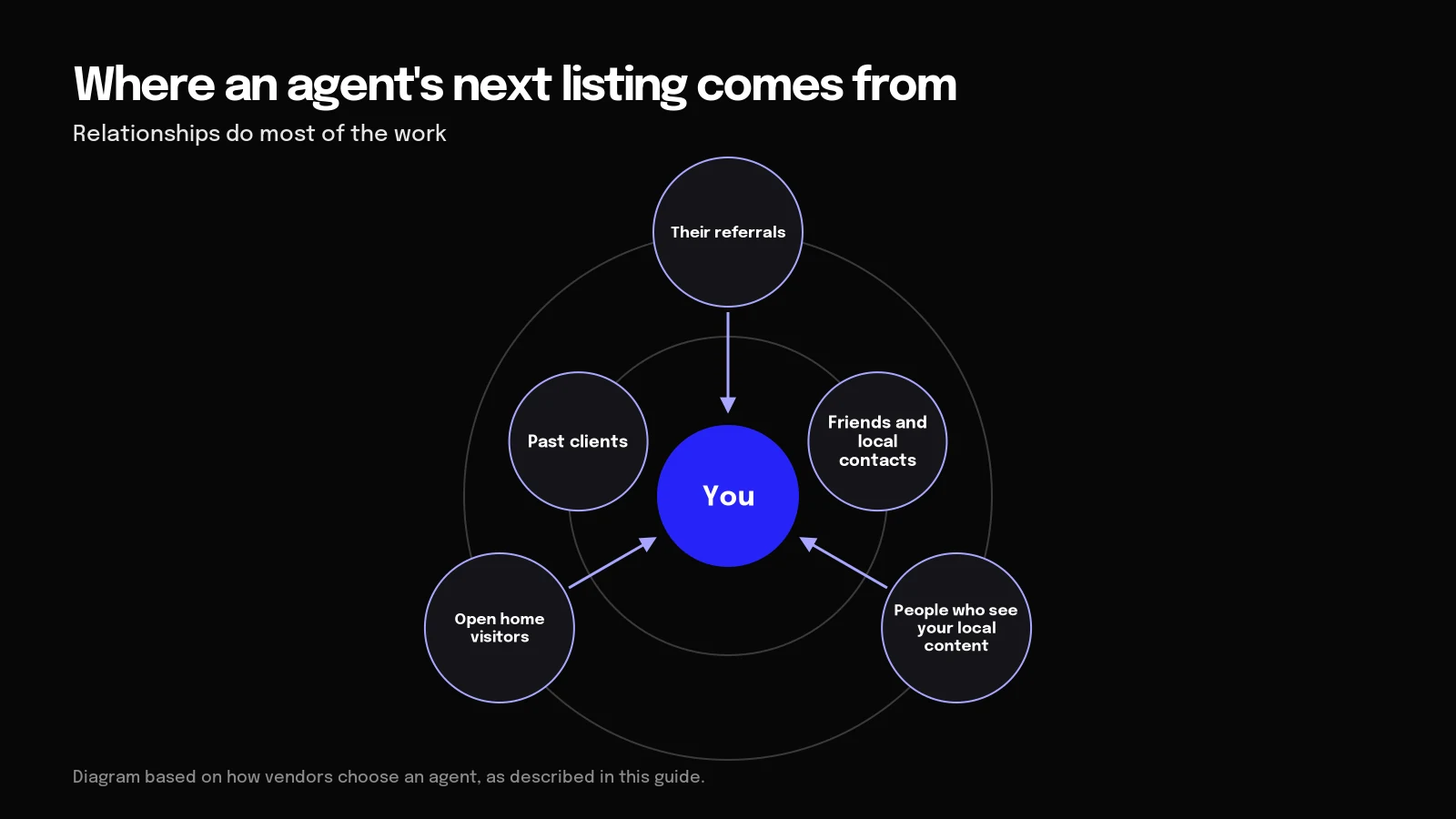
Selling a home is not usually a decision that begins with a search. Vendors tend to choose someone they know, someone a friend recommended, or the agent they keep seeing in their area. That is why personal brand and relationships do most of the work in real estate, and why paid ads suit agencies that can nurture leads for months.
A personal brand, put simply, means being known for a particular reputation in a particular place. For an agent, that might be “the agent who knows every street in this suburb”. The diagram below shows how that reputation brings listings back to you, starting with the people closest to you and widening out from there.
The three stages at a glance
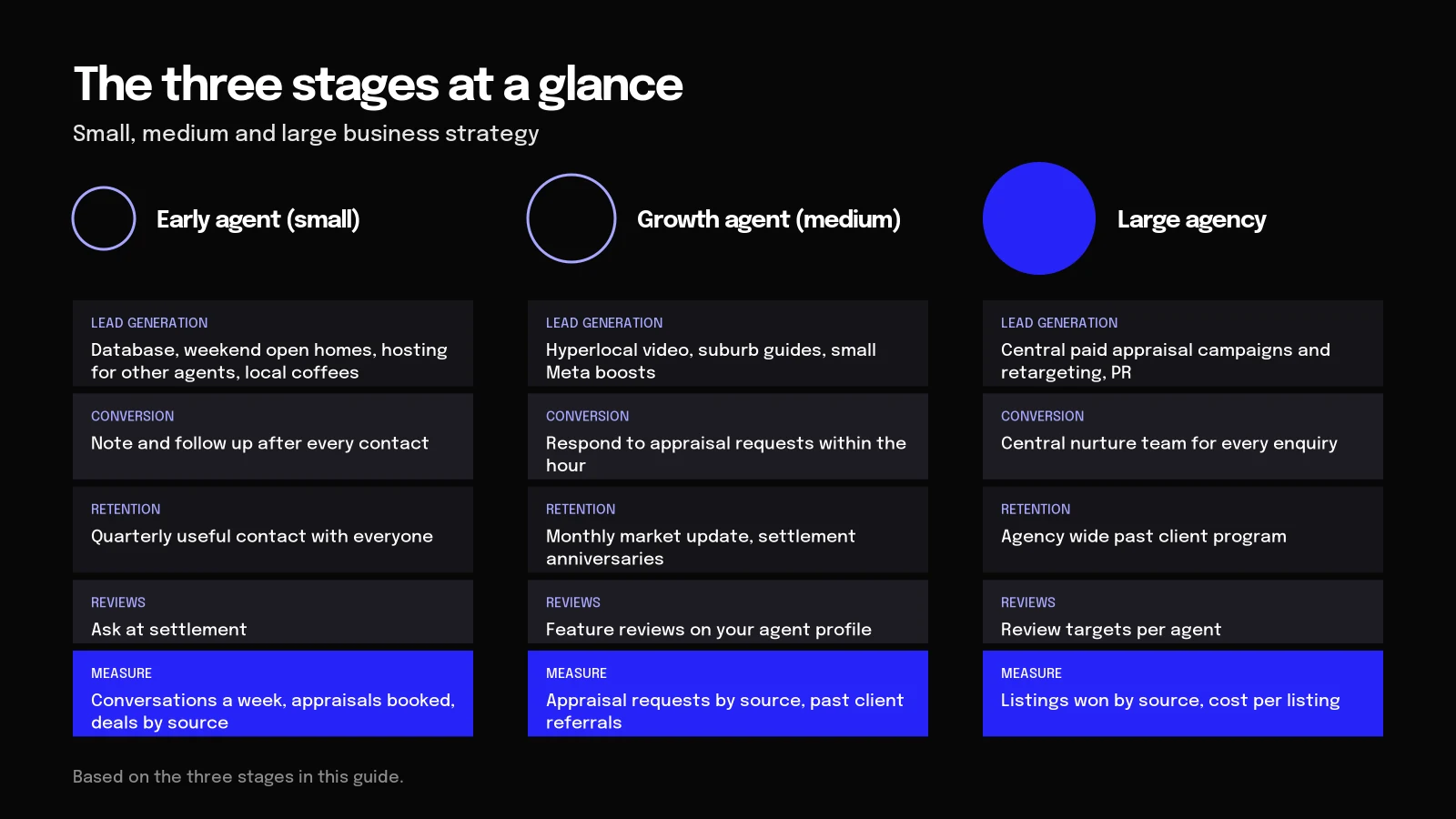
The right mix of activity changes as your career grows. The table summarises our recommended plan for an early agent, a growth agent and a large agency, and the sections that follow explain the reasoning.
| Early agent (small) | Growth agent (medium) | Large agency | |
|---|---|---|---|
| Lead generation | Database, weekend open homes, hosting for other agents, local coffees | Hyperlocal video, suburb guides, small Meta boosts | Central paid appraisal campaigns and retargeting, PR |
| Conversion | Note and follow up after every contact | Respond to appraisal requests within the hour | Central nurture team for every enquiry |
| Retention | Quarterly useful contact with everyone | Monthly market update, settlement anniversaries | Agency wide past client program |
| Reviews | Ask at settlement | Feature reviews on your agent profile | Review targets per agent |
| Measure | Conversations a week, appraisals booked, deals by source | Appraisal requests by source, past client referrals | Listings won by source, cost per listing |
Early agent (small): database, open homes and borrowed listings
When you are starting out, the people you already know are your biggest asset, so the first job is to organise them. Put everyone into a CRM, which is simply your contact system, and then create as many chances as you can to meet new people. Open homes are the most reliable of these, so we suggest running them every weekend. If you do not yet have many listings, offer to host open homes for agents with new listings or price drops. Coffee with local business owners is worth the time too, because they know everyone in the area.
Paid portal leads are optional at this stage, and they are slow. If you test them, use money you can afford to set aside for a long trial, and have a follow up system ready first.
That same follow up is what turns the people you meet into clients. Write a short note after every conversation and set the next follow up in the CRM straight away. Then contact each person in your database at least quarterly with something useful, such as a local sales snapshot. The aim is not to ask friends whether they want to buy or sell. It is to make sure they remember you are an agent when the time comes.
Reviews grow from the same relationships, so ask every vendor and buyer for a review at settlement, with a direct link. Then measure conversations per week, appraisals booked and deals by source.
Growth agent (medium): a hyperlocal personal brand
Once your database is working, you can build on it by becoming the obvious agent for one area. Choose that area and post a short weekly video about what is new there. Rather than only posting listings and sold signs, share the decisions you helped clients make, such as why you advised a buyer to walk away from a house. Honest content like that builds trust and starts conversations. If you can commit to it, YouTube suits longer suburb guides, and a small Meta budget can boost your best local posts to people in your area.
As enquiries grow, speed becomes the next priority. Reply to appraisal requests and portal enquiries within the hour, or have an assistant do it for you. Staying in touch becomes more regular too, with a monthly email market update and a message to every past client on their settlement anniversary. Keep reviews flowing on your agent profile and Google Business Profile, and measure appraisal requests by source and referrals from past clients.
Large agency: brand, paid appraisal campaigns and central nurture
A large agency can do something individual agents rarely can: run paid appraisal campaigns and retargeting centrally, and nurture every enquiry for as long as it takes. An in-house content team can support each agent’s personal brand, while PR covers agency milestones and community work.
That central approach carries through to conversion, where a nurture team or ISA (inside sales assistant) follows up every enquiry for months, not days. Retention works the same way, through an agency wide past client program of anniversaries, market updates and event invitations. Set review targets per agent and share reviews across agent and office profiles, then measure listings won by source and cost per listing.
Why the basics matter, and the easy way to do them
Across all three stages, the same few habits do most of the work, and we understand they are not always easy to keep. Agents are on the road, at open homes and juggling vendors, and many feel awkward contacting friends about work.
The effort is worth it, because referrals and past clients are usually the warmest leads an agent will ever get, and they stay warm for as long as you keep adding value. Speed pays off too. Harvard Business Review research, as summarised by Rework, found contact within an hour sharply improves lead qualification.
Relationship building does take real time each day, so the easy way is to let systems carry the load. CRM reminders and templated quarterly messages keep your database warm, an assistant can answer portal enquiries within the hour, settlement anniversary emails can go out automatically, and your content can be batched once a week.
Tip: Film four short suburb videos in one morning each month. That covers your weekly posts without eating into open home time.
Do paid ads pay for real estate?
With those habits in place, paid advertising becomes a question of numbers. Commission is high, but vendor decisions are slow, so we recommend tracking cost per listing won over 6 to 24 months rather than cost per lead. Quinn Marketing’s keyword research estimates about $18 a click for “real estate agent” (AUD, October 2024, so check locally). In the US, WordStream reports a Google cost per lead of $100.48 for real estate, compared with $16.61 on Meta.
Paid portal leads in particular can take a long time to turn into deals, and results vary a lot from agent to agent. Appraisal campaigns on Meta ads follow the same rule. That is why we suggest treating paid leads as a long term test, judging them on listings and sales rather than lead numbers, and scaling only once they pay. You can work through the Google Ads vs Meta economics section of our hub guide with your own commission and close rates. For platform detail, see our complete guide to Google Ads and guide to Facebook and Meta ads.
SEO for real estate agents
Search is another place a future vendor might find you, although the competition looks different. Real estate search is a dominance contest, because realestate.com.au and Domain own the big terms. Rather than competing for “houses for sale Perth”, the local SEO opportunity lies in the specific searches the portals answer poorly, such as “what is it like living in [suburb]” or “best streets for families in [suburb]”. Answering them well puts you in front of people early, while they are still thinking about a move. Our guide to what SEO is and how it works covers the basics.
Video and social: a commitment worth planning
Video and social posting build on the same local reputation, and they can become a strong source of leads with consistency. Agents who do well tend to post often, stay focused on one area and keep at it for months. Consistency matters far more than polished production, so we suggest starting with simple gear and suburb guides, posting on a schedule you can keep, and investing more once you can see enquiries coming from it. It also helps to remember that results shift with the market, and social leads usually convert better in a sellers’ market than in a buyers’ market.
Every channel here serves the question we began with. When homeowners decide to sell, they think of the agent they know, trust or keep seeing, and your database, local reputation and follow up make sure that agent is you. For how product, price, people and process fit together in an agency, see our guide to the 7Ps of marketing.
Compliance checklist
Before any campaign goes live, check it against the advertising rules for agents.
- Follow the ACCC’s guidance for real estate on misleading claims and pricing.
- In WA, follow the Code of Conduct and Consumer Protection WA’s rules on seller authorised prices and written price opinions.
- In NSW, follow the underquoting and advertising rules for agents.
- Follow the ACCC’s online reviews guidance, and the Spam Act for market update emails.
This guide is general information, not legal advice. Check the agent advertising rules in your state.
Want to build a personal brand that keeps listings coming? Get in touch or email hello@thedigitalmarketingconsultants.com.au and we’ll help you plan your next stage of growth.