
Australia Post’s eCommerce Report 2026 found Australians spent $82.6 billion online in 2025, up 14% on the year before. Some 9.8 million households, 82% of the total, bought something online, and 41% now shop online at least once a fortnight.

At a glance
Marketplaces are growing fast, but the customer you win there belongs to the platform, not to you. This article weighs what marketplaces give and what they keep, and why a customer list you control becomes more valuable each year. Relevant for retailers, service businesses and local businesses alike.
Balancing marketplaces with channels you own is a trade-off worth thinking through, and one we often help with through consulting.
The big picture
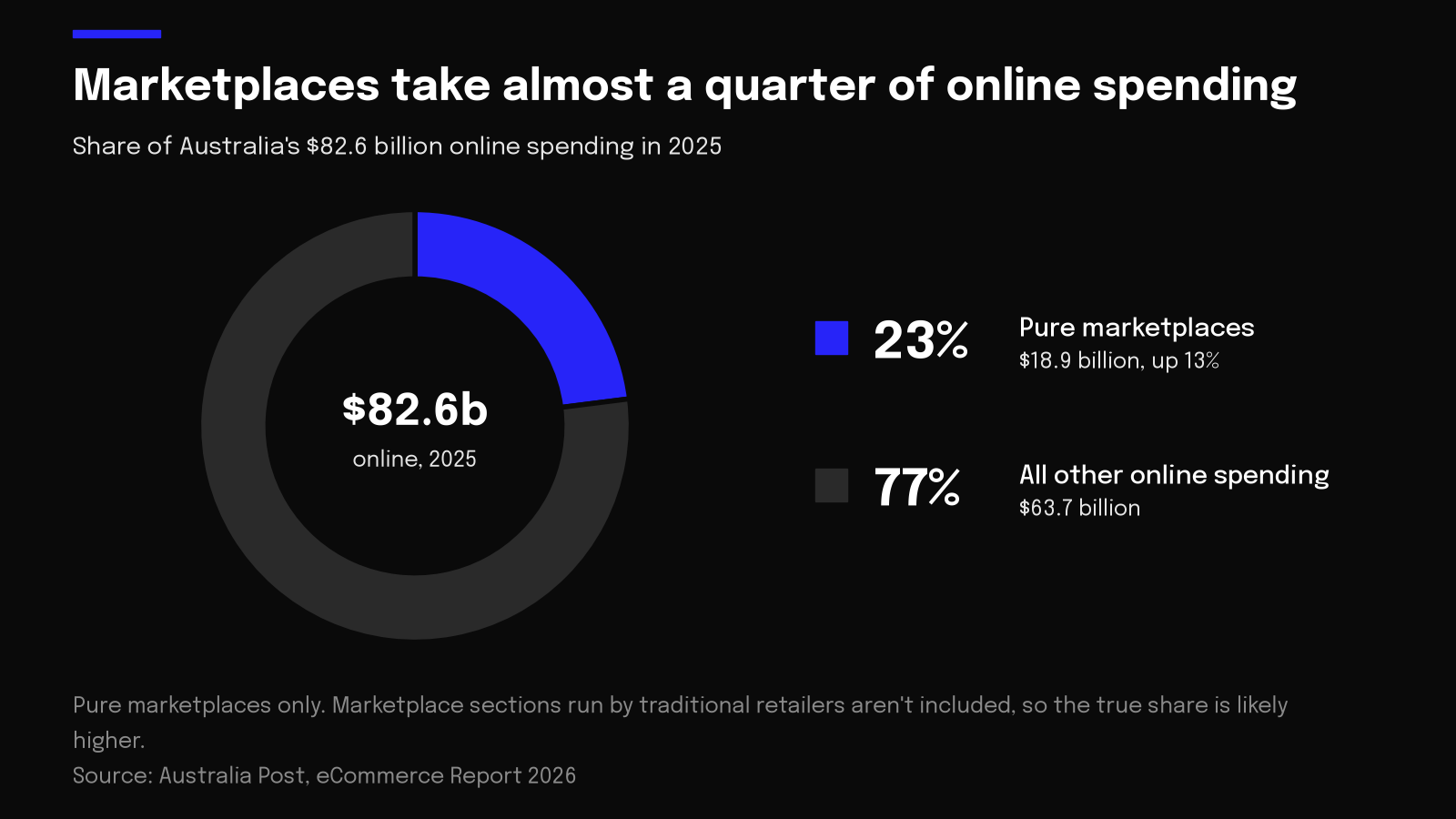
Pure marketplaces, platforms where many sellers list their products in one place, accounted for $18.9 billion of that, up 13%, or 23% of online spending. That figure doesn’t include marketplace sections run by traditional retailers, so the true share is likely higher.
Shopper numbers tell a similar story. Roy Morgan’s 2025 retail data shows Temu reached 5 million Australian shoppers, up 17%. Shein grew 28% to 2.9 million, and Amazon added around 500,000 shoppers. CommBank’s card data for the 2025 Black Friday period showed spending on marketplaces up 7.3%.
Western Australia stands out. Australia Post found WA households spent $9.1 billion online in 2025, up 18%, the fastest growth of any state, compared with $26.4 billion in NSW (up 13%), $20 billion in Victoria (up 13%) and $17.8 billion in Queensland (up 15%).
Why marketplaces are growing
The reasons are straightforward. Marketplaces offer a wide range in one place, easy price comparison, fast delivery and an app that’s always on the shopper’s phone. Australia Post found 69% of online shoppers use marketplace apps. For a price-conscious household, that convenience is hard to beat.
Retail Safari’s 2026 Christmas survey found 66% of Australians plan to use marketplaces for Christmas shopping this year.
What marketplaces give you, and what they keep
For many businesses, selling or advertising on a marketplace is a sensible way to reach new customers. The platform brings the traffic and the shopper’s trust, often handles payment and delivery, and can cost less per sale than building the same reach through your own advertising, which is why some brands make it their main channel. But it’s worth being clear about the trade-off.
The customer belongs to the platform
When someone buys from you on a marketplace, the platform usually owns the relationship. You may not get their email address, you can’t easily contact them again, and the next time they search, you’re competing for their attention all over again.
Price comparison is built in
Marketplaces are designed to make comparison easy. That’s good for shoppers but can push sellers into competing on price alone, especially when similar products sit side by side.
The rules can change
Fees, rankings and policies are set by the platform. A business that relies heavily on one marketplace has less control over its own margins and visibility.
The second-order effect: owned channels become more valuable
Here’s the chain reaction. As more shopping moves to marketplaces, more businesses compete for the same shoppers in the same places. Each new customer becomes harder to win again from scratch. That makes customers you can reach directly, through your own email list, SMS, app or loyalty program, worth more.
Owned channels have their own costs, such as software, content and the time to run them, but you don’t pay a commission each time you email an existing customer. You don’t compete with the business next door in their inbox in the same way. And a customer who already knows and trusts you is easier to bring back.
Australia Post’s advice to retailers captures the balance well. It suggests using marketplaces as acquisition engines, “leveraging marketplaces for scale and discovery, while nurturing your own channels for brand storytelling, loyalty and margin protection”.
What strong customer relationships look like
Super Retail Group, which owns Supercheap Auto, rebel, BCF and Macpac, offers a useful example from its FY26 results. The group reported 13.1 million active club members, and members account for between 80% and 92% of sales, depending on the brand. Its click and collect service accounted for 47.5% of online sales, bringing online shoppers into its stores.
Not every business can build a loyalty program at that scale. But the principle applies to a clinic, a cafe or a specialist retailer just as much: the more of your sales that come from people you can contact directly, the less you depend on any one platform.
Who this matters for
Retailers selling products found on marketplaces
If your products can be found on a marketplace, often at a lower price, your edge is everything the marketplace can’t easily offer: advice, service, local stock, fast fixes and a relationship.
Service businesses
Clinics, trades and professional services aren’t usually competing with marketplaces for the same sale, but they’re competing for the same attention and the same household budget. A strong customer list protects them too.
Local businesses
Retail Safari found six in ten Australians say they’re more likely to buy Christmas gifts from local rather than overseas retailers during Cyber Weekend, up 6 points on last year. Local businesses that stay in touch with their customers can turn that goodwill into actual sales.
Retailers with stores can read our guide to growing online sales alongside physical stores, and our guide to smarter Black Friday offers shows how early access can grow your list. Our guide to keeping customers coming back in January shows how to put that list to work after the sales.
What to do now
- Make it easy to join your email or SMS list everywhere: on your website, at checkout, in store and on receipts, with a clear reason to sign up.
- Before Black Friday, offer early access or a members-only extra to people on your list, so joining has real value.
- If you sell on marketplaces, include a card or note in each order inviting customers to buy direct next time, within the platform’s rules.
- Judge your list on how many subscribers buy again, not on open rates, and give each email a clear reason to act, such as a restock, care tips for what they bought or members-only access.
- Track what share of your sales comes from your own channels versus marketplaces and paid ads, and aim to grow it over time.
- Make your own website the easiest place to buy from you, with clear prices, fast checkout and click and collect if you have a store.
- Thank new customers after the festive season and give them a reason to come back in the new year.
Your customer list deserves a central place in your marketing strategy.
If you want to build a customer list your business controls, contact us or email hello@thedigitalmarketingconsultants.com.au.