Black Friday has moved from an American import to a fixture of the Australian calendar. CommBank iQ found Australians spent $23.8 billion over the two-week Black Friday period in 2025, up 4.6% on the year before and 19.5% more than in an average fortnight. Almost all of the growth came online, where spending jumped 9.3% to $8 billion, while in-store spending was broadly flat.

At a glance
Black Friday is now a fixture for Australian shoppers, but a big discount can wipe out much of the profit on every sale. Find out what discounts really cost, which products to discount and which offers protect your margin, such as bundles and early access. Made for retailers planning their November sales.
Planning a sale is as much a business decision as a marketing one, and it comes up in most of our consulting conversations at this time of year.
Black Friday is now part of how Australians shop
Shoppers are also planning further ahead. In the 2026 Christmas Shopping Intentions report from Retail Safari and Swinburne University, 67% of gift shoppers said they plan to use Black Friday, up 11 points on last year, and 71% plan to buy gifts at one or more sales events. More than three quarters (76%) rank sales and promotions among the top three things that influence what they buy. Australia Post’s eCommerce Report 2026 puts it simply: 73% of consumers wait for sales events before buying.
So the question for most owners isn’t whether to take part. It’s how to take part in a way that leaves you better off in December, not just busier in November.
What a discount really costs
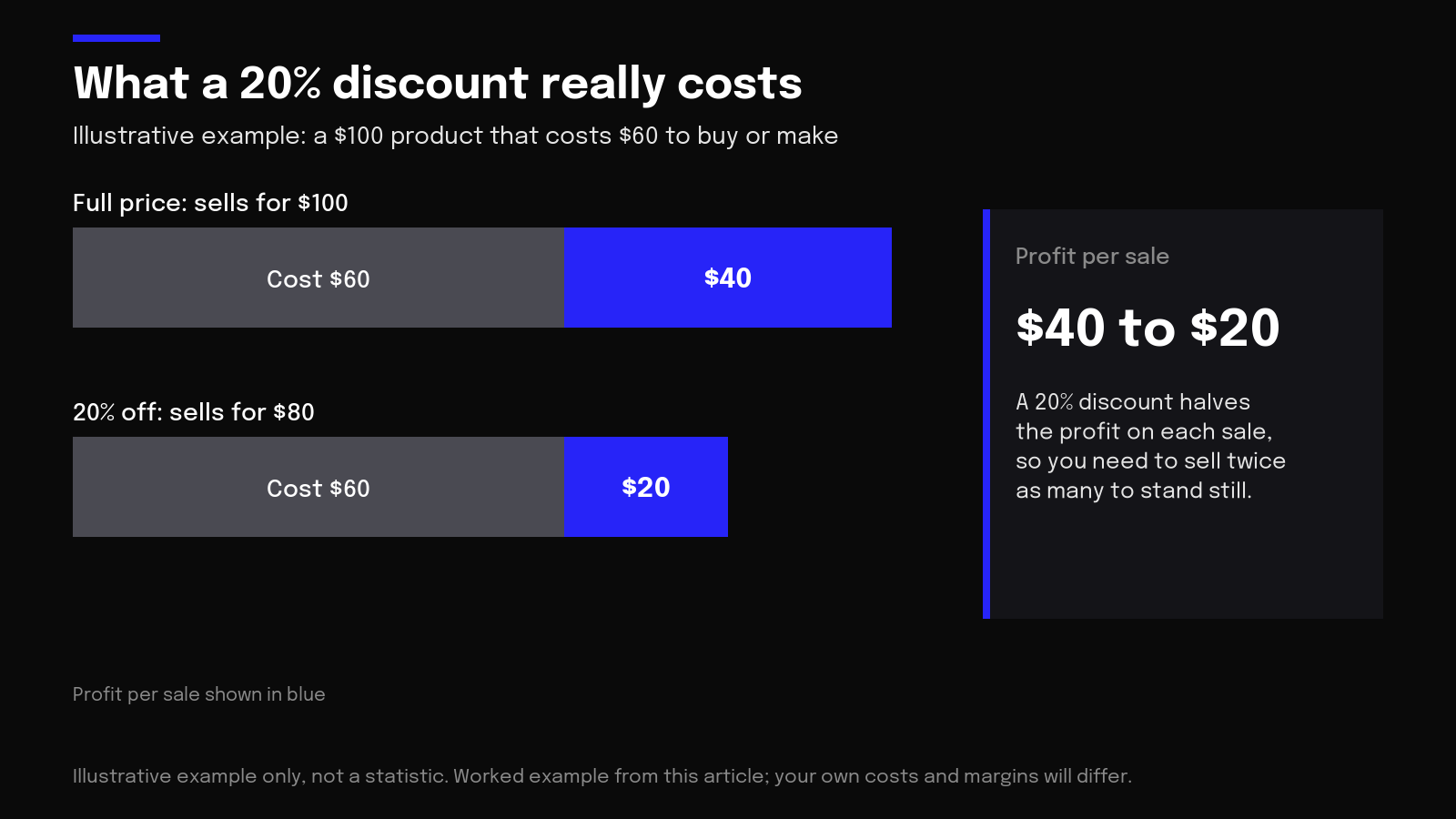
A percentage off sounds small on a poster. On your profit, it’s large. Take a product that sells for $100 and costs you $60 to buy or make. You keep $40. Take 20% off and you sell it for $80, but it still costs $60, so you now keep $20. You’ve halved your profit on every sale, which means you need to sell twice as many just to stand still.
That’s the first effect. The second and third effects are quieter but matter just as much.
Some of November’s sales are borrowed from December
When a customer buys in late November something they would have bought at full price in mid December, you haven’t won a new sale. You’ve moved an existing one forward and paid for the privilege. The ABS saw exactly this pattern last year. Household spending rose 1.0% in November 2025 and then fell in December, with clothing and footwear up 2.4% then down 2.6%, and furniture and household equipment up 2.5% then down 2.0%.
JB Hi-Fi described the same habit in its 2026 full-year results, with customers “increasingly looking for value and migrating spend to key promotional events”.
Customers learn when to wait
Deep, storewide sales can teach customers that your full price is optional. Some retailers accept that because a predictable sales calendar suits a high-volume model, but for businesses that depend on full-price sales, more customers tend to wait each year. Over time the sale stops adding demand and starts absorbing it, and the weeks either side of it get quieter.
Everyone is bidding for attention at once
In the last week of November, almost every retailer is advertising to the same people at the same time. More competition for the same attention tends to push up what each click and each sale costs. A discount that looked affordable in your planning can look very different after paying for the ads that sold it.
None of this means discounting is a mistake. Businesses discount for sound reasons: to win first-time customers they can later sell to at full price, to grow their email list while attention is at its peak, to clear ageing stock and free up cash, and to stay visible while competitors are advertising hard. Those reasons hold up best when you can follow up with the new customers and your margin can absorb the cut, so the real question is what you discount and what each discount is meant to achieve.
Who is shopping, and what they’re looking for
The big totals hide very different customers. CommBank iQ found the strongest growth last year came from the edges: spending by Australians aged 70 and over rose 8.5% and by 18 to 29-year-olds 5.9%, while 30 to 49-year-olds remained the core, contributing more than $9.5 billion.
The Retail Safari survey adds texture. Sales events matter most to younger shoppers: 85% of 18 to 34-year-olds plan to shop at one, compared with 78% of 35 to 54-year-olds and 54% of those aged 55 and over. Cost of living ranks as a top-three influence for 70% of 35 to 54-year-olds, the group carrying the most mortgages and school costs. For them, Black Friday is a budgeting tool, not a treat.
That tells you something useful. Your deal-driven customers and your loyal, less price-sensitive customers are often different people. A single storewide discount gives the same margin away to both.
Where people live
Where people live matters a little too. Western Australia was the standout state last Black Friday, with spending up 6.9% against 4.6% nationally, while NSW remained the biggest spender at $7.3 billion. Metro shoppers grew spending 4.8% against 3.9% in regional areas.
The US picture
In the United States, where Black Friday began, Adobe recorded US$11.8 billion in online spending on Black Friday 2025, up 9.1%. Its data on peak discounts is a useful reality check: around 31% off in electronics, 28% in toys, 25% in apparel and 17% in sporting goods. Even in the US, where Black Friday is most established, peak discounts in most categories stayed well short of 50%.
Choosing what to discount
The smartest Black Friday plans start by sorting your range into three groups.
Hero products
These are the few items that bring new customers through the door. They’re well known, easy to compare and often searched for by name. A genuine, eye-catching price on two or three of these gives your campaign a headline and earns attention you can then convert into larger orders.
Your full-price performers
These are products people buy from you because of your advice, quality or service, not your price. Discounting them mostly hands money to customers who would have bought anyway. Protect their price and add value instead.
Stock you need to move
Old models, overstock and end-of-line sizes are where deeper discounts make sense, because holding them costs you money and space. Clearing them during the busiest week of the year is good business.
Offers that protect your margin
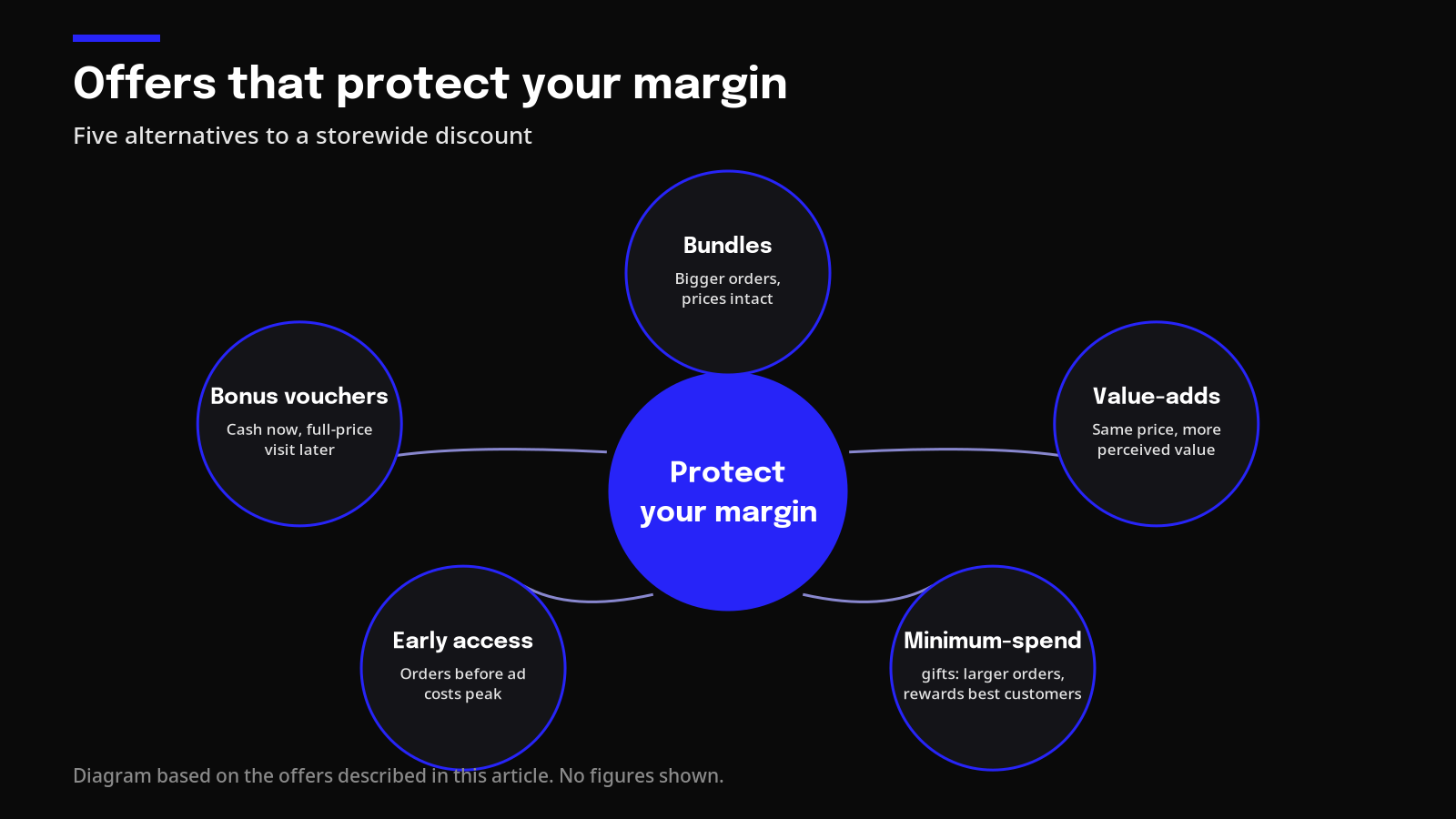
A straight percentage off is simple to promote and easy for shoppers to understand, which is why it stays popular. For everything outside your hero and clearance lines, though, these alternatives often protect more margin.
Bundles
Pair a popular product with a related one at a combined price. The customer sees a clear saving, your average order grows, and the headline price of each item stays intact. A rod and reel, a skincare routine of three products, or a service plus a follow-up visit all work this way.
Value-adds
Keep the price and add something with a high perceived value and a low cost to you: free servicing, an accessory, an extended warranty, setup or installation, or a bonus treatment. Customers often value these more than a few dollars off.
Minimum-spend gifts
“Spend $150 and receive a free gift worth $40” lifts the size of each order and rewards your best customers, rather than discounting every small sale.
Early access
Give your email subscribers and loyalty members first access a few days before the public sale. They feel valued, you take orders before ad costs peak, and you build the customer list that makes next year cheaper. Loyalty can be a very large share of sales. At Super Retail Group, which owns Supercheap Auto, BCF, rebel and Macpac, active club members accounted for between 80% and 92% of sales across its brands in FY26.
Gift vouchers with a bonus
For clinics and service businesses, a bonus on a prepaid voucher (for example, a $300 voucher with a $50 bonus credit) brings cash in now and a full-price visit later, without lowering your treatment prices.
If you’re tempted to cut prices instead, our guide to raising prices without losing your best customers explains why price has more leverage than volume, and our guide to measuring marketing by profit shows how to judge the result. Once the sales are over, our guide to keeping customers coming back in January picks up where this one ends.
What to do now
- Sort your range into hero, full-price and clearance products, and only put a headline discount on the first and last groups.
- Work out your break-even before you set any discount: how many extra sales a given percentage needs to make the same profit.
- Replace storewide percentages with bundles, value-adds and minimum-spend gifts on your full-price performers.
- Run early access for your email list and loyalty members a few days before Black Friday, and use it to grow that list.
- Keep a separate December offer, such as gift wrapping, a delivery guarantee or a gift with purchase, so Christmas doesn’t depend on more discounting.
- Set a clear end date and stick to it, so customers learn your sales are real events rather than the new normal.
- Judge the campaign on profit, not revenue: margin after discounts, ad costs and freight.
Black Friday works best as one part of a wider marketing strategy for the year, not a stand-alone event.
If you are planning your Black Friday offer, contact us or email hello@thedigitalmarketingconsultants.com.au.