Domino’s Pizza Enterprises runs Domino’s stores across Australia, New Zealand, Asia and Europe. In its FY26 results announcement to the ASX, the company said it had “reduced reliance on broad discounting” during the year and tested “more targeted value models”.

At a glance
Domino’s pulled back on broad discounting and trialled simple set prices in WA, and franchisee profit improved on fewer but better orders. We unpack what worked, what it doesn’t prove and the contrast with Guzman y Gomez. Worth reading for any business that relies on frequent promotions, especially franchise and multi-site operators.
Promotions sit right where marketing meets business strategy, which is why consulting clients ask about them so often.
What Domino’s did
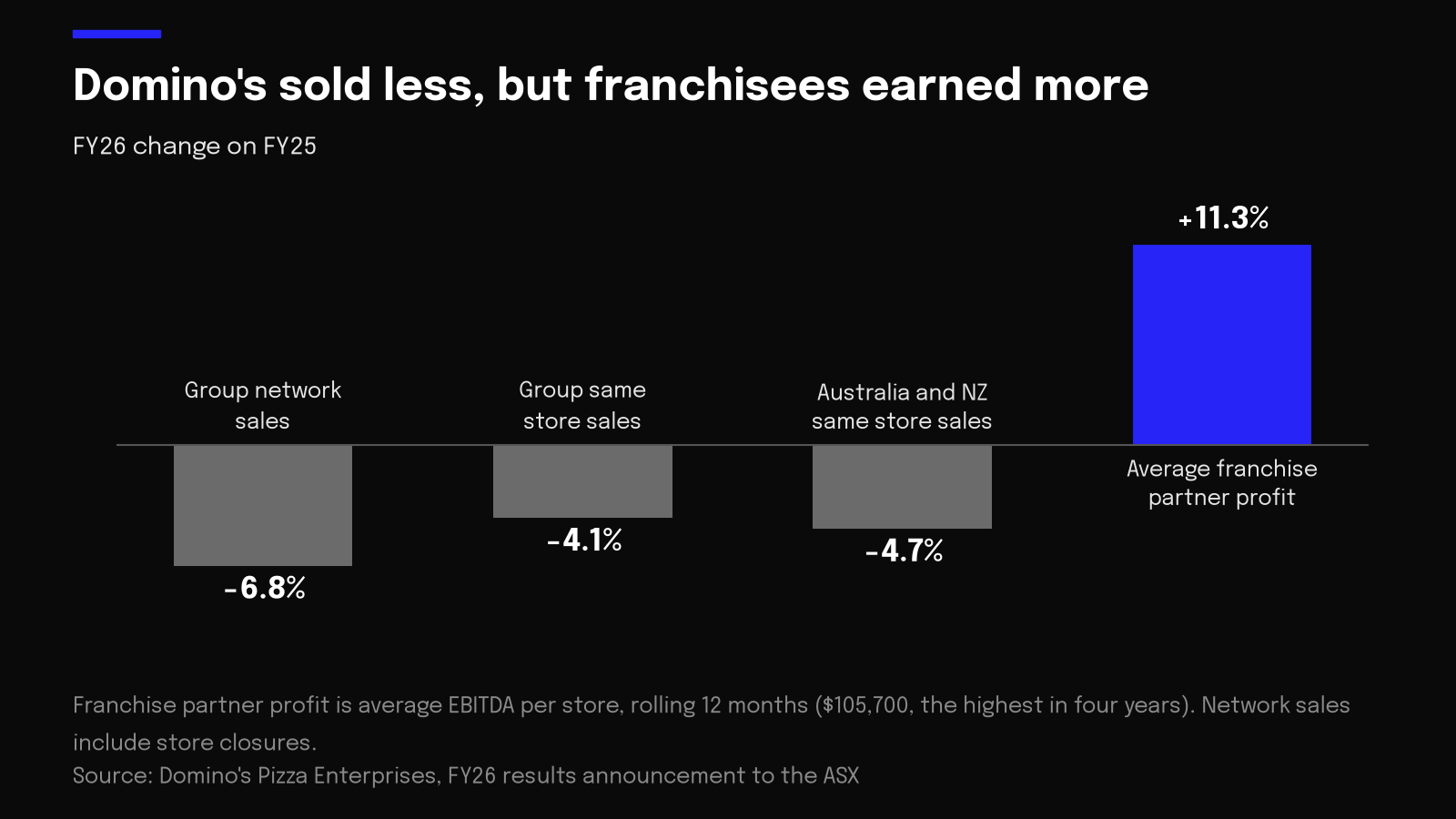
The headline numbers looked weak at first glance. Across the group, network sales fell 6.8% to $3.87 billion (including the effect of store closures), and same-store sales fell 4.1%. In Australia and New Zealand, same-store sales fell 4.7%.
But the number that matters most for a franchise system told a different story. Average franchise partner profitability rose 11.3% to $105,700 in rolling 12-month earnings per store (EBITDA, which is roughly operating cash profit), the highest in four years. The average store margin improved to 7.9%.
Executive Chairman Jack Cowin was candid about the trade-off: “We made a conscious trade-off: fewer low-margin orders in the short term to build a stronger, more sustainable system.”
The WA trial
The most interesting detail was a pilot in Western Australia. Instead of relying on vouchers, Domino’s tested “a set menu price for delivery and carry-out, with a simple low delivery fee”. The company said this “offered more transparent pricing for customers without needing to find a voucher offer”.
The result: franchisee earnings growth of more than 30% for five consecutive months, with carry-out sales growing on the year before. Domino’s now plans to “build on the lessons from the Western Australia pricing model and apply proven initiatives more broadly across the network”.
New Group CEO Andrew Gregory described what customers had been telling the business: they “want value that is easy to understand”.
Why it worked: the chain reaction
To understand why fewer sales can mean more profit, it helps to follow how each effect leads to the next.
Constant discounts shrink every order
Discounting has a clear logic for a delivery business: it keeps ovens, staff and drivers busy, fills quiet nights and wins app users who may order again. But when a large share of orders carry a discount, the business earns less on each one. Costs for ingredients, wages, rent and delivery don’t fall just because the price did. Every discounted order is doing more work for less reward.
Customers learn to hunt
When the “real” price is only available with a code, customers learn to look for codes. Many stop buying without one. The discount stops being a reason to buy and becomes the price of entry. The business ends up paying to keep customers it already had.
Complexity costs trust
A menu with many deals, conditions and codes makes customers work to find the best price. Some feel they might be missing out, or paying more than the person next to them. A simple, visible price removes that friction. That’s what “value that is easy to understand” means in practice.
Fewer orders, but better ones
When Domino’s pulled back, some deal-only customers left, so order numbers fell. But the orders that remained carried higher ticket values, and the company said “higher ticket values, cost savings and food savings supported franchisee profitability”. The business sold less, but each sale was worth more.
What it doesn’t prove
It’s worth being honest about the limits. Domino’s itself says order volumes “remain below where the business wants them to be”, and its focus for FY27 is rebuilding customer frequency. Pulling back on discounts cost it some customers. The lesson isn’t that discounting is always wrong. It’s that broad, automatic discounting can cost more than it earns, and that a clear, fair price can win back profit even if it takes time to rebuild volume.
It’s also one company in one category. Pizza is a frequent, low-cost purchase with a lot of competition. The same principle applies elsewhere, but the details will differ.
A useful contrast: value without discounting
Guzman y Gomez offers a helpful comparison from the same industry. In its FY26 results, GYG said it “continued to prioritise value”, keeping “menu price growth well below the level of cost growth”. It was rewarded with transaction growth that outpaced its 5.3% comparable sales growth, and its restaurant margin still rose to 20.3%.
The two businesses took different routes, but both reached the same destination: customers responded to value that felt fair and consistent, not to a constant stream of codes.
Who this matters for
Businesses that run frequent promotions
Clinics with monthly specials, retailers with rolling sales, cafes with app codes and service businesses with “first visit” discounts that end up applying to every visit are all exposed to the same trap. The more automatic the discount, the more profit it quietly absorbs.
Franchise and multi-site businesses
In a franchise, the owner of each store bears the cost of every discount. A head office promotion that lifts total sales can still leave individual operators worse off. Domino’s results show why measuring franchisee profit, not just network sales, changes decisions.
Western Australia
The trial happened in WA. The company hasn’t said why WA was chosen or whether results would differ in other states, so it would be unwise to read too much into the location. What is clear is that Domino’s plans to apply the lessons more broadly across its network, which suggests it believes the approach travels.
Our guide to smarter Black Friday offers applies the same thinking to the sales season, and our guides to measuring marketing by profit and raising prices without losing your best customers cover the numbers behind it. For a way to offer value without discounting at all, see our guide to a good, better, best range.
What to do now
- Review the past year of promotions and ask which ones brought in new, profitable customers and which simply discounted sales you’d have made anyway. Business.gov.au’s guide to choosing a pricing strategy has a useful section on planning discounts.
- Replace rolling or automatic discounts with a simple, fair everyday price or a clear package price that customers can understand at a glance.
- Keep one or two targeted offers for genuinely new customers or slow periods, rather than discounts that anyone can find.
- Use value-adds instead of price cuts where you can: an extra service, a bonus product or a lower delivery fee.
- Measure profit per order and profit per customer, not just sales volume.
- If you change your pricing, explain it plainly. Customers respond well to “one fair price, no codes needed” when it’s genuine.
- Heading into Black Friday, apply the same thinking: a few strong, deliberate offers will usually do more for your profit than a storewide discount.
How and when you discount should be a deliberate part of your marketing strategy, not a habit.
If you would like a fresh look at your own promotions and pricing, contact us or email hello@thedigitalmarketingconsultants.com.au.