
Busy nights tend to look after themselves. The real opportunity lies in the quiet periods, in an experience good enough to talk about, and in a guest list that brings people back. Each comes down to one question, which runs through this guide: what gives a guest a reason to find you, and a reason to return?
Because hospitality marketing runs on word of mouth, PR, creators and local guides are often the best value. Paid ads work well for events, offers and high intent searches, but results vary, so we recommend testing small.
At a glance
Get discovered through your Google profile, PR, creators and organic social. Fill one or two quiet nights with a named event or offer, run for at least four weeks. Build a guest list from day one and use it for birthdays and events. Then ask for reviews by the next day, because that is when food and drink guests expect it.
In this guide:
- How guests find a venue
- The three stages at a glance
- New venue (early stage): launch PR, Google and a guest list from day one
- Growing venue (medium): fill the quiet nights
- Hospitality group (large): a venue by venue calendar and VIP retention
- Why the basics matter, and the easy way to do them
- Do paid ads pay for hospitality?
- SEO for venues
- Creators and short video
- Compliance checklist
Fill the quiet nights by giving regulars a reason to come back and new guests a reason to find you.
How guests find a venue
How guests find you depends mostly on where you are and what you are promoting. A venue in a busy area can rely on people searching nearby, while a suburban venue usually needs to create interest. The table below shows what usually works in each situation.
| Situation | What usually works |
|---|---|
| Busy CBD or entertainment area | Google search on high intent terms such as “brunch near me”, plus a strong Google profile |
| Suburban venue | Social, creators, local guides and community, to create demand |
| Events, functions and offers | Small Meta campaigns judged on covers, plus your guest list |
| Regulars | Birthday offers, guest list emails and a reason to come back |
The three stages at a glance
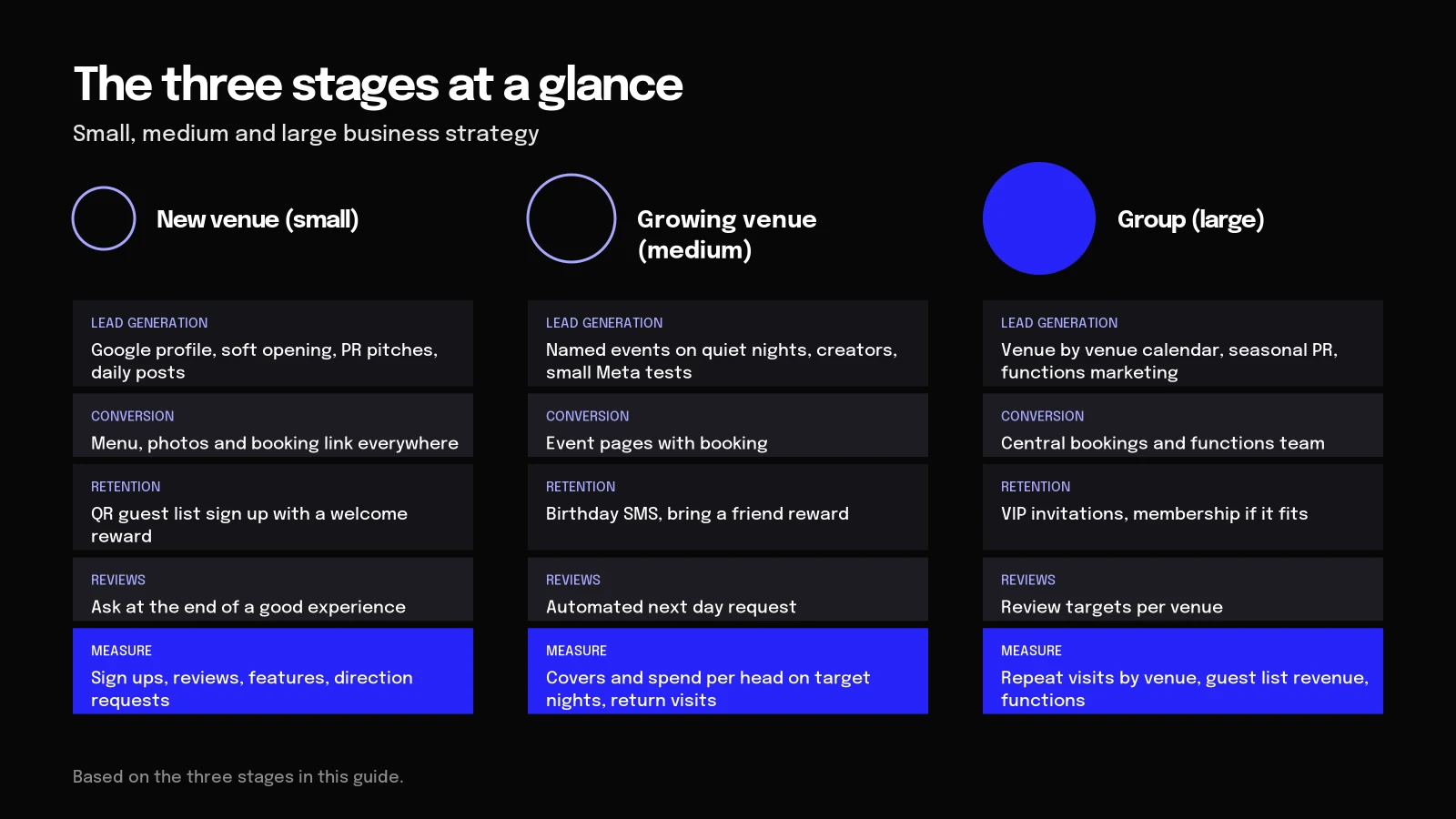
Those patterns shape a different plan at each stage. The table summarises what we recommend for a new venue, a growing venue and a group, and the sections that follow explain why.
| New venue (small) | Growing venue (medium) | Group (large) | |
|---|---|---|---|
| Lead generation | Google profile, soft opening, PR pitches, daily posts | Named events on quiet nights, creators, small Meta tests | Venue by venue calendar, seasonal PR, functions marketing |
| Conversion | Menu, photos and booking link everywhere | Event pages with booking | Central bookings and functions team |
| Retention | QR guest list sign up with a welcome reward | Birthday SMS, bring a friend reward | VIP invitations, membership if it fits |
| Reviews | Ask at the end of a good experience | Automated next day request | Review targets per venue |
| Measure | Sign ups, reviews, features, direction requests | Covers and spend per head on target nights, return visits | Repeat visits by venue, guest list revenue, functions |
New venue (early stage): launch PR, Google and a guest list from day one
A new venue needs to be found quickly, and Google is usually the first place people check. Complete your Google Business Profile with your menu, photos and hours, and keep an eye on its Performance tab. People often Google a venue after seeing it somewhere else, so direction requests are a strong sign that your other marketing is working.
From there, give people a reason to talk about you. Host a soft opening for locals, neighbouring businesses and local creators. Pitch Urban List, Broadsheet, local papers and “hidden gem” style features with a clear story about what makes you different. Post organically every day too, because a simple photo of the day’s specials costs nothing and can reach a surprisingly large local audience.
To convert that interest, put your menu, booking link and hours on every profile, so guests can decide in seconds. This is also the moment to start your guest list, with a QR code on every table and a welcome reward, because everyone who joins can be invited back without paying to reach them again. Ask for reviews at the end of a good experience and follow up with a direct link. In these early months, measure sign ups per week, reviews, features secured and Google profile direction requests.
Growing venue (medium): fill the quiet nights
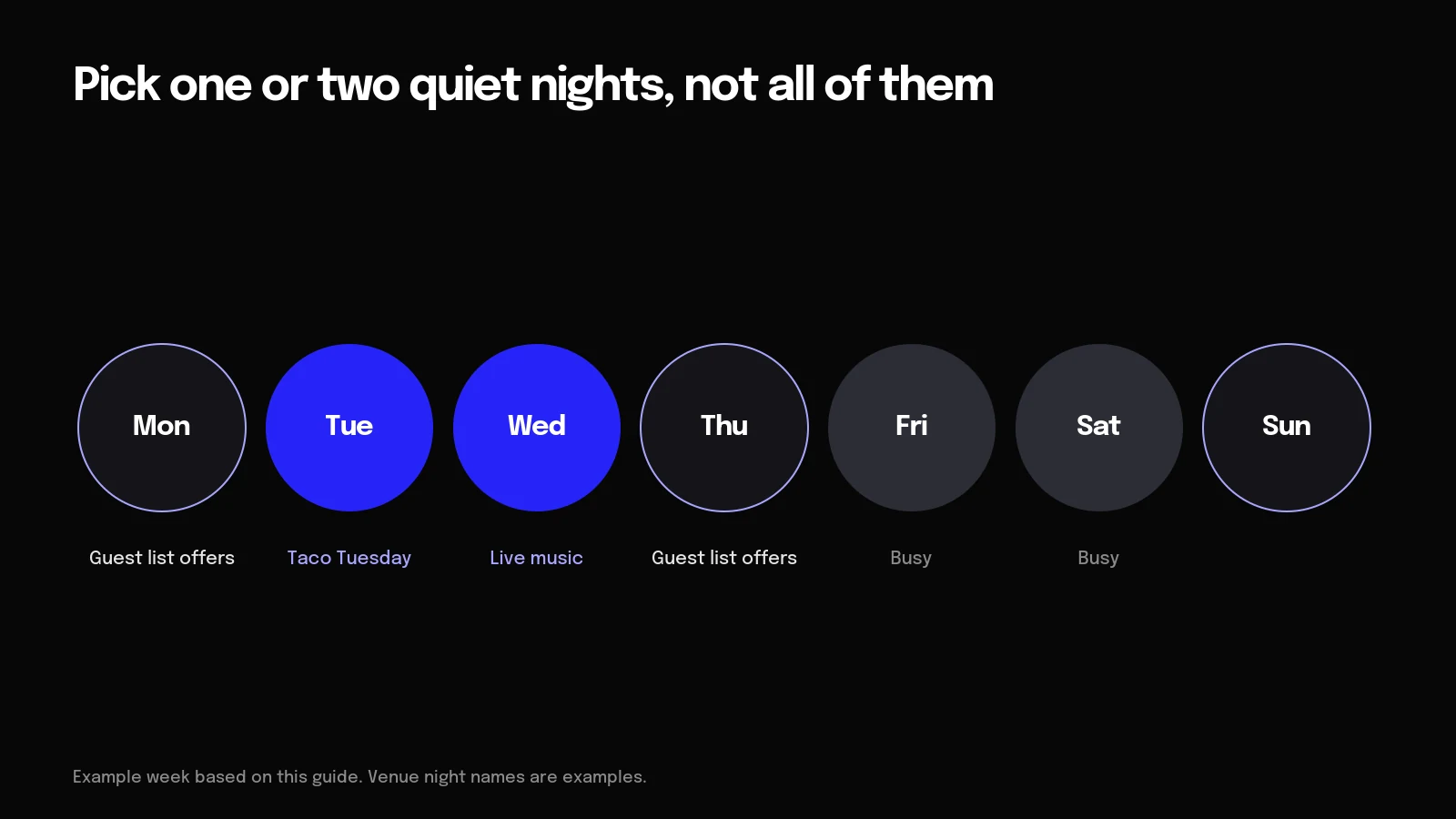
Once the venue is established, the biggest gains usually come from your slowest nights. We suggest picking one or two of them, rather than trying to fix every night at once, and giving each a named event or offer. A catchy name helps people remember it, which is why ideas like Taco Tuesday stick. Match the event to your venue and guests, too. Live music tends to keep people staying and spending, trivia often brings more of a dinner crowd, and a game night may not suit an upscale room at all.
An event also gives you something specific to promote. Invite creators when you have something genuinely unique to show, and run small Meta tests for the event, judged on covers rather than likes. Give every event its own booking page or link, so it is easy to say yes.
The guest list you started at opening now starts to pay its way. Send a birthday offer by SMS a week before the date, and offer a “bring a friend” reward. Automate a review request by the next day from your booking or POS system. Then measure covers and spend per head on your target nights, birthday redemptions and return visit rate.
Hospitality group (large): a venue by venue calendar and VIP retention
A group can take the same ideas further with a marketing calendar for each venue, built around seasonal PR moments. Private events and functions deserve their own marketing at this size, because they carry a much higher value per booking.
Consistency across venues then becomes the main task. A central bookings and functions team with fast replies keeps conversion strong, and central guest data lets you recognise your best regulars wherever they visit and invite them to tastings and launches. A paid membership can work too, provided it genuinely fits the brand. Set review targets and reply standards per venue, and measure repeat visit rate by venue, revenue from the guest list and functions booked.
Why the basics matter, and the easy way to do them
Every stage rests on a few simple habits, and we know how hard they can be to keep. Teams are often casual, rostered and flat out during service, and owners have little spare time for marketing. That is why the easiest wins are the ones your systems run for you.
Reviews show why these habits are worth protecting. BrightLocal’s 2025 survey found 48% of consumers expect a food and drink review request by the following day, and only 4% say they never read reviews. The difficulty is that staff are busy serving, rosters change and nobody owns the follow up.
The easy way is to automate what you can and give one person ownership of the rest. QR codes on tables and receipts can do the asking, and your booking or POS system can send review and birthday messages. One manager can then own the events calendar, with a week of social posts batched in a single sitting.
Tip: Give each new event at least four weeks before you judge it, because locals take time to catch on. Weekly events also tend to stick better than fortnightly ones. Even good events fade over time, so refresh the format every so often.
Do paid ads pay for hospitality?
Sometimes, and the answer depends on what a booking is worth. With a meal worth a few dozen dollars, Google often does not pay on a first visit, so it suits high intent searches in busy areas and functions. Quinn Marketing’s keyword research estimates about $5.04 a click for “restaurants near me”, with very high search volume (AUD, October 2024, so check locally). In the US, WordStream reports a Google cost per lead of $30.27 for restaurants, compared with $3.16 on Meta.
That is why, for everyday dining, Meta ads, creators and your guest list usually return more. As part of a wider advertising mix, social ads can still work for events and offers, but they reach people who were not looking for a meal, so promote something specific and track covers. The Google Ads vs Meta economics section of our hub guide shows the maths, and our complete guide to Google Ads and guide to Facebook and Meta ads cover each platform.
SEO for venues
Search plays a quieter, longer term role. Hospitality search is a volume contest, and the venues that do well invest in local SEO: a complete Google Business Profile, steady reviews, a fast mobile site with the menu as text (not just a PDF), and pages for functions and events. Getting your venue onto “best of” lists and articles is also worth the effort, because AI search tools draw on those sources when people ask for recommendations. Our guide to what SEO is and how it works covers the basics.
Creators and short video
Those lists are one form of word of mouth, and creators are another. Creators and short video can be some of the best value marketing a venue does, provided you have something unique to show. Choose local creators whose audience matches your guests, and be clear about what you offer in return. Short video on TikTok and Instagram Reels can also drive bookings when you post consistently and show the experience, not just the food. Whatever you try, make sure gifted meals are clearly disclosed, in line with ACCC guidance.
This brings us back to where we started: PR, search and creators give guests a reason to find you, while events and your guest list give them a reason to return. For how product, price, place and people fit together, see our guide to the 7Ps of marketing.
Compliance checklist
Hospitality marketing touches pricing, alcohol, music and messaging, so check each campaign against these points first.
- Card surcharges: from 1 October 2026, eftpos, Mastercard and Visa rules no longer allow card payment surcharges. Weekend and public holiday surcharges are not affected. See the RBA’s surcharging FAQs.
- Drip pricing: from 1 July 2027, per transaction charges such as booking fees must be shown clearly next to the advertised price, under the Competition and Consumer Amendment (Unfair Trading Practices) Act 2026. Follow the ACCC’s price display rules now.
- Alcohol: follow the WA guidance on responsible promotion of alcohol, the WA mandatory website information and the ABAC Responsible Alcohol Marketing Code.
- Music: live and recorded music events need the right licence, such as from OneMusic.
- Reviews and creators: follow the ACCC’s online reviews guidance, and make sure creators disclose gifted meals.
- Competitions and messages: avoid “like and share to win” posts, which can breach Meta’s promotion rules, and follow the Spam Act for SMS and email.
This guide is general information, not legal advice. Check current liquor, pricing and advertising rules for your venue.
If you’d like busier quiet nights and more regulars, talk to our team or email hello@thedigitalmarketingconsultants.com.au. We’ll share the ideas we’d test first for your venue.