
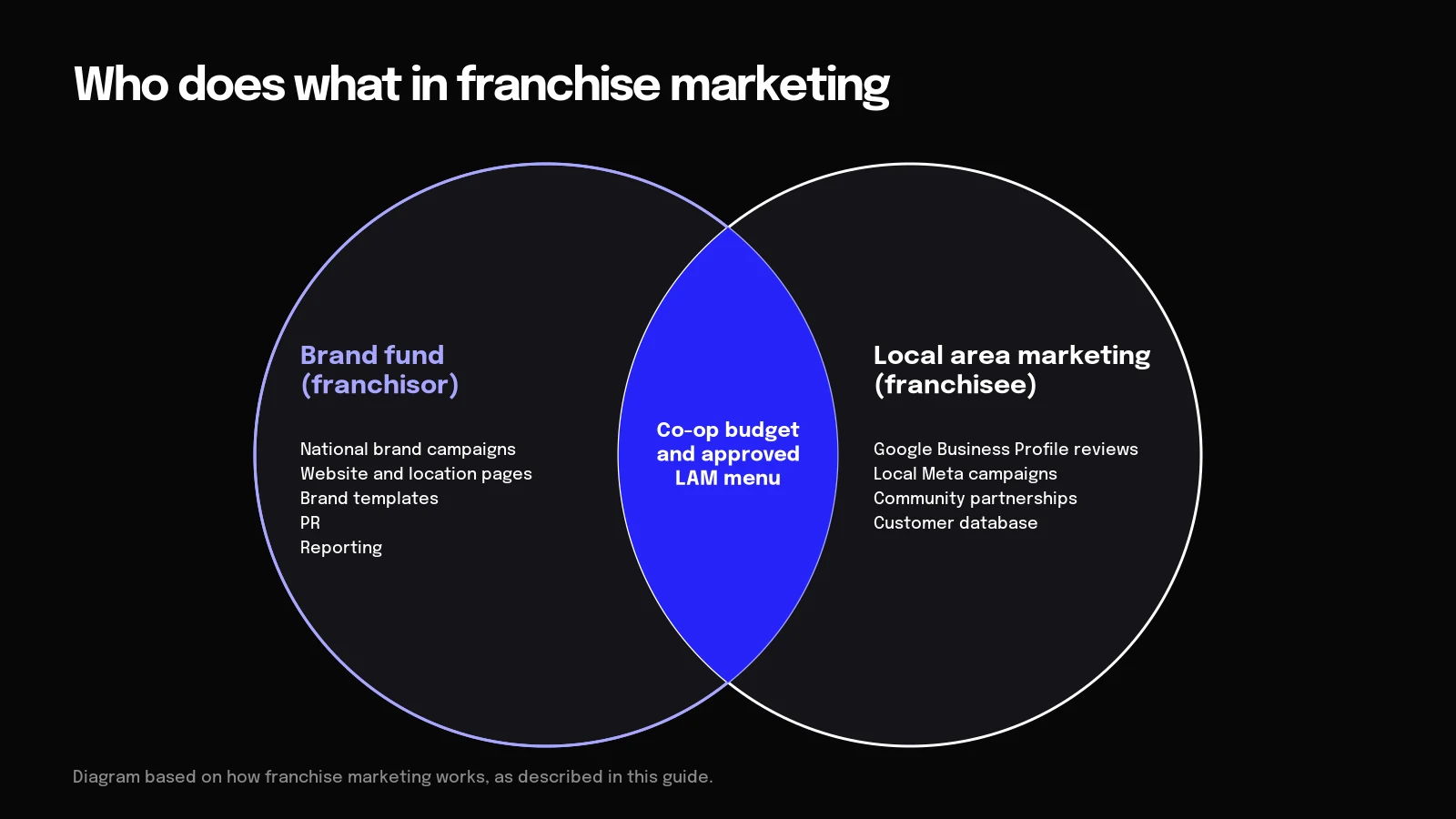
Franchise marketing works on two layers. The brand fund builds awareness for the whole network, while local area marketing fills each location with customers. Both matter, and the networks that grow most smoothly are the ones that are clear about who does what.
That question of who does what runs through this guide. Once franchisors and franchisees agree on it, each side can focus on the work it does best, and the network’s marketing can grow in stages. We set out one recommended plan for an early network with its first few sites, a growing network and a large network, covering lead generation, conversion, retention, reviews and measurement for both franchisors and franchisees.
At a glance
The brand fund builds the brand. How much it fills any single location varies by system, so every franchisee also needs a local lead generation plan. Franchisors keep the network on side with clear fund reporting, approved local campaign templates and results by site.
In this guide:
The brand fund builds the brand, but every franchisee still needs a local plan to fill their own location.
Key terms, in plain English
A few terms come up throughout, so it helps to define them first.
- Brand fund or marketing fund: the levy franchisees pay for network marketing. Under the Franchising Code it is a specific purpose fund.
- LAM (local area marketing): what an individual franchisee does in their own territory.
- Co-op budget: local funds pooled or matched between franchisees or with the franchisor.
How franchise marketing works
The brand fund exists for the network as a whole. The ACCC notes that paying into a marketing fund “does not mean that the franchisee’s individual business must be promoted or advertised using money from the fund” (ACCC: specific purpose funds). This is simply how the model is designed. The fund builds the brand, and local leads come from local work. Planning both together is a core part of marketing strategy, and our consulting team often helps franchisors set that split.
Buying a franchise therefore gives you a proven system, but the system still needs local effort to fill your location. In our experience, the quickest way to lift a slower site is to talk to the most successful franchisees in the network and adopt what they do locally.
Good local work also depends on good measurement. When a new location’s ads seem to underperform, the cause is often a form or a conversion tracking setting rather than the campaign itself. Checking that enquiries are being recorded properly, before judging the channel, keeps good campaigns from being switched off too early.
Why the basics matter, and why they are hard
With the roles clear, the next question is which local habits matter most. Repeat customers carry a new location through its first year, because a return visit from someone already on your list usually needs far less ad spend than winning a new customer. Reviews then strengthen every other channel. In the US, BrightLocal’s 2025 survey found 71% of adults always or regularly read reviews for local businesses (BrightLocal).
The challenge is time and coordination. Franchisees work in the business all day, and every local campaign has to follow brand approvals. Franchisors, meanwhile, support many sites, each with its own local conditions.
The answer is to make the right thing easy for everyone. Templates supplied by the franchisor and a pre-approved LAM menu let franchisees launch a campaign in minutes. Automated review requests and return offers from the network platform take the remembering out of it. A monthly report for each site then shows franchisees what is working, which brings us to how this looks at each stage.
Stage 1: Early network (first few sites)
Recommended strategy: a local launch and retention playbook every franchisee follows.
In an early network, each new site is also a test of the playbook, so the launch deserves careful planning. We recommend verifying the Google Business Profile before opening, with photos, hours and services in place, so every location starts building local SEO from day one. Then build a sign-up list over the six weeks before opening, promoted locally and online. A soft opening for neighbours, local businesses and local creators gets people talking early, and the invitation can be simple: “We’re opening [date]. Come in on [soft opening date] as our guest and tell us what you think.”
Paid ads can then build on that early interest. An opening offer on Meta (Facebook and Instagram) to a tight radius, with a unique code, makes results easy to trace, and our Facebook and Meta ads guide explains the setup. Local partnerships complete the picture, such as staff discounts with neighbouring businesses or fundraising nights with local schools and sports clubs.
Because all of this relies on accurate data, test every location’s booking and enquiry forms before launch, so good campaigns are judged on real results. Train staff to welcome first-time customers warmly and to capture their details. Those details become a local customer database, with birthday and return offers sent through network tools where they are available.
Reviews should start from day one. Put a QR code on the counter and the receipt, and have staff invite customers to leave a review when they are clearly happy. To see how the launch is going, track sign-ups, customers in the first 90 days, return rate and reviews, with the franchisor reporting results for each site monthly.
Stage 2: Growing network
Recommended strategy: a clear fund split and real support for local marketing.
As a network grows, trust becomes as important as tactics, and trust grows when franchisees can see the numbers. Publish the split between what the fund spends on brand and what it spends on local activation. Then offer an approved LAM menu of templates, budgets, tracking codes and ready-made local ad campaigns. A franchisee request can be as simple as: “I’d like approval to run a local Meta campaign in [postcodes] using brand templates, budget $[x] for 8 weeks, tracked with a unique code. I’ll share results with the network.”
Sharing results this way lets the whole network learn from its best performers. At the same time, location pages for each site build SEO (search engine optimisation) for the network, and our guide to what SEO is explains how.
Consistency then turns that demand into customers. Use the same scripts and offers at every site, with local flexibility where the data supports it. A network-wide loyalty and email programme that each franchisee can see and use keeps customers coming back, and showing review volume and rating by site in the monthly report keeps reviews front of mind.
Governance holds all of this together. In our view, a franchisee advisory council that reviews marketing each quarter keeps trust high. The franchisor usually controls the ad fund under the franchise agreement, so communicating changes to local ads before they happen keeps everyone aligned. At this stage, watch leads and same store sales by site, repeat rate, and local marketing spend against results.
Stage 3: Large network
Recommended strategy: central performance marketing plus local co-op budgets.
A large network can do centrally what individual sites cannot, while still letting each location speak to its own community. Manage location pages and Google profiles centrally so every site is accurate. Run Google Ads where search volume supports it, and test every location’s forms and tracking before judging results. Our Google Ads complete guide covers conversion tracking. Meta campaigns by territory then create demand, co-op budgets let franchisees direct spend locally, and national PR lifts the brand as a whole.
The same balance applies to customers. Where the model suits, handle bookings or enquiries centrally and report response times by site. Use loyalty data across the network to send local offers to lapsed customers. Monitor reviews centrally but reply locally, so customers hear from their own store.
Measurement at this size reflects both layers. Focus on cost per customer by site, franchisee satisfaction with marketing, and fund transparency.
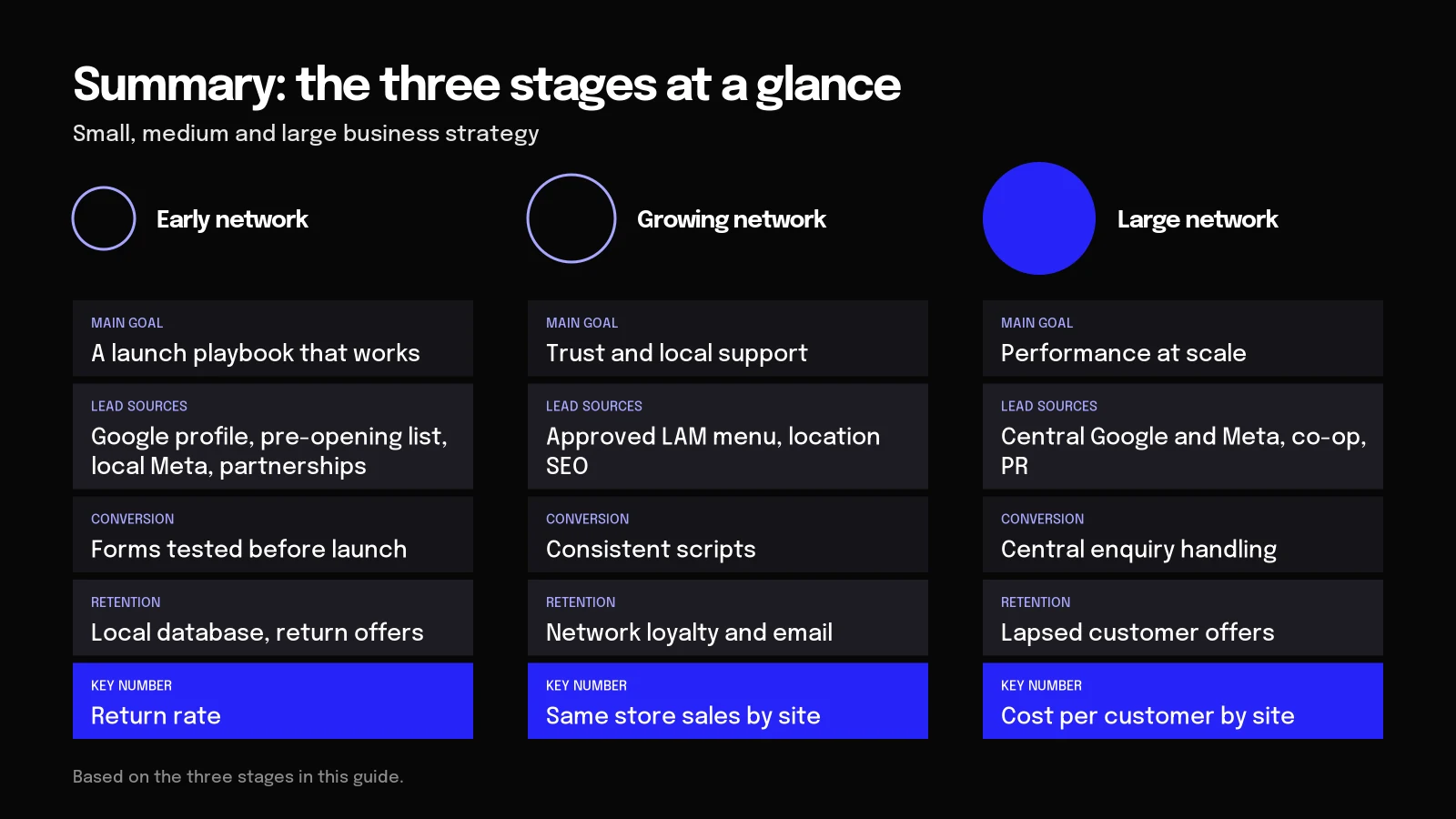
Summary: the three stages at a glance
| Early network | Growing network | Large network | |
|---|---|---|---|
| Main goal | A launch playbook that works | Trust and local support | Performance at scale |
| Lead sources | Google profile, pre-opening list, local Meta, partnerships | Approved LAM menu, location SEO | Central Google and Meta, co-op, PR |
| Conversion | Forms tested before launch | Consistent scripts | Central enquiry handling |
| Retention | Local database, return offers | Network loyalty and email | Lapsed customer offers |
| Key number | Return rate | Same store sales by site | Cost per customer by site |
Do ads pay for franchises?
It depends on what you sell. Low ticket franchises, such as food and retail, often do not recover the cost of Google Ads on a first purchase and rely on repeat visits to make the numbers work. Service franchises with higher job values often can. In our experience, Meta to a tight radius suits openings and offers, while Google captures people who are already searching for the service. The practical approach is to test, track cost per paying customer by site, and keep what works.
For the maths on CPC, cost per lead, cost per customer, break-even and lifetime value, with a worked example, see the Google Ads vs Meta economics section of our industry marketing guide.
Compliance checklist
Both layers of franchise marketing sit within the Franchising Code and consumer law, so these points apply across the network.
- Specific purpose funds: a new Franchising Code started on 1 April 2025, with fund rules applying from 1 November 2025. Franchisors must keep contributions in a separate account, contribute for corporate units on the same basis as franchisees, prepare an annual fund statement within 4 months of the financial year end, have it audited unless 75% of contributing franchisees vote otherwise, and give it to franchisees within 30 days (ACCC; ACCC summary of 2025 code changes).
- Fund statements must be meaningful. The ACCC notes that a line such as “social media” without detail is unlikely to comply.
- Card surcharges: eftpos, Mastercard and Visa ban card payment surcharges from 1 October 2026. The change does not cover weekend or public holiday surcharges (Reserve Bank of Australia).
- Drip pricing: from 1 July 2027, per transaction charges such as booking or delivery fees must be displayed clearly next to the base price (Competition and Consumer Amendment (Unfair Trading Practices) Act 2026).
- Australian Consumer Law for network advertising and pricing (ACCC price displays).
- Spam Act and Privacy Act for network customer databases (ACMA).
Inside Franchise Business has practical local area marketing tips for franchisees. For how product, price, place and promotion fit across a network, see our guide to the 7Ps of marketing.
Want every location in your network to grow with confidence? Contact our team or email hello@thedigitalmarketingconsultants.com.au and we’ll help you get the brand fund and local marketing working together.