
Choosing aged care is one of the hardest decisions a family makes, and it often has to be made quickly, after a fall or a hospital stay. In that moment, families are looking for one thing above all: a provider they can trust with someone they love. They judge that trust on what they see and feel when they visit, on the staff and the food, and on the star ratings.
That makes trust the thread running through this guide. The job of aged care marketing is to make your service easy to find, easy to trust and quick to respond. We set out one recommended plan for a single home or new Support at Home provider, a growing provider and a large group, covering lead generation, conversion, retention, reviews and measurement.
At a glance
Enquiries come mostly from referrers (hospital discharge teams, GPs, social workers and placement consultants), word of mouth and Google. Respond the same day, offer a genuine visit, explain fees in plain English, and keep families informed once their loved one moves in. Their word of mouth brings the next family.
In this guide:
Families choose the provider they trust. Fast replies, honest fees and genuine visits earn that trust.
How aged care marketing works
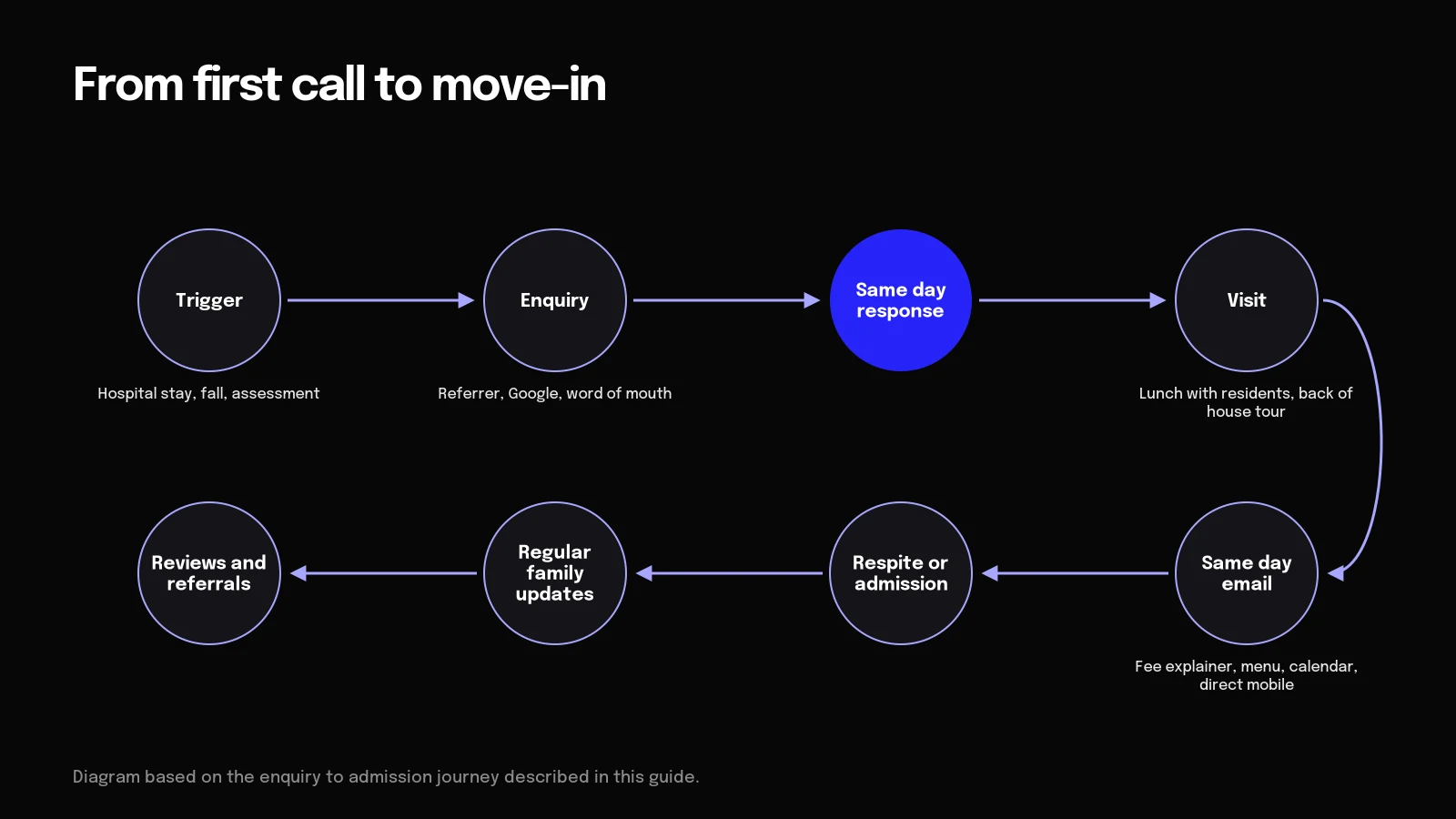
Because families decide under pressure, many of them turn first to people they already trust. Word of mouth tends to bring the visits most likely to lead to an admission, followed closely by hospital social workers, discharge teams and rehabilitation services. That is why referrer relationships sit at the heart of every plan below.
Once a family has your name, speed becomes just as important. Families often contact several providers at once, and the provider who answers warmly and offers a visit first is often the one they visit. The visit then does most of the deciding. Families notice natural light, ensuites, real menus, a fresh and clean feel, and whether staff smile and greet them as they walk through.
The relationship continues long after admission, because families stay closely involved in their loved one’s care. In aged care, retention really means family satisfaction, and satisfied families are the ones who write reviews and bring the next family to your door.
Why the basics matter, and why they are hard
If the visit decides so much, the first conversation decides whether the visit happens at all. A clear, kind response often wins it. Many families also find the aged care system confusing, because assessments through My Aged Care can take time and fees are hard to estimate without help. A plain English fee explainer fills that gap and shows your team as the people who make things easier.
Doing this consistently is harder than it sounds. Enquiry calls often reach clinical or admin staff who are already covering shifts, and workforce shortages in aged care are well documented, especially outside metro areas (PubMed Central). The calls simply arrive at a busy moment.
The good news is that three small changes solve most of this. First, name one enquiry owner and a backup, and divert enquiry calls to their mobile. Second, keep a same day email template ready with the fee explainer, menu and activity calendar. Third, write the monthly referrer update from a template, so it takes minutes rather than an afternoon.
Stage 1: Single home or new Support at Home provider
Recommended strategy: be easy to find, easy to trust and quick.
A single home or new provider does best by making sure the people already looking can find it. Start by completing your Google Business Profile and My Aged Care details, with real photos, care types and contact details. A complete profile is the foundation of local SEO, and it supports every other part of your search engine optimisation. From there, build a list of referrers, including hospital discharge teams, GP practices, local social workers and placement consultants. Give each one a named contact and a monthly update on vacancies by care type and respite availability. Local community Facebook groups are worth using too, and it helps to have a short description ready that covers what you specialise in, the funding you accept, room types, meals, laundry and activities.
Your offers should build the same trust. A respite stay works well as a gentle trial, as do lunch with residents during the visit and a plain English walk through the fees. Sensible pricing matters here as well, because a price far below nearby providers can leave families wondering what is missing.
When an enquiry arrives, respond the same day. A gentle opening helps: “I’m sorry you’re dealing with this; it’s a big decision. Can I ask a little about [Mum or Dad] and what’s happened recently?” Then offer a visit with two specific times, ideally over lunch. We also recommend offering a tour of the kitchen, pantry and laundry before families ask, because it shows openness and confidence. Publishing your real activity calendar, menus and fees on your website reinforces the same message.
Once a resident moves in, keep their family updated from the first week, by phone, app or email. That steady contact is also the natural moment to ask for a review. Ask every family, at a set point such as after the first month, with consent and dignity. Inviting every family, rather than only the happiest ones, keeps you within Google’s review policy, which does not allow review gating. Families value detailed reviews, so invite people to describe what the experience was really like.
To see what is working, track enquiries by source, your response time and the share of visits that become admissions.
Stage 2: Growing provider
Recommended strategy: educate families and become part of the community.
Once enquiries arrive reliably, a growing provider can start reaching families earlier in their search, while they are still learning. Content that answers real questions does this well. Write about costs, assessments, how to choose a home and what to ask on a visit. In our experience, this kind of SEO (search engine optimisation) content takes about 6 to 12 months to build, and our guide to what SEO is and how it works explains why. Community events at the home, such as open days or morning teas, bring families and referrers through the door in a relaxed way.
Because families often research for months, it also pays to stay in view while they decide. Retargeting, which shows ads to people who have already visited your website, does exactly that, and our Facebook and Meta ads guide covers the setup. Placement consultants can become a useful referral channel at this stage too, because they help families narrow their options. Check and disclose any fee arrangements with them.
The visit remains the turning point, so the follow-up deserves equal care. Send a same day email after each visit with a thank you, the fee explainer, the calendar, the menu and the direct mobile of the person the family met. During the visit, let families see everyday life, such as a meal in the regular dining room, and make sure staff engage warmly. Those small moments leave a lasting impression.
As your resident numbers grow, family feedback becomes more valuable. A family feedback group that meets regularly, with visible changes made from its suggestions, shows families they are heard. Request reviews from every family at set points, reply thoughtfully to every review, and watch visits booked, admissions by source and your review rating.
Stage 3: Large provider
Recommended strategy: a central enquiry team, with separate funnels for each service.
At scale, the challenge shifts from finding families to serving each type of family well. Residential care, Support at Home and retirement living each attract different searches and different questions, so we recommend a separate funnel for each. Paid search can play a larger role where tracked admissions justify it, and our Google Ads complete guide explains how to track calls through to outcomes. PR built on resident stories, shared with consent, builds reputation across the group. If you work with placement agents, choose local, proven ones who visit your homes before referring families, and review and disclose any fees.
Consistency holds this together. A central enquiry team with consistent scripts handles the first call, and local staff who know the home and its people then host the visit, so families get both a reliable response and a personal welcome.
Trust at this size also depends on what families can see. Make star rating and quality improvements visible, track ratings by home, and share them with home managers each month. The numbers that matter most now are enquiry to admission by home, occupancy and the time it takes to fill a vacancy.
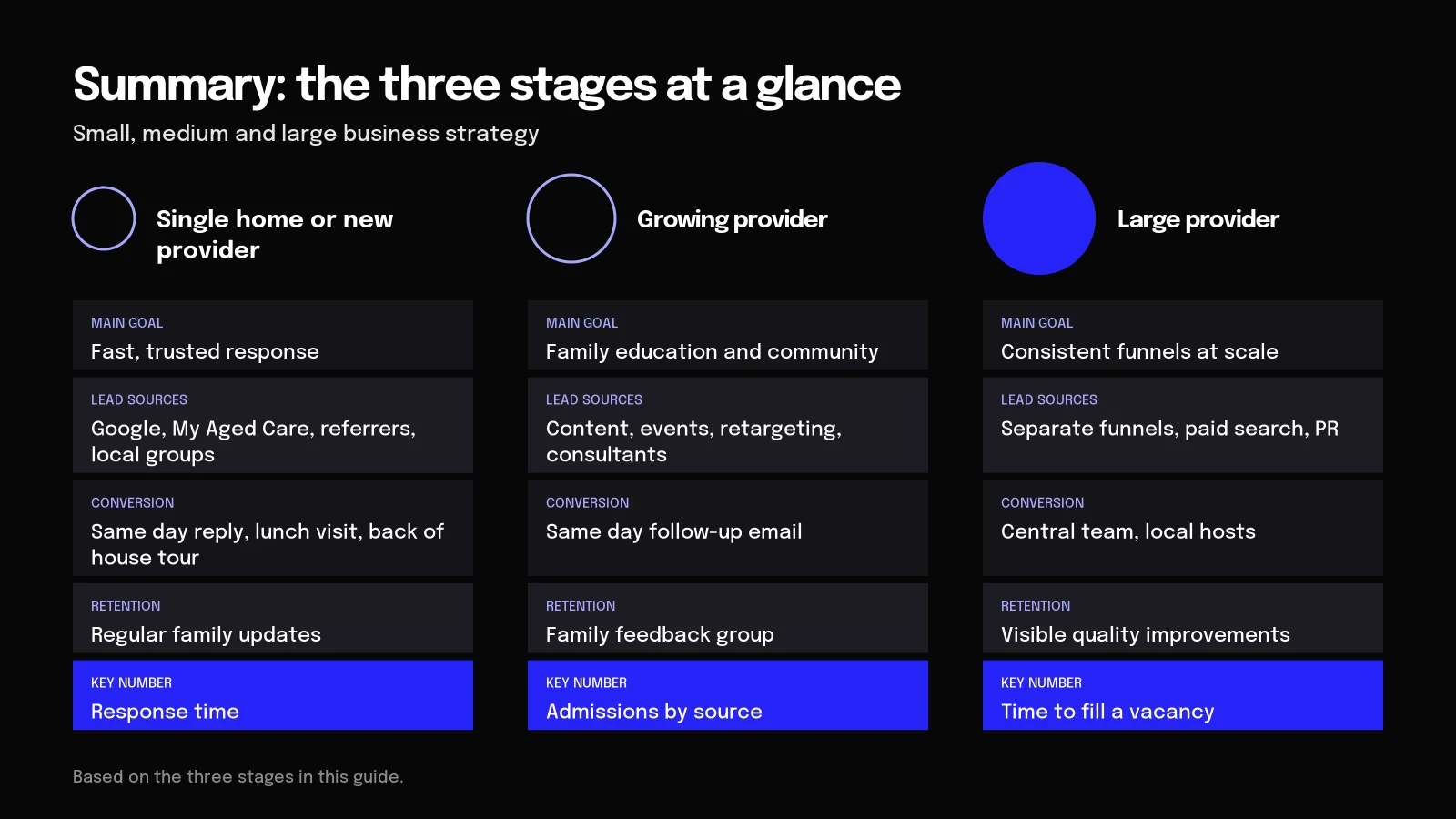
Summary: the three stages at a glance
| Single home or new provider | Growing provider | Large provider | |
|---|---|---|---|
| Main goal | Fast, trusted response | Family education and community | Consistent funnels at scale |
| Lead sources | Google, My Aged Care, referrers, local groups | Content, events, retargeting, consultants | Separate funnels, paid search, PR |
| Conversion | Same day reply, lunch visit, back of house tour | Same day follow-up email | Central team, local hosts |
| Retention | Regular family updates | Family feedback group | Visible quality improvements |
| Key number | Response time | Admissions by source | Time to fill a vacancy |
Do ads pay for aged care?
They can, although search volume is often thin, which is worth understanding before you set a budget. Quinn Marketing’s Australian keyword research (October 2024) puts “elderly care services” at about $13.14 a click (AUD), with only about 20 monthly searches for that phrase (Quinn Marketing). Families use many other phrases, so check your own area in Keyword Planner. In the US, LocaliQ puts the average cost per lead for assisted living, elder and home care at US$74.44 (LocaliQ).
Because a resident or Support at Home client is high value, search can pay, and careful Google Ads management helps make every dollar count. In our experience, though, referrers and reputation usually carry more of the load, which is why they sit at the centre of every stage above. For the maths on CPC, cost per lead, break-even and lifetime value, see the Google Ads vs Meta economics section of our industry marketing guide.
Compliance checklist
Everything above sits within a regulated system, so it is worth checking your marketing against these points.
- The Aged Care Act 2024 started on 1 November 2025, replacing the Aged Care Act 1997 and putting the rights of older people at the centre. It started alongside the Support at Home program (Department of Health, Disability and Ageing).
- Support at Home prices must be clear and current (Support at Home prices; Aged Care Quality and Safety Commission).
- Star ratings: quote yours accurately and keep it current (Star Ratings for residential aged care).
- Australian Consumer Law applies to claims about care and facilities.
- Consent and dignity for resident images and stories.
- Spam Act for family and referrer emails (ACMA).
Families also find the My Aged Care steps to entering a home useful, so link to it from your fees page. For how people, process and physical evidence shape the visit, see our guide to the 7Ps of marketing.
If you’d like to become the provider families and referrers recommend first, get in touch or email hello@thedigitalmarketingconsultants.com.au. We’ll help you build a plan that fits your stage.