
Most businesses hold their prices for years, then make one big jump to catch up, which is the move most likely to send good customers elsewhere. A better approach is to test how much room your price has with data you already collect, then move in measured steps.
At a glance
How to test your price with your close rate and your advertising, reshape your tiers and make a rise stick.
| Strategy | How to run it | What it tells you or the result |
|---|---|---|
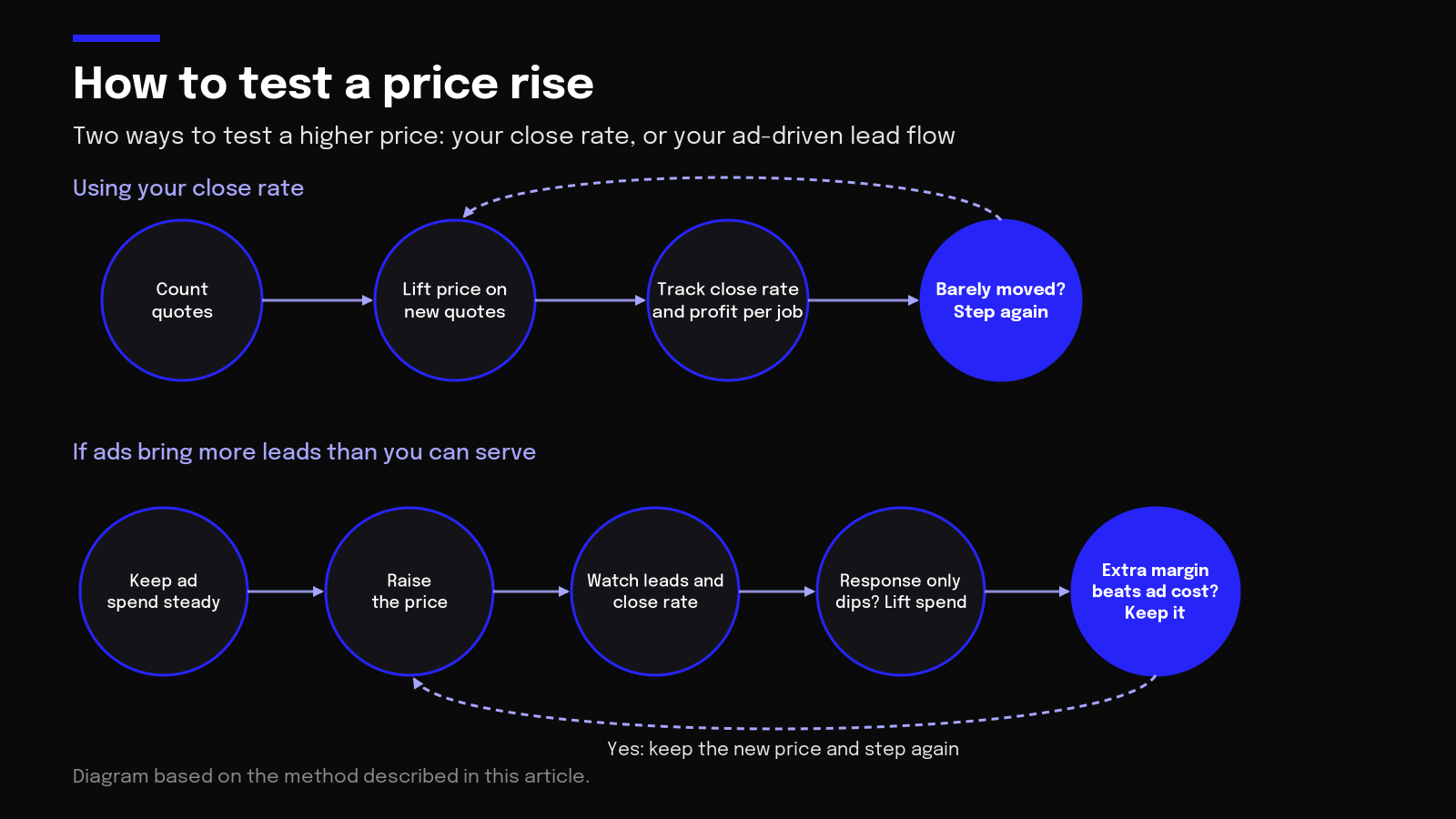
| Test with your close rate | Lift prices on new quotes by about 10% and track for a quarter | If the close rate barely moves, there’s room to step again |
| Scale spend to test market depth | Raise ad spend toward double over three or four weeks, changing nothing else | Leads keep pace and cost holds: room to raise. Cost climbs fast: go gently |
| Advertise the higher-value offer | Run a campaign for your premium service alongside the standard one | Leads cost a little more, but each is worth far more |
| Raise prices when nearly booked out | Lift the price, keep the ads running, add spend if acceptances dip | Same capacity, more margin per job |
| Offer a priority booking fee | Charge extra for a sooner slot, keep the standard lead time | How much your time is worth to customers |
| Run a fair price test | One change at a time, using ad experiments, for six to twelve weeks | A result you can trust, judged on profit after ad spend |
| Send sale values to Google and Meta | Import qualified leads and sale values from your CRM, use value-based bidding | The platforms look for buyers like your best customers, not cheap enquiries |
| Reshape your tiers | Drop the entry plan and add a genuine premium-plus | Your old top plan becomes the popular middle, lifting the average sale |
| Give the real reason | Tell existing customers about genuine demand when you raise prices | Fewer cancellations than blaming costs |
Start With Your Close Rate
A very high close rate usually means almost nobody found your price a reason to hesitate. Count the genuine quotes from the last three to six months and how many converted, split by service line, since an engineering firm may close small jobs very differently from large projects. Lift prices on new quotes by a modest step, such as 10 percent, and track close rate and gross profit per job for a quarter. If the close rate barely moves, step again.
If you’re regularly turning work away, you already have part of the answer. Your advertising can tell you the rest.
Use Your Advertising to Test Your Price
Every campaign is a running measure of how the market responds to your offer, and you’re already paying for it. These are the tests we use most often with clients.
Test How Deep Your Market Is
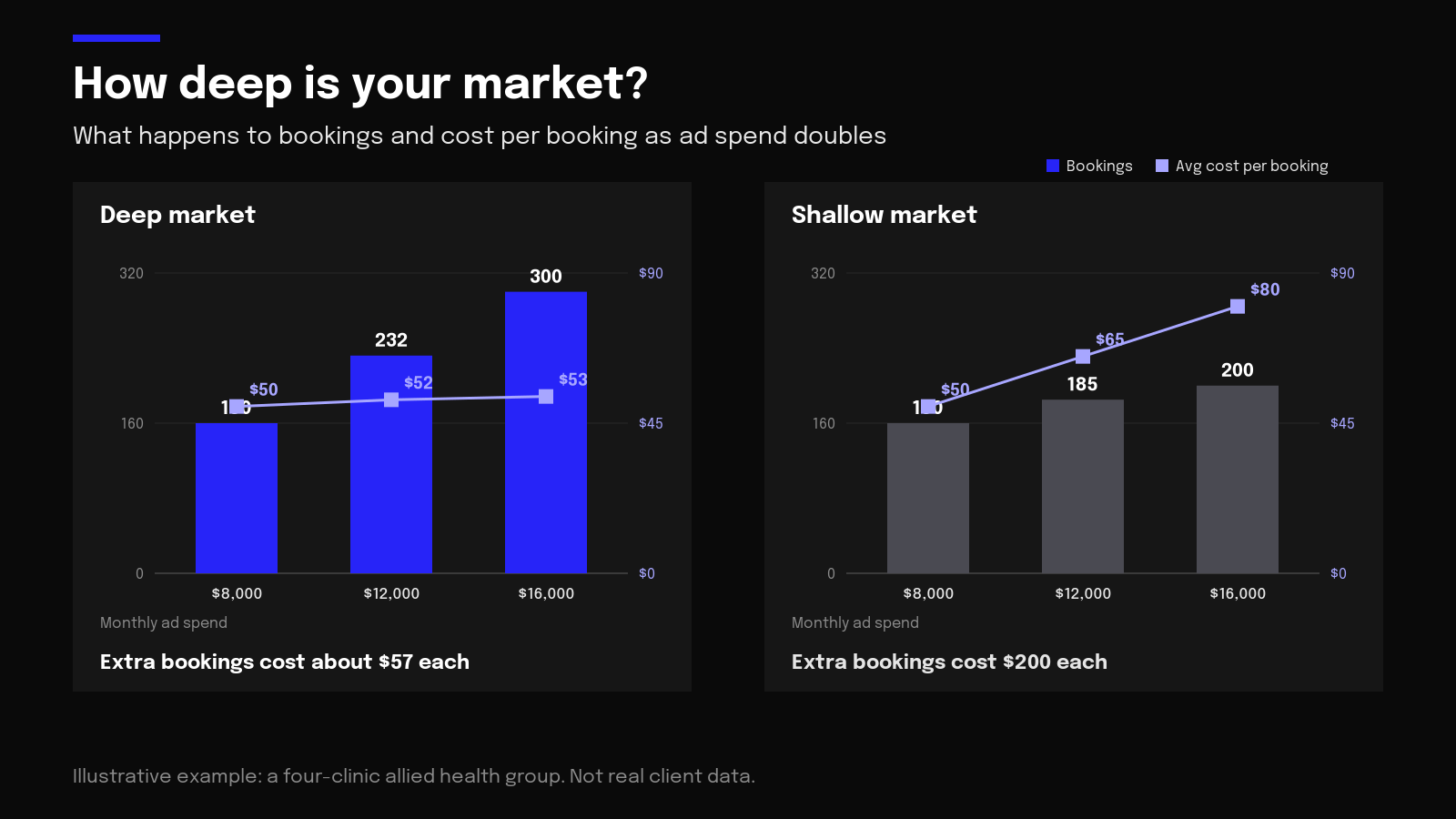
Lift your ad spend in steps toward double over three or four weeks, keeping the targeting, ads and landing page the same. If leads rise roughly in line and the cost per lead holds, there are far more buyers than you’ve been reaching, so any customers a price rise loses are cheap to replace. If the cost per lead climbs quickly, you’ve reached most of the people looking and a rise carries more risk. Watch the cost of the extra leads, not the average, and check the Search lost impression share (budget) column in Google Ads first to see whether there’s headroom.
As an illustrative example, a four-clinic physiotherapy group turning over around $6 million spends $8,000 a month for 160 new patient bookings, or $50 each, then lifts spend to $16,000. In a deep market, bookings reach 300 and the extra 140 cost about $57 each, a good sign it can test a higher initial consultation fee. In a shallow market, bookings stop at 200 and the extra 40 cost $200 each, so it’s better to hold the price and focus on retention. A business serving one suburb or a small niche will reach that point sooner.
Advertise the Higher-Value Offer
Google and Meta find people who match what you advertise. Promote a $1,000 service and they look for $1,000 buyers, and online you aren’t limited to the customers who walk past your door. Reaching them often costs only a little more per lead.
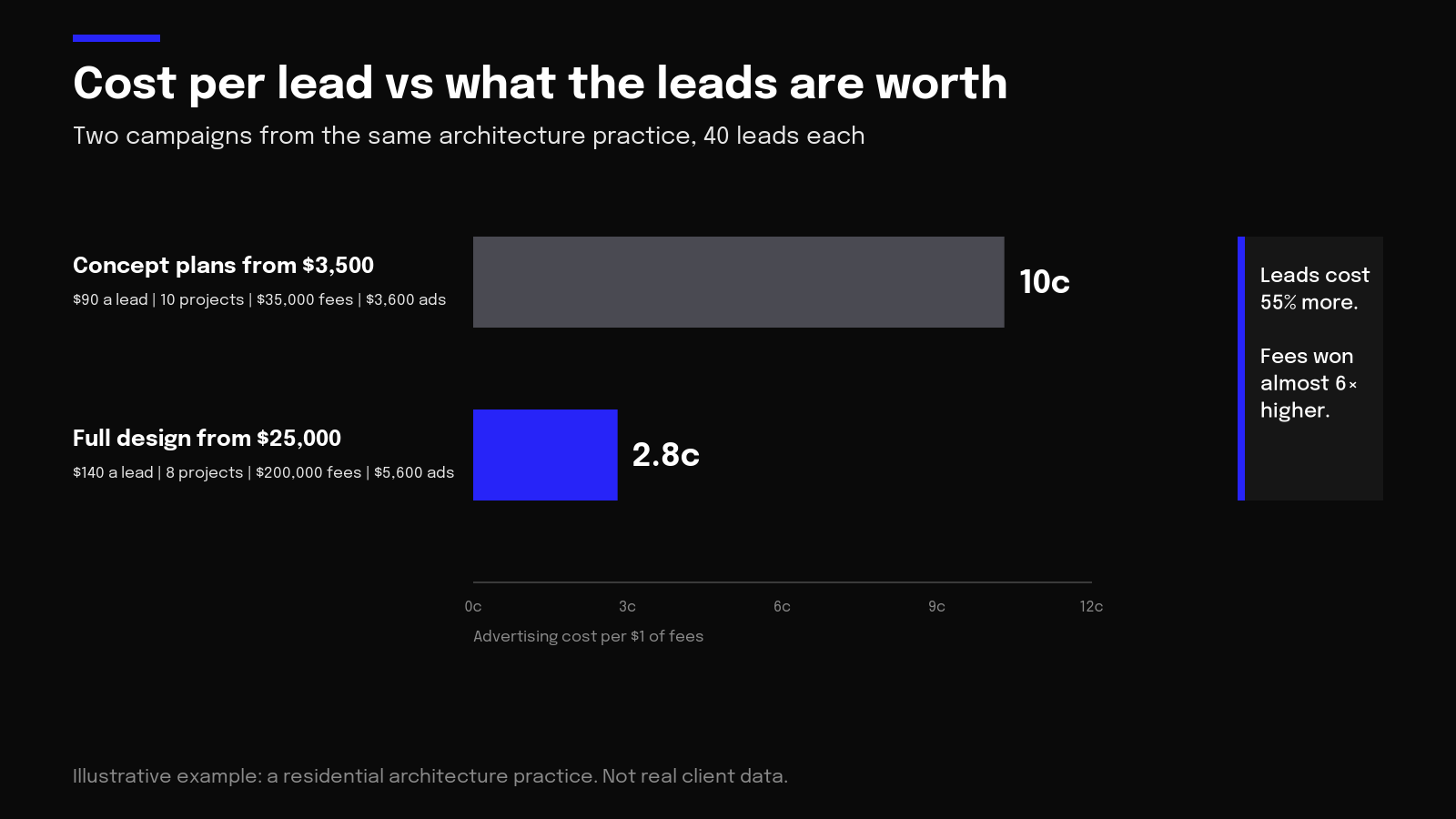
As an illustrative example, a residential architecture practice turning over about $5 million runs two campaigns of 40 leads each. Concept plans from $3,500 cost $90 a lead and win 10 projects, or $35,000 in fees for $3,600 of advertising. Full design for extensions from $25,000 costs $140 a lead and wins 8 projects, or $200,000 in fees for $5,600. Advertising takes about 10 cents of each fee dollar on the first and under 3 cents on the second.
It works where real demand exists, so check Keyword Planner and your search terms for people looking for the premium version of what you do. In heavily sales-led industries, such as a manufacturer selling into large accounts, the ads open the door and the sales process tests the price, so judge on qualified opportunities and won work.
When You’re Nearly Booked Out, Raise the Price and Keep the Ads Running
When the diary fills, the instinct is to pause the ads. Raise the price instead and keep them running, so they keep testing demand at the new price. If acceptances only dip, a little more spend refills your capacity.
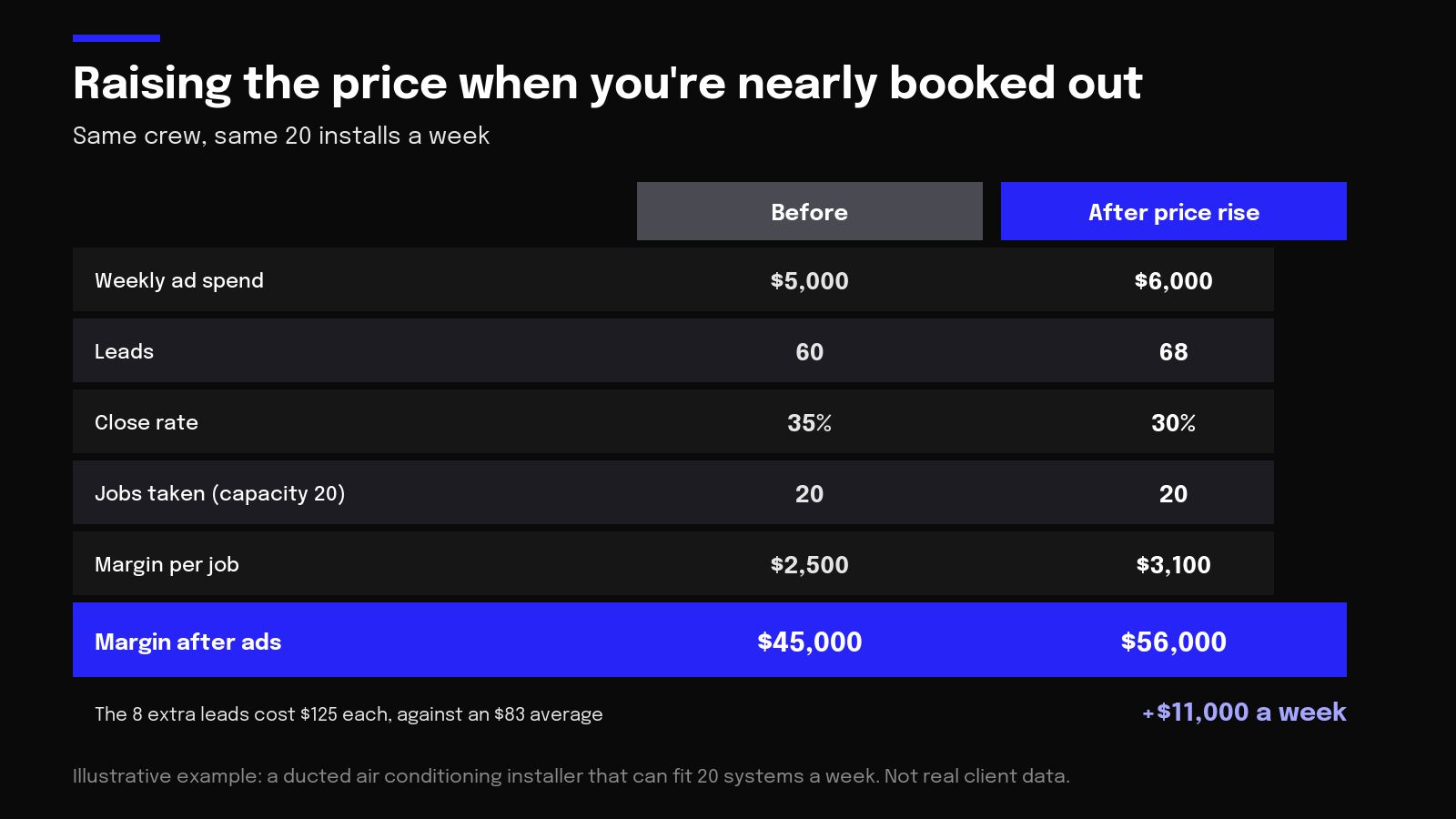
As an illustrative example, a ducted air conditioning installer turning over about $9 million can fit 20 systems a week at a $2,500 margin each. Its $5,000 a week in ads brings about 60 leads, and at a 35 percent close rate it’s turning work away. The week clears $45,000 after ads. It lifts the average install price by $600, taking the margin to $3,100, and its close rate dips to 30 percent. Another $1,000 a week in ads brings about 68 leads, enough for 20 jobs again, and the week clears $56,000. Same crew, same installs, $11,000 more.
Trades and clinics with a waiting list can also offer a priority booking fee alongside the standard lead time. How many customers pay it shows how much your time is worth to them.
Judge It on Profit After Ad Spend
A higher price usually brings a slightly higher cost per lead and a lower close rate, which is fine if each job is worth more. Judge the test on cost per qualified lead, close rate, average job value and profit after ad spend, and record why quotes are lost. Change one thing at a time, use Google Ads custom experiments or Meta A/B tests to keep the comparison fair, and at 30 to 80 leads a month allow six to twelve weeks before calling it.
It also pays to tell the platforms what a good customer is worth. If your account only reports form fills, Google and Meta will find the cheapest enquiries they can. Importing qualified leads and sale values from your CRM and using value-based bidding points them at buyers like your best customers. Our guides to conversion tracking setup and measuring marketing by profit cover the detail.
Reshape Your Tiers So Your Best Option Sits in the Middle
If you sell packages or plans, remove the entry option and add a premium-plus above your current top tier. Your old top tier becomes the middle, and research on the compromise effect shows buyers tend to avoid the extremes of a range and settle in the middle.
As an illustrative example, a mechanical services business turning over about $12 million sells commercial maintenance plans at $1,800, $3,200 and $4,800 a year, with new contracts averaging about $2,960. It drops the $1,800 plan for new customers and adds Premium Plus at $7,900, with quarterly servicing, two-hour response and remote monitoring. From every 100 enquiries it now signs 24 contracts instead of 30, but at around $4,700 on average, so new contract revenue rises by about a quarter.
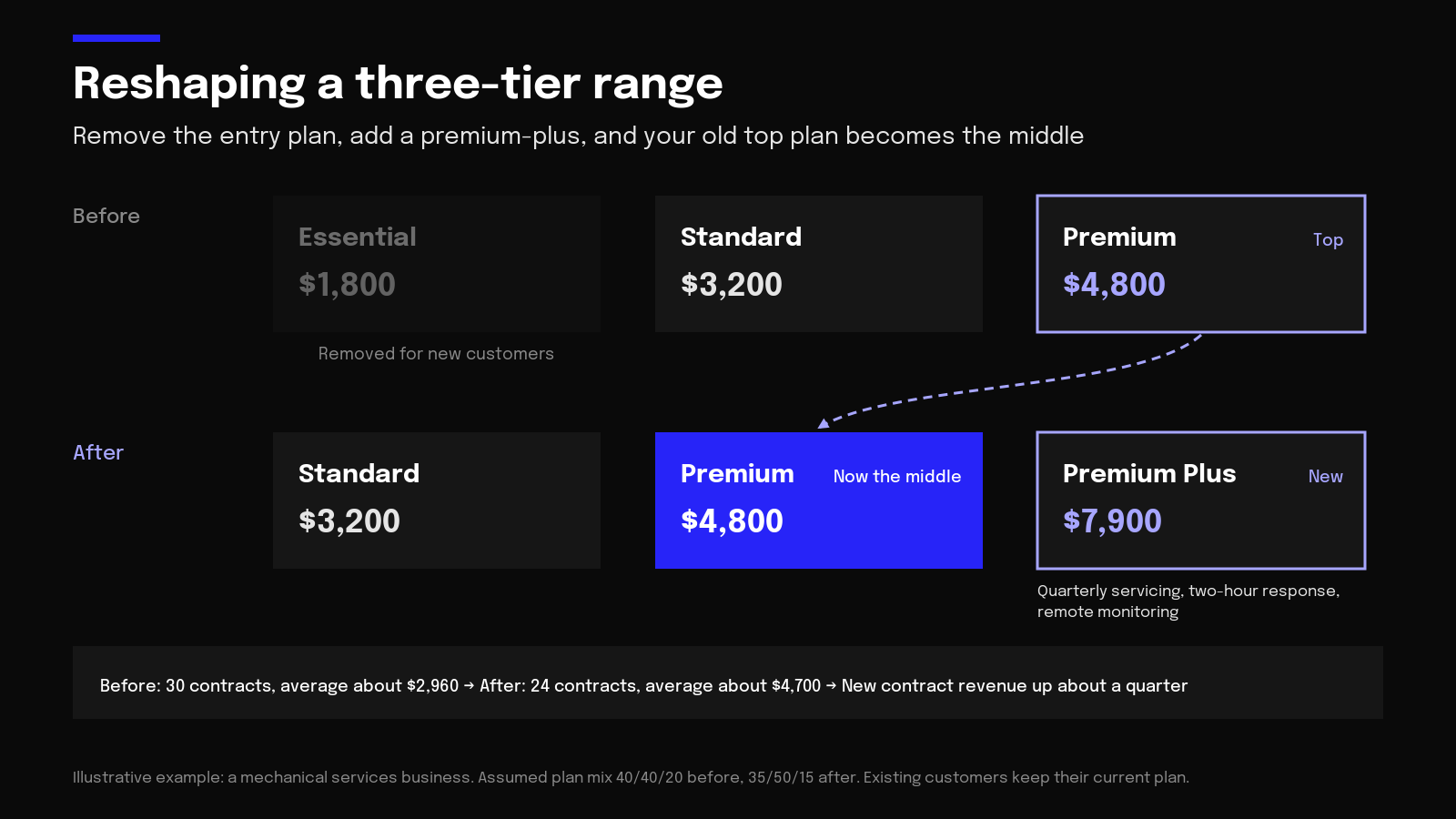
The new top option needs real extra value, not just a higher number. Keep existing customers on their current plan until renewal, since a lower tier gives squeezed customers somewhere to step down to rather than leave, as covered in our guide to a good, better, best range.
Make the Rise Stick
Your marketing has to move with the price. Ads that lead with discounts keep attracting the customers you’ve priced out, so shift the message to expertise, outcomes and reduced risk, with proof such as warranties and qualifications on your landing pages. A starting price or minimum in your ads also filters enquiries before they reach your team.
Give existing customers the real reason for a rise. In a Journal of Marketing field experiment with around 1,600 self-storage customers, notices citing higher costs or added quality kept customers no better than giving no reason, while a truthful market reason, such as strong demand, cut cancellations by 29.5 percent. Businesses can generally set and raise their own prices, but the ACCC is clear they must not mislead customers about what they’ll pay or why.
Expect the pipeline to dip before customer quality improves. Lead volume moves within a fortnight, close rate and job size take a month or more, so agree up front which figure you’ll judge on and when.
If you’re planning a price change and would like a second opinion, contact us or email hello@thedigitalmarketingconsultants.com.au.